

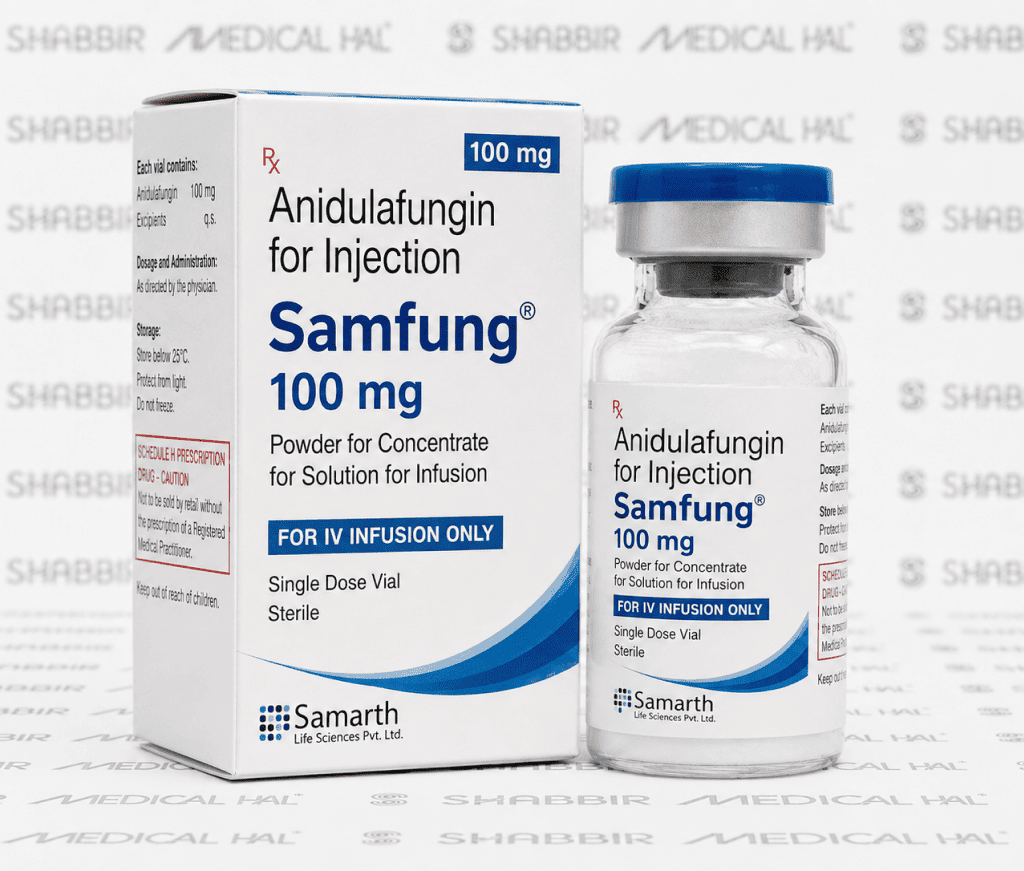
SAMFUNG 100MG INJ
 Item requires a valid prescription
Manufactured By SAMARTH LIFE SCIENCES PVT.LTD
Composition Anidulafungin 100mg
RS 9202.80
MRP RS 15338.00
(40% OFF)
Includes all taxes
Package SIZE
( Vial )

100% Authentic
Products

Free
Shipping*

Products
Return Policy
Description:
Samfung 100mg Injection (Anidulafungin 100mg) is a third-generation echinocandin antifungal agent manufactured by Samarth Life Sciences Pvt Ltd, indicated for the treatment of invasive candidiasis — including candidaemia (fungal bloodstream infection) — in adult patients, and for the treatment of oesophageal candidiasis. Anidulafungin acts by non-competitively inhibiting (1,3)-beta-D-glucan synthase, an enzyme essential for fungal cell wall synthesis, leading to disruption of cell wall integrity, osmotic instability, and fungal cell death. Available from Shabbir Medical Hall at the best price in India, this genuine prescription injection is available online with fast delivery nationwide.
BENEFITS: Samfung 100mg Injection offers a clinically proven echinocandin with a distinct pharmacological profile that makes it particularly advantageous in hospitalised and immunocompromised patients. Unlike azole antifungals, anidulafungin has no significant hepatic metabolism and is not a substrate, inducer, or inhibitor of cytochrome P450 enzymes — making it an excellent option for patients on polypharmacy regimens (e.g., transplant recipients, oncology patients). It demonstrates activity against Candida species including azole-resistant strains (e.g., Candida glabrata, Candida krusei, Candida auris) and has shown comparable or superior efficacy to fluconazole in pivotal clinical trials for invasive candidiasis.
USAGE OVERVIEW: Samfung 100mg Injection is administered exclusively by intravenous (IV) infusion under the supervision of a specialist (infectious disease physician, intensivist, or clinical microbiologist). A loading dose of 200mg is given on Day 1, followed by 100mg daily maintenance doses. Treatment duration is typically 14 days after the last positive blood culture or resolution of signs and symptoms, as determined by the treating physician. The vial must be reconstituted and diluted before infusion per institutional protocol.
SAFETY OVERVIEW: Anidulafungin is generally well tolerated. The most common adverse effects include histamine-mediated infusion reactions (flushing, urticaria) with rapid infusion, and occasional elevations in liver enzymes. Hepatotoxicity is rare. It does not require dose adjustment for renal impairment or mild-to-moderate hepatic impairment. This medicine requires a valid prescription from a registered specialist.
Uses / Indications:
• Invasive Candidiasis: treatment of serious Candida infections affecting the bloodstream and internal organs in hospitalised adult patients, including:
• Candidaemia (Candida bloodstream infection / fungal sepsis)
• Intra-abdominal candidiasis (peritoneal, hepatosplenic)
• Candida peritonitis
• Oesophageal Candidiasis: treatment of severe fungal infection of the oesophagus in adult patients where systemic therapy is required
ADDITIONAL USES:
• Empirical antifungal therapy in febrile neutropenic patients at high risk of invasive fungal infection (haematology/oncology, post-chemotherapy)
• Prophylaxis of invasive candidiasis in high-risk ICU patients (selected centres)
• Infections caused by azole-resistant Candida species (Candida glabrata, Candida krusei, Candida auris) — as per sensitivity testing
• Step-down from IV anidulafungin to oral fluconazole once clinical stability is achieved and isolate is azole-susceptible
PATHOGENS COVERED:
• Candida albicans, Candida glabrata, Candida parapsilosis, Candida tropicalis, Candida krusei, Candida guilliermondii, Candida dublinensis
• Note: Candida parapsilosis has naturally elevated MICs to echinocandins — clinical significance varies; specialist guidance required
Interactions / Warnings:
INFUSION RATE WARNING — CRITICAL:
Maximum infusion rate: 1.1 mg/min (equivalent to 90-minute infusion for 100mg dose; 180-minute infusion for 200mg loading dose). Exceeding this rate causes histamine-mediated reactions (flushing, urticaria, bronchospasm, hypotension). Monitor patient for first 30 minutes of each infusion; resuscitation equipment must be immediately available. If infusion reaction occurs: slow or stop the infusion; administer antihistamine and/or corticosteroid as clinically appropriate.
LIVER FUNCTION MONITORING:
Monitor liver function tests (ALT, AST, ALP, total bilirubin) at baseline and weekly during treatment. If significant LFT elevation occurs (>5x ULN) or symptoms of hepatotoxicity develop: discontinue Samfung and switch to alternative antifungal therapy. Rare cases of significant hepatic dysfunction, hepatitis, and hepatic failure have been reported.
ELECTROLYTE MONITORING (ICU Patients):
Monitor serum potassium, magnesium, and calcium daily in critically ill patients — hypokalaemia is common. Correct electrolyte abnormalities throughout treatment.
CANDIDAEMIA MANAGEMENT PROTOCOLS:
Remove or replace all intravascular catheters as soon as possible (central line removal is a key step in managing candidaemia). Ophthalmological examination is recommended in all patients with candidaemia to rule out candida endophthalmitis. Echocardiography should be considered to exclude candida endocarditis in patients with persistent candidaemia.
CONTRAINDICATIONS:
Known hypersensitivity to anidulafungin, other echinocandins (caspofungin, micafungin), or any excipient.
ANTIFUNGAL STEWARDSHIP:
Use only when invasive candidiasis is confirmed or strongly suspected — do NOT use for superficial, non-invasive fungal infections. Sensitivity/susceptibility testing (blood culture, fungal culture) should guide therapy selection and duration. Consider step-down to oral azole (fluconazole) therapy once clinical stability and azole-susceptibility are confirmed.
Pregnancy interaction:
• Animal reproductive studies have shown evidence of foetal harm (skeletal abnormalities at high doses in rats). There are no adequate data from use in pregnant women
• Samfung 100mg Injection should be used during pregnancy ONLY if the potential benefit clearly outweighs the risk to the foetus — as determined by the treating physician
• Category: Use with extreme caution in pregnancy; specialist decision required
• Fertility-aged women on antifungal therapy should use effective contraception during treatment
BREASTFEEDING:
• It is unknown whether anidulafungin is excreted in human breast milk
• Due to the potential for adverse effects in nursing infants, a decision should be made whether to discontinue breastfeeding or discontinue the drug, based on the clinical necessity of treatment for the mother
• Consult the treating specialist and neonatologist before use in a breastfeeding patient
PAEDIATRIC USE:
• Samfung 100mg Injection is not licensed for patients below 18 years of age
• Limited clinical data exist in paediatric patients; use only on expert specialist advice with appropriate dosing guidance
Expert advice:
1. CONTROL INFUSION RATE — THIS IS NON-NEGOTIABLE:
• The most critical practical safety point with Samfung 100mg Injection is ensuring the infusion rate never exceeds 1.1 mg/min
• For the 100mg maintenance dose, this means infusing over at least 90 minutes (1.5 hours); for the 200mg loading dose, over at least 180 minutes (3 hours)
• Rapid infusion triggers histamine-mediated reactions — flushing, urticaria, bronchospasm, and hypotension — which can be severe
• Always use an infusion pump to ensure rate accuracy; never give as a rapid IV push or bolus
2. FOLLOW THE LOADING DOSE PROTOCOL PRECISELY:
• Samfung must always be started with a 200mg loading dose on Day 1 for invasive candidiasis
• Omitting or reducing the loading dose results in sub-therapeutic drug levels on Day 1 and delays achieving adequate tissue concentrations
• The loading dose is not optional — it is essential for clinical efficacy, particularly in the critically ill where rapid fungicidal activity is critical
3. REMOVE CENTRAL VENOUS CATHETERS IN CANDIDAEMIA:
• In all patients with candidaemia, the removal or replacement of existing intravascular catheters (central lines, Hickman catheters, PICC lines) should be considered as an urgent priority
• The catheter is a primary source of Candida bloodstream infection; failure to remove it significantly increases treatment failure rates and risk of persistent candidaemia
• Coordinate with the ICU team and vascular access team immediately on diagnosis
4. VERIFY RECONSTITUTION TECHNIQUE:
• Reconstitute each 100mg vial with exactly 30 mL of Water for Injection or 5% Dextrose
• Swirl gently to dissolve — vigorous shaking causes foaming and may affect drug stability
• Check for visible particles or discolouration before further dilution
• Dilute the reconstituted solution into an appropriate IV bag (0.9% NaCl or 5% Dextrose) as per the target infusion volume
• Prepared infusion solutions are stable for up to 48 hours at room temperature (25°C) or 72 hours under refrigeration (2–8°C) — label with preparation date and time
5. PLAN FOR STEP-DOWN THERAPY:
• Anidulafungin is a hospital-only IV antifungal. Once a patient is clinically stable (usually after 5–7 days of IV therapy), blood cultures are clear, and the Candida isolate is confirmed susceptible to fluconazole, step-down to oral fluconazole 400mg daily is recommended to complete the 14-day minimum course
• Coordinate with the infectious disease team for timely step-down to enable earlier patient discharge and reduce IV line-associated risks
MONITORING ADVICE:
• Liver Function Tests (LFTs — ALT, AST, ALP, bilirubin): Baseline + weekly throughout therapy
• Serum Electrolytes (K+, Mg2+, Ca2+): Daily in ICU patients
• Blood Cultures: Repeat every 24–48 hours until blood cultures are negative — document date of first negative culture
• Renal Function (serum creatinine): No dose adjustment needed, but monitor in ICU patients on multiple nephrotoxic agents
• Infusion Monitoring: Observe patient clinically for first 30 minutes of each infusion for infusion reactions
• Ophthalmology Referral: Within first 7 days of candidaemia diagnosis — rule out candida endophthalmitis
• Echocardiography: Consider in all patients with persistent (>72 hours) candidaemia — rule out endocarditis
COMPLIANCE TIPS:
• Administer at the same time each day — consistent daily dosing maintains optimal drug exposure
• Document each dose in the patient medication chart with time of administration and infusion duration
• Label all prepared infusion bags with: drug name, dose, diluent, volume, concentration, preparation time, expiry time
• Dispose of unused reconstituted/diluted solution per institutional pharmaceutical waste policy
SAFETY TIPS:
• Samfung 100mg Injection is administered ONLY in a hospital/clinical setting — NOT for home infusion or self-administration
• Keep resuscitation equipment (adrenaline, antihistamine, corticosteroid, IV fluids) immediately available at bedside during infusion
• Antifungal stewardship: document indication, culture data, dose, and planned duration at every prescription review
• This medicine MUST NOT be used without a valid prescription from a registered specialist (infectious disease physician, intensivist, or clinical microbiologist)
Side Effects:
• Infusion-related / Histamine-mediated reactions (particularly with rapid infusion):
• Flushing (warmth, redness of skin)
• Urticaria (hives, itching)
• Bronchospasm (wheezing, chest tightness)
• Hypotension (low blood pressure)
• Rash
• Elevated liver enzymes (ALT, AST, ALP, bilirubin) — usually mild and reversible
• Hypokalemia (low potassium) — monitor electrolytes, especially in ICU patients
• Nausea, vomiting, diarrhoea
• Headache
• Pyrexia (fever)
• Peripheral oedema
SERIOUS SIDE EFFECTS (rare but important — contact doctor immediately):
• Hepatotoxicity: significant liver function test elevations, jaundice, or symptoms of liver disease — monitor LFTs throughout treatment
• Severe hypersensitivity / anaphylaxis: urticaria, angioedema, anaphylactic shock — infusion must be stopped immediately; emergency treatment required
• Severe infusion reaction: bronchospasm, significant hypotension — reduce infusion rate or stop; do NOT exceed 1.1 mg/min
• Deep vein thrombosis (DVT) or thrombophlebitis at IV site
• Significant electrolyte disturbances in ICU patients
EMERGENCY SIGNS — SEEK IMMEDIATE MEDICAL HELP:
• Difficulty breathing, wheezing, or chest tightness during infusion
• Sudden drop in blood pressure, dizziness, or collapse
• Severe rash, swelling of face/lips/throat
• Jaundice (yellow skin/eyes) or right upper quadrant abdominal pain
How to use:
INVASIVE CANDIDIASIS (including Candidaemia):
• Loading Dose: 200mg IV on Day 1 (given as a single infusion over 3 hours at max rate 1.1 mg/min)
• Maintenance Dose: 100mg IV once daily from Day 2 onwards (infused over 1.5 hours at max rate 1.1 mg/min)
• Duration: minimum 14 days after last positive blood culture AND at least 7 days after resolution of candidaemia signs and symptoms
• Step-down to oral fluconazole: acceptable once clinical stability is confirmed and isolate is confirmed fluconazole-susceptible
OESOPHAGEAL CANDIDIASIS:
• Loading Dose: 100mg IV on Day 1
• Maintenance Dose: 50mg IV once daily from Day 2
• Duration: minimum 14 days and at least 7 days after symptom resolution
DOSE ADJUSTMENTS:
• Renal Impairment (any degree including dialysis): NO dose adjustment required
• Mild-Moderate Hepatic Impairment: NO dose adjustment required
• Severe Hepatic Impairment: use with caution; limited data
• Paediatric patients: not licensed for use below 18 years (limited data; specialist discretion)
• Elderly patients: no dose adjustment required based on age alone
RECONSTITUTION & PREPARATION:
• Step 1: Reconstitute each 100mg vial with 30 mL of Water for Injection or 5% Dextrose (concentration: 3.33 mg/mL)
• Step 2: Gently swirl — do NOT shake vigorously
• Step 3: Dilute reconstituted solution in 0.9% Sodium Chloride or 5% Dextrose for IV bag
• 100mg dose: add reconstituted solution to 100 mL IV bag (final volume 130 mL); infuse at max 1.1 mg/min over 1.5 hours
• 200mg loading dose: add to 200 mL IV bag (final volume 260 mL); infuse over 3 hours
• Reconstituted and diluted solutions: stable for up to 48 hours at room temperature or 72 hours refrigerated
ADMINISTRATION PRECAUTIONS:
• IV infusion ONLY — NOT for IM or SC injection
• Do NOT infuse faster than 1.1 mg/min — risk of histamine-mediated infusion reactions (flushing, urticaria, bronchospasm)
• Administer in a clinical setting with resuscitation facilities available
STORAGE (Unopened Vials):
• Store between 2°C–8°C (refrigerator)
• May be stored at room temperature (up to 25°C) for up to 96 hours before use
• Do NOT freeze
• Protect from light; keep in original packaging
• Keep out of reach of children
How it works:
Samfung 100mg Injection contains Anidulafungin, a semisynthetic echinocandin lipopeptide antifungal agent. Fungal cell walls are structurally distinct from human cells, making (1,3)-beta-D-glucan — a key cell wall polysaccharide — an ideal antifungal drug target.
ANIDULAFUNGIN WORKS BY:
• Non-competitively inhibiting (1,3)-beta-D-glucan synthase, the enzyme complex responsible for synthesising beta-glucan polymers in the fungal cell wall
• Preventing beta-glucan incorporation into the growing cell wall
• Disrupting fungal cell wall structural integrity and osmotic regulation
• Causing osmotic instability, cell lysis, and fungal cell death (fungicidal activity against Candida species)
KEY PHARMACOLOGICAL ADVANTAGES:
• NO hepatic (CYP450) metabolism: anidulafungin is chemically degraded (non-enzymatic hydrolysis) in the plasma — not metabolised by the liver → Minimal drug-drug interactions: no clinically significant interactions with immunosuppressants (tacrolimus, cyclosporine), antiretrovirals, or azoles
• NO renal excretion of active drug: safe to use without dose adjustment in renal impairment including dialysis patients
• Fungicidal against Candida (not just fungistatic): achieves rapid clearance of Candida from the bloodstream
• Active against azole-resistant Candida strains including fluconazole-resistant C. glabrata and intrinsically resistant C. krusei
SPECTRUM OF ACTIVITY:
• Active against: Candida spp. (most clinically relevant species), some Aspergillus spp. (fungistatic)
• NOT active against: Cryptococcus neoformans, Fusarium spp., Mucorales, dermatophytes, Pneumocystis jirovecii
Faq for medicine:
Samfung 100mg (Anidulafungin 100mg) is an echinocandin antifungal used to treat invasive candidiasis — including candidaemia (fungal bloodstream infection), intra-abdominal candidiasis, and oesophageal candidiasis — in hospitalised adult patients under specialist supervision.
2. How does Samfung 100mg Anidulafungin Injection work?
Anidulafungin non-competitively inhibits (1,3)-beta-D-glucan synthase, an enzyme essential for fungal cell wall synthesis. This disrupts Candida cell wall integrity, causes osmotic instability, and leads to fungal cell death. It is fungicidal against most Candida species.
3. What is the dose of Samfung 100mg Injection for invasive candidiasis?
Loading dose: 200mg IV on Day 1 (infused over 3 hours). Maintenance: 100mg IV once daily from Day 2 (infused over 1.5 hours). Duration: minimum 14 days after last positive blood culture. No dose adjustment needed for renal or mild-to-moderate hepatic impairment.
4. What are the side effects of Samfung 100mg Anidulafungin Injection?
Common: flushing, urticaria, rash (histamine-mediated infusion reactions with rapid infusion), elevated liver enzymes, nausea, hypokalaemia. Serious: anaphylaxis, hepatotoxicity, bronchospasm. Do not exceed infusion rate of 1.1 mg/min. Monitor LFTs weekly.
5. Can I buy Samfung 100mg Anidulafungin Injection online at the best price in India?
Yes. Buy Samfung 100mg Injection online from Shabbir Medical Hall at 40% OFF MRP (Rs 9,202.80 vs Rs 15,338.00 per vial). Valid prescription from a registered specialist required. Fast delivery across Hyderabad, Bangalore, Mumbai, Delhi, and Chennai.
Medicine interaction:
Since anidulafungin undergoes non-enzymatic (non-CYP450) degradation in the plasma, it has very few clinically significant drug interactions compared to azole antifungals.
INTERACTIONS TO BE AWARE OF:
• Cyclosporine: may increase anidulafungin AUC by ~22% — not considered clinically significant; no dose adjustment required; monitor renal function (as cyclosporine is nephrotoxic)
• Tacrolimus, Sirolimus: no clinically significant PK interaction — safe to use concurrently in transplant patients
• Voriconazole, Fluconazole: no PK interaction — can be used together or in sequence
• Amphotericin B: no direct interaction; monitor renal function if used concurrently (amphotericin B is nephrotoxic)
• Rifampicin, Phenytoin, Carbamazepine (enzyme inducers): no clinically significant interaction (anidulafungin is not CYP-metabolised)
CONTRAINDICATED COMBINATIONS:
• No absolute contraindicated drug-drug interactions identified with anidulafungin
SUPPLEMENT INTERACTIONS:
• No specific herbal/supplement interactions documented
• Always inform the treating specialist of all medications, vitamins, and herbal products