

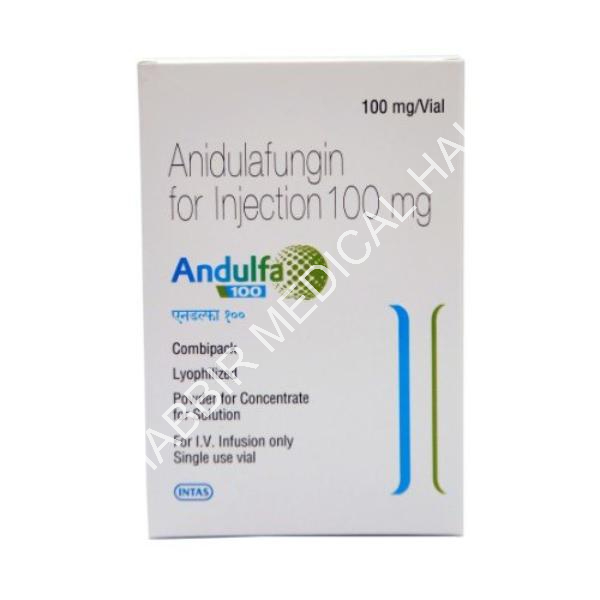
ANDULFA 100MG INJ
 Item requires a valid prescription
Manufactured By Intas Pharmaceuticals Ltd
Composition Anidulafungin 100mg
RS 9042.00
MRP RS 15070.00
(40% OFF)
Includes all taxes
Package SIZE
( Vial )

100% Authentic
Products

Free
Shipping*

Products
Return Policy
Description:
Andulfa 100mg Injection (Anidulafungin 100mg) is a parenteral antifungal agent belonging to the echinocandin class, manufactured by Intas Pharmaceuticals Ltd and used to treat serious and life-threatening fungal infections in hospitalised adults. It is indicated for the treatment of candidemia (fungal blood infection), invasive candidiasis (including peritonitis and intra-abdominal abscess), and oesophageal candidiasis caused by Candida species. Available from Shabbir Medical Hall at the best price in India, this genuine prescription-only injection is administered in ICU, hospital, and clinical settings under medical supervision with fast and reliable delivery options.
BENEFITS: Andulfa 100mg works by non-competitively inhibiting 1,3-β-D-glucan synthase — the enzyme responsible for synthesising β-glucan, an essential structural component of the fungal cell wall. Unlike human cells, fungal cells depend on this enzyme for structural integrity; blocking it leads to osmotic instability and fungal cell death. Because this target is absent in mammalian cells, Anidulafungin has a highly selective mechanism with a favourable safety profile. It is fungicidal against Candida species and shows no clinically significant drug-drug interactions via the CYP450 pathway, making it suitable for critically ill patients on complex medication regimens.
USAGE OVERVIEW: Andulfa 100mg is administered exclusively as a slow intravenous (IV) infusion by a trained healthcare professional in a clinical setting. A loading dose of 200mg (2 vials) is given on Day 1, followed by a maintenance dose of 100mg (1 vial) once daily. Duration is determined by clinical response and infection type — typically 14 days for candidemia after the last positive blood culture, or at least 14 days for oesophageal candidiasis.
SAFETY OVERVIEW: Andulfa 100mg is generally well tolerated. The most common side effects include nausea, headache, fever, hypokalemia, and elevated liver enzymes. Infusion-related reactions (rash, flushing, hypotension) are rare but possible if infused too rapidly. Inform your treating physician about all concurrent medications and hepatic function before starting therapy.
Uses / Indications:
• Candidemia — fungal infection of the bloodstream caused by Candida species
• Invasive Candidiasis — including peritonitis, intra-abdominal abscess, and pleural space infections
• Oesophageal Candidiasis — fungal infection of the oesophagus
COMMON / OFF-LABEL USES:
• Step-down therapy after initial IV treatment before transitioning to oral fluconazole (in suitable patients)
• Empirical antifungal therapy in high-risk ICU patients with suspected fungal infection (off-label)
• Candida endocarditis management (specialist use)
Interactions / Warnings:
LIVER DISEASE:
• No dose adjustment is required for mild to moderate hepatic impairment.
• Limited data in severe hepatic impairment — use with caution and close monitoring of liver enzymes.
KIDNEY DISEASE:
• No dose adjustment is required for any degree of renal impairment, including patients on haemodialysis.
• Anidulafungin is NOT dialysed — no supplemental dosing needed after sessions.
ALLERGY WARNING:
• Do not use Andulfa 100mg if you are allergic to Anidulafungin, other echinocandins (caspofungin, micafungin), or any excipients in the formulation.
PAEDIATRIC USE:
• Safety and efficacy in children below 18 years is not established. Not recommended for paediatric patients without specialist advice.
DRIVING & MACHINERY:
• Andulfa 100mg may cause headache, dizziness, or seizures in rare cases. Patients should be assessed before resuming driving or operating heavy machinery during treatment.
Pregnancy interaction:
• The safety of Anidulafungin during human pregnancy has not been established.
• Animal studies have shown developmental toxicity at high doses.
• Andulfa 100mg should NOT be used during pregnancy unless the potential benefit clearly outweighs the risk to the fetus.
• Women of childbearing potential should use effective contraception during treatment.
• Inform your treating physician immediately if pregnancy is suspected or confirmed during treatment.
BREASTFEEDING:
• It is not known whether Anidulafungin is excreted into human breast milk.
• Breastfeeding is NOT recommended during Andulfa 100mg treatment as a precautionary measure.
• Discuss alternative infant feeding options with your treating physician.
DOCTOR CONSULTATION WARNING:
• Andulfa 100mg is a hospital-only, prescription antifungal. Never self-administer. Always follow the prescribed dosage duration — premature discontinuation may lead to treatment failure and relapse.
Expert advice:
1. HOSPITAL-ONLY IV MEDICINE:
• Andulfa 100mg must only be administered by trained healthcare professionals in a hospital or ICU setting.
• It is never self-administered at home.
• Always ensure the infusion is prepared and administered by a qualified nurse or physician.
2. CORRECT RECONSTITUTION IS CRITICAL:
• The vial must be reconstituted with Water for Injection, then diluted in 0.9% Sodium Chloride or 5% Dextrose solution.
• Failure to correctly prepare the infusion can result in underdosing, particulate contamination, or infusion reactions.
3. NEVER INFUSE AS IV BOLUS:
• Andulfa must be administered as a slow IV infusion only, at a rate not exceeding 1.1mg/minute.
• Rapid infusion is associated with histamine-mediated reactions including flushing, hypotension, and bronchospasm.
4. COMPLETE THE FULL COURSE:
• Premature discontinuation of antifungal therapy, particularly in immunocompromised patients, leads to treatment failure and recurrence.
• The treating physician determines the duration based on clinical response and culture results.
5. MONITOR LIVER FUNCTION:
• Though Anidulafungin has a favourable hepatic safety profile, periodic LFT monitoring is recommended, especially in patients with pre-existing liver disease or those on hepatotoxic medications.
Monitoring Advice
LIVER FUNCTION TESTS (LFTs / ALT, AST):
• At baseline and periodically during treatment.
SERUM POTASSIUM (K+):
• Monitor closely — hypokalemia is a common adverse effect.
RENAL FUNCTION (CREATININE / eGFR):
• Baseline monitoring recommended — no dose adjustment usually needed, but important in ICU patients.
BLOOD CULTURES:
• Repeat blood cultures to confirm mycological eradication in candidemia cases.
INFUSION SITE MONITORING:
• Watch for signs of phlebitis or extravasation.
Compliance Tips
STORAGE:
• Keep Andulfa 100mg vials refrigerated (2°C–8°C) — do not freeze or expose to direct sunlight.
RECONSTITUTED SOLUTION:
• Once reconstituted, use prepared infusion within 48 hours at room temperature or within 72 hours if refrigerated.
SAFE DISPOSAL:
• Always dispose of unused or expired vials through the hospital's pharmaceutical waste system.
MEDICAL DOCUMENTATION:
• Ensure patients wear a medical alert band indicating ongoing IV antifungal therapy.
• Document infusion start and end time for every dose in the clinical record.
Safety Tips
ALLERGY PRE-ASSESSMENT:
• Pre-assess the patient for allergy history to echinocandins before the first dose.
EMERGENCY PREPAREDNESS:
• Keep emergency anaphylaxis medication (adrenaline, antihistamines, corticosteroids) available at bedside during the first infusion.
INFUSION SITE CARE:
• Rotate infusion sites to minimise phlebitis risk.
PATIENT REPORTING:
• Instruct patients to report any rash, itching, or difficulty breathing immediately during infusion.
SPECIALIST COORDINATION:
• Coordinate with the treating infectious disease specialist for appropriate step-down to oral therapy.
Side Effects:
• Nausea, vomiting, diarrhoea
• Headache
• Pyrexia (fever)
• Hypokalemia (low blood potassium — may cause muscle weakness, cramps, palpitations)
• Elevated liver enzymes (ALT/AST) — usually transient
• Peripheral oedema
• Skin rash
INFUSION-RELATED REACTIONS (uncommon, usually due to rapid infusion):
• Flushing, urticaria (hives), pruritus (itching)
• Hypotension (low blood pressure)
• Bronchospasm (rare)
SERIOUS SIDE EFFECTS (seek immediate medical attention):
• Severe hepatotoxicity — jaundice, dark urine, severe fatigue, right upper abdominal pain
• Severe hypersensitivity / anaphylaxis — swelling of face/lips/throat, difficulty breathing
• Clinically significant hypokalemia — severe muscle weakness, arrhythmia
• Worsening sepsis or superinfection
EMERGENCY WARNING SIGNS — SEEK IMMEDIATE MEDICAL HELP:
• Sudden difficulty breathing or chest tightness during infusion
• Signs of severe allergic reaction
• Yellowing of skin or eyes (jaundice) — possible hepatic toxicity
How to use:
CANDIDEMIA & INVASIVE CANDIDIASIS:
• Loading Dose (Day 1): 200mg IV infusion (2 vials) over 3 hours
• Maintenance Dose (Day 2 onwards): 100mg IV infusion once daily
• Duration: Minimum 14 days after the last positive blood culture, or until clinical resolution.
OESOPHAGEAL CANDIDIASIS:
• Loading Dose (Day 1): 100mg IV infusion
• Maintenance Dose: 50mg IV infusion once daily
• Duration: Minimum 14 days and for at least 7 days after symptom resolution.
ADMINISTRATION:
• Andulfa must be reconstituted with Water for Injection and diluted in 0.9% Sodium Chloride or 5% Dextrose before infusion.
• Infuse at a rate NOT exceeding 1.1mg/minute (to avoid infusion-related reactions).
• Never administer as an IV bolus injection.
• Prepared infusion is stable for 48 hours at room temperature or 72 hours when refrigerated.
STORAGE:
• Store unreconstituted vials at 2°C–8°C (refrigerated).
• Do not freeze.
• Protect from light.
• Keep out of reach of children.
• Do not use after the expiry date printed on the vial.
How it works:
Anidulafungin works by non-competitively inhibiting 1,3-β-D-glucan synthase, thereby blocking the synthesis of β-glucan. Without this structural polymer, the fungal cell wall becomes osmotically unstable and the fungal cell lyses (bursts) and dies. This makes Anidulafungin fungicidal (cell-killing) against Candida species — unlike older azoles which are often only fungistatic.
KEY ADVANTAGES:
• No hepatic (CYP450) metabolism — minimal drug-drug interactions.
• Fungicidal activity against most Candida species including Candida glabrata and Candida krusei.
• Does not require dose adjustment for renal or hepatic impairment (mild-to-moderate).
• Predictable pharmacokinetics with once-daily IV dosing.
• Highly selective — no mammalian equivalent of the target enzyme.
Faq for medicine:
Andulfa 100mg Injection (Anidulafungin) treats serious invasive fungal infections, particularly candidemia (Candida bloodstream infection) and other forms of invasive candidiasis including intra-abdominal abscess and peritonitis. It belongs to the echinocandin class and is used in hospitalized patients, including those in intensive care settings.
2.How is Andulfa 100mg injection administered to patients?
Andulfa 100mg is administered as a slow intravenous (IV) infusion by healthcare professionals in a clinical setting. The loading dose is typically 200mg on Day 1, followed by 100mg daily thereafter. The infusion rate must not exceed 1.1mg/min to avoid infusion-related reactions. Duration depends on clinical response.
3.Why is Andulfa 100mg preferred in immunocompromised patients with fungal infections?
Andulfa 100mg is preferred in immunocompromised patients because Anidulafungin is not metabolized by the liver's cytochrome P450 system, minimizing drug interactions common in transplant or cancer patients on multiple medications. Its targeted action against fungal cell wall synthesis also reduces systemic toxicity.
4.What are the known side effects of Andulfa 100mg injection?
Common side effects of Andulfa 100mg include nausea, elevated liver enzymes, hypokalemia (low potassium), and infusion-related reactions such as rash, flushing, or hypotension. Serious adverse events are rare but may include hepatotoxicity. Liver function and electrolytes should be monitored during treatment.
5.Is Andulfa 100mg effective against azole-resistant Candida infections?
Andulfa 100mg is effective against many Candida strains that are resistant to fluconazole and other azoles, including Candida glabrata and Candida krusei. Its unique mechanism of inhibiting beta-1,3-D-glucan synthesis in the fungal cell wall makes it a valuable alternative when azole-based treatments have failed.
6.How long does treatment with Andulfa 100mg injection typically last?
Treatment with Andulfa 100mg is continued for at least 14 days after the last confirmed positive blood culture, or for a minimum of 14 days for candidemia. For other forms of invasive candidiasis, duration is guided by clinical response and microbiological clearance as assessed by the treating infectious disease specialist.
Medicine interaction:
• Cyclosporin: May increase Anidulafungin AUC by ~22% — monitor but generally considered clinically manageable; no dose adjustment required per current guidelines, though close clinical monitoring is recommended.
• Rifampicin and other CYP inducers: No clinically significant interaction (Anidulafungin is NOT metabolised by CYP450).
• Tacrolimus, sirolimus: No significant pharmacokinetic interaction observed.
• Other antifungals (fluconazole, voriconazole, amphotericin B): No clinically significant interactions, though combination use is generally avoided unless medically indicated.
• Warfarin: No clinically significant pharmacokinetic interaction, but monitor INR closely in anticoagulated patients with serious infections.
NOTE ON CYP450:
• Unlike azole antifungals (fluconazole, voriconazole), Anidulafungin is NOT metabolised by hepatic CYP450 enzymes.
• It undergoes slow chemical degradation in plasma, making it a preferred option in patients on complex drug regimens.
ALCOHOL INTERACTION:
• No specific alcohol restriction; however, alcohol is generally contraindicated in serious infections and hospitalised patients.