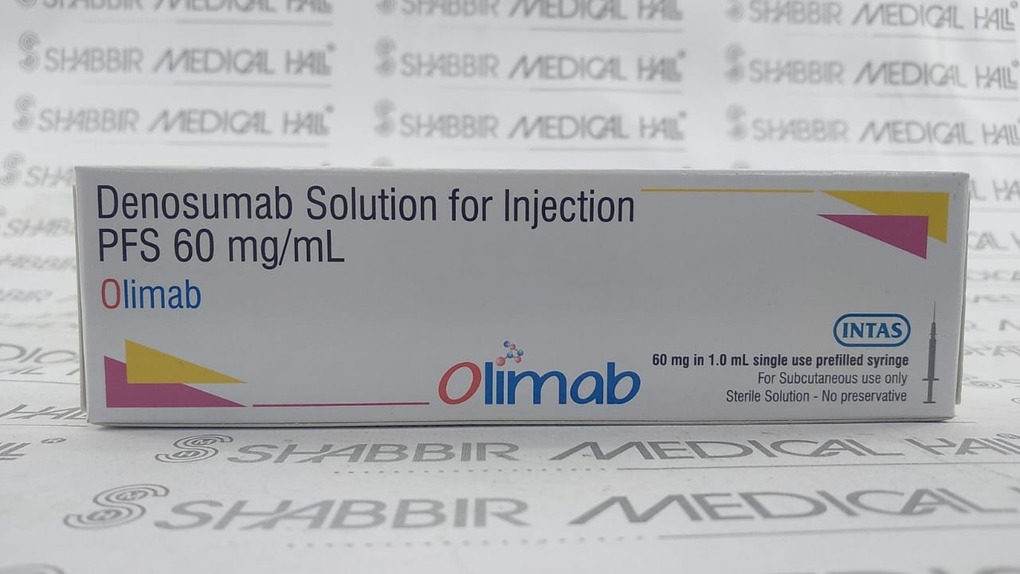


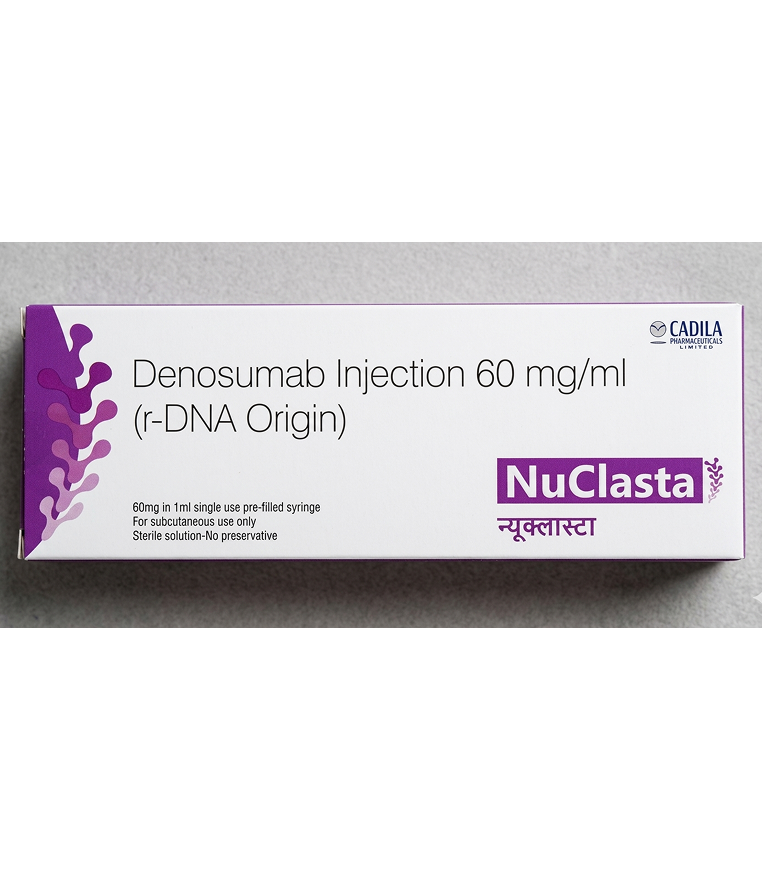
Nuclasta 60mg
 Item requires a valid prescription
Manufactured By Cadila Pharmaceuticals Limited
Composition Denosumab 60mg/ml
RS 15706.40
MRP RS 18478.10
(15% OFF)
Includes all taxes
Package SIZE
( Pre Filled Syringe )

100% Authentic
Products

Free
Shipping*

Products
Return Policy
Description:
Nuclasta 60mg Injection (Denosumab 60mg/ml) is a subcutaneous monoclonal antibody belonging to the class of RANK Ligand (RANKL) inhibitors, manufactured by Cadila Pharmaceuticals Limited and used to treat and prevent bone loss in adults at high risk of fractures. It is prescribed for postmenopausal women and men with osteoporosis, patients receiving long-term glucocorticoid therapy, and adults at high risk of skeletal-related events due to solid tumour bone metastases. Available from Shabbir Medical Hall at the best price in India, this genuine prescription-only injection is easy to order online with fast home delivery.
BENEFITS: Nuclasta 60mg works by binding to and inhibiting RANKL, a protein that activates osteoclasts (bone-dissolving cells). By blocking RANKL, Denosumab reduces bone resorption, increases bone mineral density (BMD), and significantly lowers the risk of vertebral, non-vertebral, and hip fractures. Unlike bisphosphonates, it does not accumulate in bone, making it reversible and suitable for patients with renal impairment who cannot tolerate oral bisphosphonate therapy.
USAGE OVERVIEW: Nuclasta 60mg is administered as a subcutaneous (under-the-skin) injection once every 6 months by a trained healthcare professional. It is typically injected into the abdomen, upper thigh, or upper arm. Patients must ensure adequate calcium and vitamin D supplementation during treatment. Never stop treatment without consulting your doctor as this can trigger rapid bone loss (rebound effect) and increase fracture risk.
SAFETY OVERVIEW: The most common side effects include musculoskeletal pain, hypocalcaemia (low calcium), and injection-site reactions. Serious but rare effects include osteonecrosis of the jaw (ONJ), atypical femoral fractures, and severe hypocalcaemia. Inform your doctor about all dental procedures, calcium levels, kidney function, and pregnancy status before starting therapy.
Uses / Indications:
• Postmenopausal Osteoporosis — treatment of women at high risk of fractures including vertebral, hip, and non-vertebral fractures.
• Male Osteoporosis — treatment of men at increased risk of fracture due to primary or hypogonadal osteoporosis.
• Glucocorticoid-Induced Osteoporosis — prevention and treatment of bone loss in adults receiving long-term corticosteroid therapy.
• Bone Metastases from Solid Tumours — prevention of skeletal-related events such as fractures and spinal cord compression.
• Breast Cancer / Prostate Cancer Adjuvant Therapy — prevention of bone loss associated with hormone deprivation therapy.
COMMON / OFF-LABEL USES:
• Giant Cell Tumour of Bone (GCTB) — Denosumab 120mg formulation commonly used; 60mg formulation primarily used for osteoporosis indications.
• Hypercalcaemia of Malignancy (HCM) refractory to bisphosphonate therapy.
• Rheumatoid Arthritis-related bone erosion (off-label use).
Interactions / Warnings:
KIDNEY DISEASE:
* Nuclasta 60mg can be used in renal impairment including severe CKD and dialysis patients
* Risk of hypocalcaemia is significantly higher in severe renal impairment
* More frequent calcium monitoring and higher calcium/Vitamin D doses required
LIVER DISEASE:
* Denosumab pharmacokinetics not significantly affected by hepatic impairment - no dose adjustment generally needed
DENTAL HEALTH:
* OSTEONECROSIS OF THE JAW (ONJ) - risk increases with dental extractions, implants, or poor oral hygiene
* Dental examination with preventive dentistry recommended before starting Nuclasta
* Avoid invasive dental procedures during treatment; always inform your dentist you are on Denosumab
HYPOCALCAEMIA WARNING:
* Pre-existing hypocalcaemia must be corrected before initiating Nuclasta 60mg
* Monitor calcium levels before each injection and within 2 weeks of initiation
REBOUND FRACTURE RISK:
* Abrupt discontinuation leads to rapid bone loss and significantly increased vertebral fracture risk
* Transition to bisphosphonate therapy on discontinuation is strongly recommended
ALLERGY WARNING:
* Do not use Nuclasta 60mg if allergic to Denosumab or any excipients in the formulation
ELDERLY USE (>=65 years):
* Same 60mg dose every 6 months - no dose adjustment required; monitor calcium levels carefully
Pregnancy interaction:
• Nuclasta 60mg (Denosumab) is CONTRAINDICATED during pregnancy.
• Animal studies show that RANKL inhibition may cause lymph node, bone, and dental abnormalities in the fetus.
• Women of childbearing potential must use effective contraception during treatment and for at least 5 months after the last dose.
• Denosumab crosses the placental barrier and may interfere with fetal bone development.
• If pregnancy occurs during treatment, inform your doctor immediately and seek specialist advice.
BREASTFEEDING:
• It is not known whether Denosumab passes into human breast milk.
• Breastfeeding is NOT recommended during treatment and for at least 5 months after the last dose.
• Discuss alternative feeding options and timing with your doctor.
FERTILITY:
• Animal studies suggest potential reversible suppression of bone development in offspring.
DOCTOR CONSULTATION WARNING:
• Never stop or delay Nuclasta injections without consulting your doctor.
• Stopping treatment may trigger rapid bone loss and rebound vertebral fractures, reported within 7–12 months after discontinuation.
Expert advice:
1. NEVER DISCONTINUE ABRUPTLY:
• Stopping Nuclasta suddenly significantly increases the risk of rapid bone loss (rebound effect) and multiple vertebral fractures within 7–12 months after the last dose.
• Always consult your orthopaedist or endocrinologist before making any treatment changes.
• Transition to bisphosphonate therapy is often strongly recommended after discontinuation.
2. CALCIUM & VITAMIN D ARE MANDATORY:
• All patients should take at least 1000mg calcium and 400 IU Vitamin D daily during treatment.
• Inadequate supplementation can lead to severe hypocalcaemia (low blood calcium levels).
• Follow your doctor’s supplementation advice carefully.
3. CORRECT HYPOCALCAEMIA BEFORE FIRST DOSE:
• Existing low calcium levels must be corrected before starting Nuclasta.
• Inform your doctor about Vitamin D deficiency or calcium imbalance before treatment begins.
4. DENTAL PRECAUTIONS:
• Have a complete dental examination before starting Nuclasta therapy.
• Avoid tooth extractions, implants, or invasive dental procedures whenever possible during treatment.
• Always inform your dentist that you are receiving Denosumab therapy.
• Poor oral hygiene increases the risk of osteonecrosis of the jaw (ONJ).
5. INJECTION SCHEDULE COMPLIANCE:
• Nuclasta is administered once every 6 months by a healthcare professional.
• Never miss or delay scheduled injections, as consistent dosing is essential for bone protection.
6. REPORT ALL MEDICINES:
• Inform your orthopaedist, endocrinologist, oncologist, and pharmacist about all medicines, supplements, and herbal products you use before starting Nuclasta.
MONITORING ADVICE:
• Serum Calcium: Before each dose and within 2 weeks after the first injection.
• Serum Vitamin D (25-OH Vitamin D): Baseline assessment and supplementation if deficient.
• Kidney Function (eGFR / Serum Creatinine): Baseline and periodic monitoring.
• Bone Mineral Density (DXA Scan): Baseline and every 1–2 years.
• Bone Turnover Markers (serum CTX, P1NP): Periodic assessment where indicated.
• Dental Review: Before treatment and at least annually thereafter.
COMPLIANCE TIPS:
• Keep a written record of all injection dates.
• Set a reminder 1 month before your next injection appointment.
• Attend all scheduled bone density scans and blood test appointments.
• Never share your prescription medicine with others.
• Do not self-administer unless specifically trained by a healthcare professional.
SAFETY TIPS:
• Prevent falls by maintaining safe home surroundings and adequate lighting.
• Maintain a calcium-rich diet including dairy products, leafy greens, and fortified foods.
• Regular weight-bearing exercise under medical supervision may improve bone strength.
• Inform surgeons and dentists about Nuclasta use before any procedure.
• Dispose of used pre-filled syringes in an approved sharps disposal container — never in household waste.
Side Effects:
• Musculoskeletal pain (back pain, limb pain, joint pain, muscle pain)
• Hypocalcaemia (low blood calcium — muscle cramps, tingling, numbness)
• Injection-site reactions (pain, redness, swelling, bruising)
• Hypercholesterolaemia (increased blood cholesterol levels)
• Urinary tract infections and upper respiratory tract infections
• Fatigue and lethargy
SERIOUS SIDE EFFECTS (contact your doctor immediately):
• Osteonecrosis of the Jaw (ONJ) — jaw pain, swelling, loosening of teeth, or non-healing mouth wounds
• Atypical Femoral Fractures — new or unusual pain in the thigh or groin before a stress fracture occurs
• Severe Hypocalcaemia — seizures, muscle spasms (tetany), irregular heartbeat, numbness around the mouth
• Serious Skin Infections — cellulitis causing warmth, redness, swelling, especially in the lower legs
• Hypersensitivity / Anaphylaxis — rash, hives (urticaria), swelling of the face or throat, difficulty breathing
EMERGENCY WARNING SIGNS — SEEK IMMEDIATE MEDICAL HELP:
• Jaw pain or swelling, especially after dental procedures (possible osteonecrosis of the jaw)
• New or unusual thigh or groin pain (possible atypical femoral fracture)
• Muscle cramps, spasms, seizures, or severe tingling (possible severe hypocalcaemia)
• Signs of severe allergic reaction — swelling of face, tongue, or throat, and difficulty breathing
How to use:
• Postmenopausal / Male Osteoporosis: 60mg subcutaneous injection once every 6 months.
• Glucocorticoid-Induced Osteoporosis: 60mg subcutaneous injection once every 6 months.
ADMINISTRATION:
• Administered as a subcutaneous injection into the abdomen, upper thigh, or outer upper arm.
• Must be administered by a trained healthcare professional or under medical supervision.
• Allow the pre-filled syringe to reach room temperature for approximately 30 minutes before injection.
• Do not shake the syringe. The solution should appear clear, colourless to pale yellow, and free from particles.
CALCIUM & VITAMIN D (MANDATORY):
• All patients must receive at least 1000mg calcium daily and 400 IU vitamin D daily during treatment.
• Serum calcium levels should be checked before each dose and monitored regularly throughout therapy.
MISSED DOSE:
• If a scheduled injection is missed, administer it as soon as convenient.
• The next injection should then be scheduled 6 months from the date of the delayed dose.
STORAGE:
• Store in a refrigerator at 2°C to 8°C — do not freeze.
• May be kept at room temperature (up to 25°C) for a maximum of 30 days in the original container.
• Protect from direct light and heat.
• Keep out of reach of children.
How it works:
Bone remodelling is controlled through the RANK/RANKL/OPG pathway. RANKL is produced by osteoblasts and activates osteoclast precursors, which increases bone breakdown (bone resorption).
Denosumab acts similarly to osteoprotegerin (OPG), the body’s natural “decoy receptor” for RANKL. It binds strongly to RANKL and prevents it from attaching to RANK receptors on osteoclasts. This action:
• Reduces osteoclast formation, activity, and survival
• Decreases bone resorption and bone turnover
• Increases Bone Mineral Density (BMD) in the lumbar spine, total hip, and femoral neck
• Reduces the risk of fractures in postmenopausal women and high-risk men
KEY ADVANTAGES OVER BISPHOSPHONATES:
• Does not accumulate in bone — effects are reversible after discontinuation
• Can be used in patients with moderate-to-severe renal impairment (CrCl <35 mL/min) under medical supervision
• Convenient subcutaneous injection given once every 6 months
• Rapid onset of action, with BMD improvements observed as early as 1 month after initiation
Faq for medicine:
Nuclasta 60mg Injection (Denosumab 60mg) is used to treat osteoporosis and reduce fracture risk in men and women, particularly postmenopausal women at high risk of fractures. It is also used in patients with bone loss related to cancer hormone therapy, working by reducing osteoclast-driven bone breakdown.
2.How is Nuclasta 60mg different from bisphosphonates for osteoporosis?
Nuclasta 60mg (Denosumab) and bisphosphonates both treat osteoporosis but via different mechanisms. Denosumab blocks RANKL signaling to reduce bone resorption, while bisphosphonates bind to bone mineral. Nuclasta does not accumulate in bone, allowing full reversal of its effects after discontinuation, unlike bisphosphonates.
3.What calcium and vitamin D supplementation is needed with Nuclasta 60mg?
Patients receiving Nuclasta 60mg are advised to take adequate calcium (at least 1000mg daily) and vitamin D (at least 400 IU daily) supplements unless hypercalcemia is present. Denosumab inhibits bone resorption significantly, making calcium supplementation essential to prevent hypocalcemia during treatment.
4.How quickly does Nuclasta 60mg improve bone mineral density?
Nuclasta 60mg improves bone mineral density (BMD) within the first six months of treatment, with continued gains over multiple years of therapy. Clinical data show significant increases in lumbar spine and hip BMD compared to placebo, translating into meaningful reductions in vertebral and non-vertebral fracture incidence.
5.What happens to bone density if Nuclasta 60mg is discontinued?
Discontinuing Nuclasta 60mg can lead to a rebound increase in bone resorption, resulting in rapid bone mineral density loss and increased fracture risk, particularly vertebral fractures. Transitioning to a bisphosphonate after stopping Denosumab is often recommended by physicians to mitigate this discontinuation effect.
6.Is Nuclasta 60mg effective in cancer patients with bone metastases?
At higher doses (120mg), Denosumab is used for bone metastases. Nuclasta 60mg at the standard dose targets osteoporosis, including cancer treatment-induced bone loss. Oncologists may prescribe it for patients undergoing hormone deprivation therapy to maintain bone integrity and reduce fracture risk during cancer treatment.
Medicine interaction:
• Other Immunosuppressants (cyclosporine, methotrexate, corticosteroids): May increase the risk of infections.
• Bisphosphonates (alendronate, zoledronic acid): Combined use may increase the risk of hypocalcaemia and osteonecrosis of the jaw (ONJ); usually not given together.
• Calcium & Vitamin D Supplements: REQUIRED during therapy; regular monitoring of serum calcium is recommended.
• Chemotherapy / Anti-Hormonal Therapy: May contribute to bone loss; Denosumab may be prescribed to reduce skeletal complications.
• Live Vaccines: Use with caution due to potential effects on immune function.
CALCIUM INTERACTION:
• Low dietary calcium intake and Vitamin D deficiency significantly increase the risk of hypocalcaemia.
• Adequate calcium and Vitamin D supplementation is essential throughout treatment.
SUPPLEMENT INTERACTIONS:
• St. John’s Wort: May interfere with immune modulation — discuss use with your doctor.
• High-dose Zinc or Magnesium Supplements: May affect calcium absorption balance during treatment.
Available Substitutes