


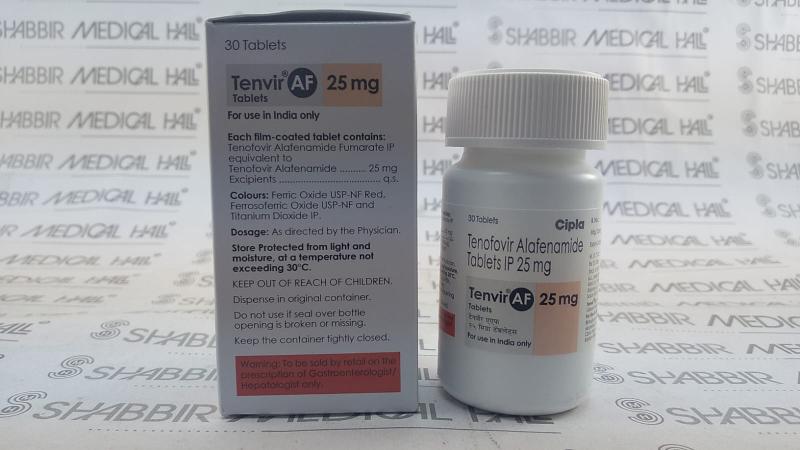
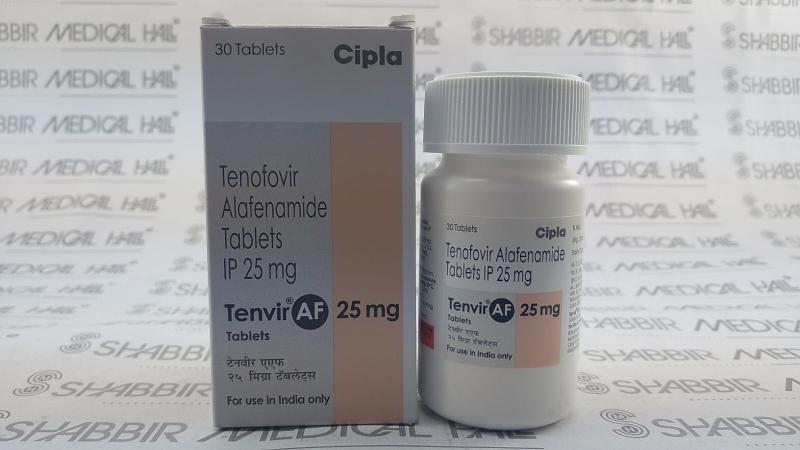
TENVIR AF TABLET
 Item requires a valid prescription
Manufactured By CIPLA HIV DIVISION
Composition TENOFOVIR ALAFENAMIDE 25MG
RS 1098.46
MRP RS 1373.08
(20% OFF)
Includes all taxes
Package SIZE
( 30`S )

100% Authentic
Products

Free
Shipping*

Products
Return Policy
Description:
Tenvir-AF 25mg Tablet (Tenofovir Alafenamide 25mg) is a next-generation nucleotide reverse transcriptase inhibitor (NtRTI) manufactured by Cipla HIV Division, indicated for the treatment of chronic Hepatitis B virus (HBV) infection and HIV-1 infection in adults. Tenofovir Alafenamide (TAF) is a prodrug of tenofovir that delivers high intracellular concentrations of the active metabolite tenofovir diphosphate in hepatocytes and lymphocytes while maintaining significantly lower systemic tenofovir plasma levels compared to the older formulation Tenofovir Disoproxil Fumarate (TDF). This results in equivalent or superior antiviral efficacy with a markedly improved renal and bone safety profile. Available from Shabbir Medical Hall at the best price in India, this genuine prescription tablet is available online with fast delivery nationwide.
BENEFITS: Tenvir-AF 25mg delivers potent HBV DNA suppression and HIV-1 RNA suppression with an improved tolerability profile. Clinical studies demonstrated non-inferior virological suppression vs TDF-based regimens, with statistically significant improvements in eGFR, serum creatinine, and bone mineral density. TAF is approved for both HBeAg-positive and HBeAg-negative chronic HBV, making it versatile across all patient profiles. In HIV, it forms the backbone of multiple first-line and switch regimens.
USAGE OVERVIEW: Tenvir-AF 25mg Tablets are taken orally, once daily, with or without food (food is not required but may improve tolerability). For chronic HBV: the standard dose is 25mg once daily. For HIV-1: TAF is used in combination with other antiretroviral agents as directed by the treating physician/infectious disease specialist. Dosage and duration are strictly determined by the prescribing doctor based on HBV DNA/HIV RNA levels, renal function, and overall treatment plan.
SAFETY OVERVIEW: The most common side effects include headache, fatigue, nausea, and abdominal discomfort. Severe lactic acidosis and hepatomegaly with steatosis have been reported rarely. Patients co-infected with HIV must not use TAF as monotherapy for HBV, as HIV resistance may develop. Regular monitoring of liver function, renal parameters, and HBV DNA/HIV RNA levels is mandatory during therapy.
Uses / Indications:
• Chronic Hepatitis B Virus (HBV) Infection: treatment of HBeAg-positive and HBeAg-negative chronic HBV in adults with compensated liver disease
• HIV-1 Infection: used as part of combination antiretroviral therapy (cART) in HIV-1 infected adults
ADDITIONAL USES:
• HIV/HBV co-infection (dual coverage)
• Treatment-experienced patients switching from TDF-based regimens to TAF for improved renal and bone tolerability
• Prevention of HBV reactivation in immunosuppressed patients (off-label in some protocols)
Interactions / Warnings:
HEPATITIS B EXACERBATION ON DISCONTINUATION
NEVER stop Tenvir-AF without explicit physician guidance — severe acute HBV flares can occur weeks after stopping. Monitor liver function (ALT, AST, HBV DNA) for at least 6 months after discontinuation in HBV patients.
HIV CO-INFECTION WARNING
HIV-positive patients must NEVER use TAF as HBV monotherapy — this can lead to HIV resistance. Always use within a complete cART regimen in HIV/HBV co-infected patients.
RENAL MONITORING
TAF has significantly improved renal safety vs TDF, but monitor eGFR, serum creatinine, serum phosphate, and urine glucose in: patients with baseline renal impairment (eGFR <30 mL/min: use with caution); patients on concurrent nephrotoxic agents.
HEPATIC IMPAIRMENT
Mild-moderate (Child-Pugh A/B): no dose adjustment required. Severe (Child-Pugh C): not recommended (limited data).
LACTIC ACIDOSIS / STEATOSIS RISK
Suspend TAF if clinical or laboratory findings suggestive of lactic acidosis develop.
DRIVING & MACHINERY
May cause dizziness and fatigue; assess personal response before driving.
ELDERLY (≥65 years)
Limited data; use with caution; monitor renal function closely.
Pregnancy interaction:
• Category B (US FDA): animal studies show no harm to foetus; limited human data available
• TAF use during pregnancy should only be considered when clearly needed and after careful risk-benefit assessment with the prescribing physician
• HIV-positive pregnant women: TAF may be used as part of an ART regimen under specialist supervision to prevent mother-to-child transmission
• HBV-infected pregnant women: discuss risks and benefits with hepatologist; antiviral suppression late in pregnancy reduces perinatal HBV transmission
BREASTFEEDING:
• HIV-positive women: WHO recommends ART throughout breastfeeding; discuss individual risk-benefit with physician
• HBV-positive women: TAF can be present in breast milk; weigh risk of HBV transmission against breastfeeding benefits
CONTRACEPTION WARNING:
• No specific contraceptive requirement; discuss family planning with prescribing physician
Expert advice:
1. TAF IS NOT INTERCHANGEABLE WITH TDF WITHOUT PRESCRIPTION CHANGE:
• Tenvir-AF 25mg (TAF) and older Tenofovir Disoproxil (TDF) 300mg are both tenofovir prodrugs but are NOT interchangeable without physician direction. TAF delivers equivalent efficacy at a 10-fold lower dose via a more targeted delivery mechanism. Never substitute one for the other without explicit prescription guidance.
2. NEVER STOP TENVIR-AF ABRUPTLY IN HBV PATIENTS:
• Discontinuing TAF without physician approval in hepatitis B patients can trigger severe acute HBV flares — potentially causing fulminant liver failure in patients with advanced disease. Always taper or transition as directed, with LFT monitoring for at least 6 months post-discontinuation.
3. HIV-POSITIVE PATIENTS: COMPLETE ART REGIMEN IS MANDATORY:
• Tenvir-AF must NEVER be used as the sole antiretroviral in HIV-positive patients. Monotherapy will select for HIV drug resistance. Always use as part of a complete, prescription-guided combination regimen.
4. WATCH FOR LACTIC ACIDOSIS WARNING SIGNS:
• Although rare with TAF, report unexplained weakness, unusual muscle pain, difficulty breathing, stomach pain, nausea, vomiting, or coldness in extremities immediately. These are early signs of lactic acidosis — a medical emergency.
5. IMPROVED RENAL AND BONE SAFETY — BUT MONITORING STILL REQUIRED:
• TAF significantly improves kidney and bone outcomes vs TDF, but is not without risk, especially in patients with pre-existing renal impairment or concurrent nephrotoxic medicines. Regular monitoring of eGFR, serum creatinine, and phosphate is recommended.
MONITORING ADVICE:
• Liver Function Tests (ALT, AST, bilirubin): At baseline, then every 3 months for first year, then every 6 months
• HBV DNA / HBeAg / HBeAb: Every 3–6 months to assess virological response
• HIV-1 RNA (in HIV patients): Every 3–6 months as per ART monitoring protocol
• eGFR / serum creatinine / serum phosphate: At baseline, 3 months, then every 6 months
• Bone mineral density: Baseline and periodic monitoring in patients with osteoporosis risk
COMPLIANCE TIPS:
• Set a daily phone alarm at a consistent time for your dose
• TAF can be taken with or without food — choose what works best for your routine
• Store tablets in original blister pack away from moisture, heat, and direct sunlight
• Carry your physician's prescription and a medication alert card listing all medicines
• Do NOT crush, split, or chew tablets — swallow whole
SAFETY TIPS:
• Do NOT stop Tenvir-AF without consulting your doctor — abrupt cessation carries serious risks
• Maintain all scheduled blood tests and specialist appointments
• Inform all treating doctors (GP, dentist, surgeon) that you are on Tenofovir Alafenamide
• Avoid St John's Wort and other herbal P-gp inducers during therapy
• Report any new medicines, including OTC and supplements, to your physician before starting
Side Effects:
• Headache — most commonly reported across clinical trials
• Fatigue and asthenia (weakness)
• Nausea, abdominal pain, diarrhoea, dyspepsia
• Elevated ALT and AST (liver enzymes) — especially during initial weeks
• Dizziness
SERIOUS SIDE EFFECTS (contact your doctor immediately):
• Lactic acidosis: rare but potentially life-threatening — symptoms include weakness, unusual muscle pain, breathing difficulties, stomach pain, nausea, vomiting, cold/blue skin, dizziness, irregular heartbeat
• Severe hepatomegaly with steatosis (fatty liver): more common in women, obese patients, or those on prolonged nucleoside therapy
• HBV exacerbation on discontinuation: severe acute flares of hepatitis may occur if TAF is stopped abruptly in HBV-infected patients — DO NOT stop without physician guidance
• Immune reconstitution inflammatory syndrome (IRIS) in HIV patients: inflammatory response to opportunistic infections when ART is initiated
EMERGENCY SIGNS — SEEK IMMEDIATE MEDICAL HELP:
• Rapid breathing, extreme weakness, nausea/vomiting (lactic acidosis warning)
• Jaundice, dark urine, severe right upper abdominal pain (liver toxicity)
• Sudden worsening of liver disease after stopping TAF
How to use:
• Chronic HBV: 25mg (1 tablet) orally ONCE DAILY — with or without food
• HIV-1: 25mg (1 tablet) as part of a combination ART regimen ONCE DAILY — always with other antiretrovirals
ROUTE OF ADMINISTRATION:
• Oral (tablet) — swallow whole with water
• Can be taken with or without food (food not mandatory but may improve GI tolerability)
TIMING:
• Take at the same time each day for consistency
• Do NOT skip doses — consistent daily dosing is critical to prevent HBV/HIV resistance
MISSED DOSE:
• If within the same day: take as soon as remembered
• If the next dose is due: skip the missed dose and continue the regular schedule
• Do NOT double up
STORAGE:
• Store below 30°C in a dry place, away from moisture and sunlight
• Keep in original blister pack until use
• Keep out of reach of children
• Do not use after the expiry date printed on the strip
How it works:
MECHANISM:
• TAF is taken up by hepatocytes (for HBV) and lymphocytes (for HIV), where intracellular enzymes cleave it to release tenofovir. Tenofovir is then phosphorylated intracellularly to tenofovir diphosphate (TFV-DP), the active metabolite.
FOR HBV:
• TFV-DP competitively inhibits HBV reverse transcriptase (polymerase), incorporating into viral DNA and causing chain termination — blocking HBV replication.
FOR HIV-1:
• TFV-DP inhibits HIV-1 reverse transcriptase, blocking conversion of HIV RNA to DNA — preventing integration into the host genome.
KEY ADVANTAGES OVER TDF:
• TAF delivers ~90% lower plasma tenofovir levels, reducing renal tubular toxicity and bone density loss
• Equivalent or superior virological suppression at a 10-fold lower dose (25mg TAF vs 300mg TDF)
• More stable in plasma — resistant to degradation before cellular uptake
• Clinically proven to preserve eGFR and bone mineral density better than TDF
Faq for medicine:
Tenvir AF contains Tenofovir Alafenamide (TAF), a prodrug of Tenofovir used in combination antiretroviral therapy for HIV-1 infection in adults and pediatric patients weighing at least 14kg. Tenvir AF delivers Tenofovir selectively to lymphocytes with lower plasma drug levels, significantly reducing kidney and bone toxicity compared to older Tenofovir Disoproxil Fumarate formulations.
2.How does Tenvir AF Tenofovir Alafenamide differ from TDF in HIV treatment?
Tenvir AF achieves higher intracellular drug concentrations using 90% lower plasma Tenofovir levels compared to TDF. This translates to superior antiviral efficacy with significantly less kidney tubular toxicity, lower bone mineral density loss, and reduced proteinuria. Tenvir AF is preferred over TDF for HIV patients with renal impairment, osteoporosis risk, or established kidney disease requiring safer antiretroviral therapy.
3.What are the advantages of Tenvir AF over older HIV medications like Zidovudine?
Tenvir AF offers a more favorable safety profile than Zidovudine, which causes bone marrow suppression, anemia, and mitochondrial toxicity. Tenvir AF is once-daily without food restrictions, has no lipodystrophy risk, and is a preferred first-line HIV regimen backbone per WHO and major treatment guidelines. Unlike AZT, Tenvir AF does not significantly deplete mitochondrial function over time.
4.Can Tenvir AF be used in HIV patients with chronic kidney disease?
Tenvir AF is preferred over TDF in HIV patients with chronic kidney disease due to significantly lower nephrotoxic potential. However, Tenvir AF is not recommended when CrCl is below 15mL/min without dialysis. For patients on dialysis, Tenvir AF can be administered on dialysis days after the session. Renal function should be monitored periodically throughout Tenvir AF therapy.
5.What drugs interact significantly with Tenvir AF tablets?
Tenvir AF is a P-gp and BCRP substrate. P-gp inducers like rifampicin, carbamazepine, and St. John's Wort reduce TAF exposure and may compromise HIV viral suppression. P-gp inhibitors like cobicistat increase TAF levels. Complete ARV combination evaluation is essential before prescribing Tenvir AF to avoid clinically significant pharmacokinetic drug interactions.
6.Is Tenvir AF tablet safe for HIV-positive pregnant women?
Tenvir AF has growing but limited pregnancy data. While TDF has more robust pregnancy safety evidence, Tenvir AF is increasingly used when benefits outweigh risks. Its lower nephrotoxicity is an advantage, but reduced pharmacokinetic data in pregnancy requires caution. Clinical decisions should be guided by current national HIV perinatal guidelines and monitored by an infectious disease or HIV specialist.
Medicine interaction:
• Rifampicin / Rifabutin (CYP3A4/P-gp inducers): significantly reduce TAF plasma levels — AVOID or use an alternative antiviral
• St John's Wort (Hypericum perforatum): P-gp inducer — AVOID; reduces TAF efficacy
• Carbamazepine, Phenytoin, Phenobarbital: strong inducers — reduce TAF exposure; AVOID if possible
• Atazanavir/ritonavir, Darunavir/cobicistat, Lopinavir/ritonavir: P-gp/BCRP inhibitors — may increase TAF exposure; dose adjustment may be required
• Nephrotoxic drugs (NSAIDs, aminoglycosides, vancomycin): additive renal risk — monitor renal function closely
• Adefovir Dipivoxil: DO NOT co-administer — potential additive renal toxicity with overlapping mechanism
VACCINE INTERACTIONS:
• HBV-vaccinated patients: TAF still required if HBV infection is established
• Consult physician before live vaccinations, particularly in immunocompromised (HIV) patients
SUPPLEMENT INTERACTIONS:
• Herbal products with P-gp induction potential (e.g., St John's Wort): contraindicated
• Always inform your doctor of all vitamins, herbal products, and supplements
Available Substitutes