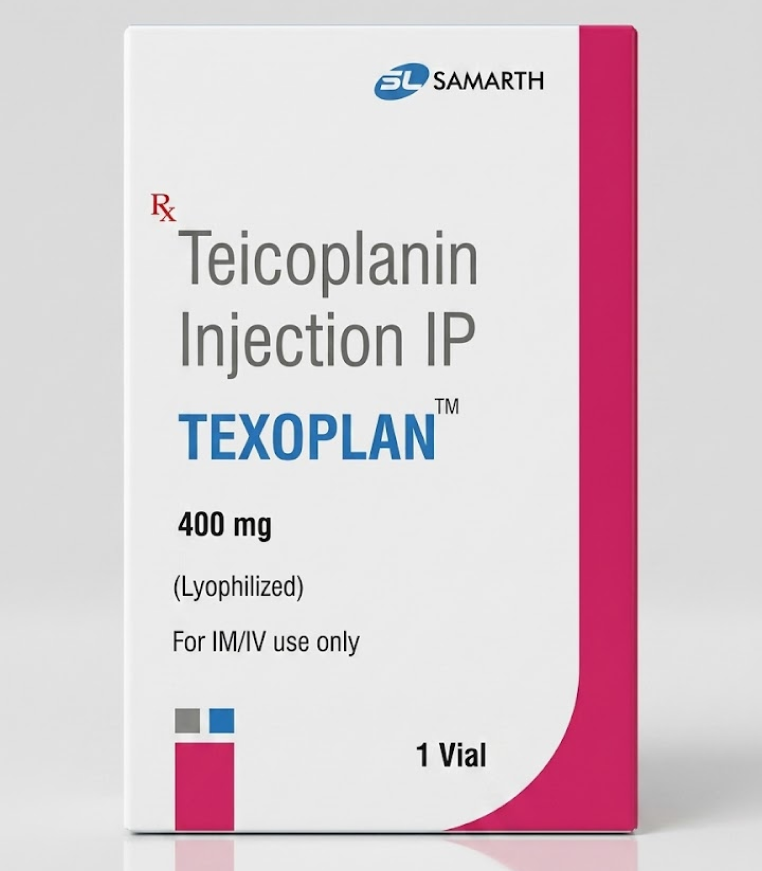


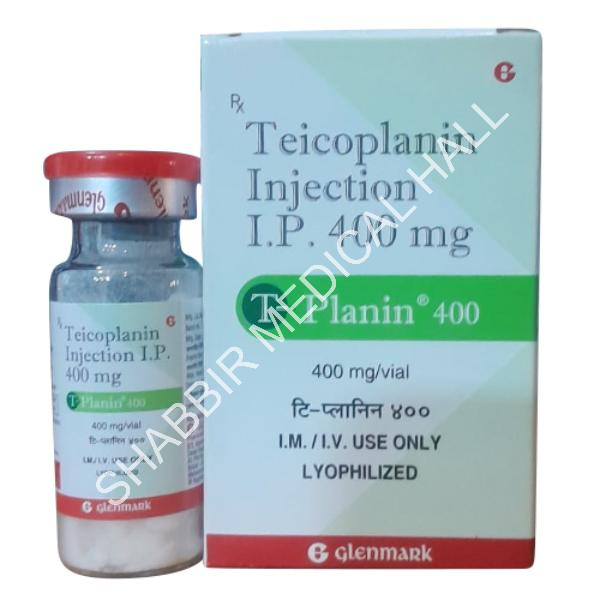
T PLANIN 400MG INJECTION
 Item requires a valid prescription
Manufactured By Glenmark
Composition Teicoplanin 400mg
RS 2216.90
MRP RS 3167.00
(30% OFF)
Includes all taxes
Package SIZE
( Vial )

100% Authentic
Products

Free
Shipping*

Products
Return Policy
Description:
T-Planin 400mg Injection(Teicoplanin 400mg) is a second-generation glycopeptide antibiotic manufactured by Glenmark Pharmaceuticals Ltd, indicated for the treatment of serious and life-threatening infections caused by Gram-positive bacteria, including methicillin-resistant Staphylococcus aureus (MRSA) and other resistant strains. It is used across a broad spectrum of critical infections — from endocarditis and septicaemia to bone & joint infections and peritonitis — in both adult and paediatric patients. Available from Shabbir Medical Hall at the best price in India, this genuine Glenmark prescription injection is available online with fast home delivery.
BENEFITS: T-Planin 400mg works by inhibiting the synthesis of the bacterial cell wall. Teicoplanin binds to the D-alanyl-D-alanine terminus of peptidoglycan precursors, blocking transglycosylation and transpeptidation steps essential for cell wall assembly. This bactericidal action is highly effective against resistant Gram-positive pathogens. Key clinical advantages include once-daily dosing (improving compliance), a long half-life (>100 hours) allowing flexible administration, excellent tissue penetration into bone, synovial fluid, and soft tissue, and a comparatively favourable renal toxicity profile versus vancomycin.
USAGE OVERVIEW: T-Planin 400mg is administered as an intravenous (IV) injection or infusion, or by intramuscular (IM) injection as directed by the treating physician or infectious disease specialist. The dose and duration are determined by the type and severity of infection. A loading dose regimen is typically used for serious infections to rapidly achieve therapeutic serum concentrations.
SAFETY OVERVIEW: The most common side effects include injection site reactions, fever, rash, and elevated liver enzymes. Serious but rare effects include ototoxicity, nephrotoxicity, and hypersensitivity reactions. Inform your doctor about all current medications, renal function, and any history of glycopeptide allergy before starting therapy.
Uses / Indications:
• Skin & Soft Tissue Infections (SSTIs): complicated cases caused by MRSA or other resistant Gram-positive organisms
• Endocarditis: bacterial infection of the heart valves, particularly staphylococcal endocarditis
• Bone & Joint Infections: osteomyelitis and septic arthritis due to Gram-positive pathogens
• Septicaemia / Bacteraemia: serious bloodstream infections caused by Gram-positive bacteria
• Peritonitis: including CAPD (continuous ambulatory peritoneal dialysis)-associated peritonitis
• Lower Respiratory Tract Infections: Gram-positive pneumonia in hospitalised / ICU patients
• Urinary Tract Infections: complicated UTIs caused by Gram-positive organisms
ADDITIONAL USES:
• Febrile neutropenia empirical therapy covering Gram-positive component
• Surgical prophylaxis in patients at high risk of MRSA infection
• Hospital-acquired infections (HAIs) and ICU-acquired infections caused by resistant Gram-positive bacteria
Interactions / Warnings:
RENAL MONITORING:
- Monitor renal function (serum creatinine, urea, eGFR) before starting and regularly during prolonged treatment, especially in patients with pre-existing renal impairment or on concurrent nephrotoxic drugs.
AUDITORY / VESTIBULAR MONITORING:
- Audiometry recommended for patients on prolonged high-dose therapy or with pre-existing hearing impairment.
HAEMATOLOGICAL MONITORING:
- Full blood count (FBC) monitoring recommended during extended courses — watch for leucopenia and thrombocytopenia.
HEPATIC MONITORING:
- Liver function tests (LFTs) should be checked in patients receiving prolonged therapy or those with pre-existing liver disease.
HYPERSENSITIVITY / CROSS-ALLERGY:
- Caution in patients with known hypersensitivity to vancomycin. Cross-reactivity between glycopeptides is possible but not universal; specialist assessment required before use.
C. DIFFICILE RISK:
- Antibiotic-associated diarrhoea and pseudomembranous colitis have been reported. Evaluate patients who develop significant diarrhoea during or after treatment.
DRIVING & MACHINERY:
- May cause dizziness and/or vestibular disturbances. Assess individual response before driving or operating heavy machinery.
ELDERLY USE (>=65 years):
- Elderly patients are at greater risk of renal impairment and ototoxicity; start at lower end of dosing range and monitor closely.
PAEDIATRIC USE:
- Use only under specialist paediatric infectious disease supervision. Neonates and infants require specific dosing adjustment.
Pregnancy interaction:
• Safety of Teicoplanin in human pregnancy has not been established through controlled clinical trials.
• Animal reproductive toxicity data are limited.
• T-Planin 400mg should NOT be used during pregnancy unless clearly necessary — only when the benefit to the mother outweighs potential risk to the foetus.
• Inform your physician immediately if pregnancy is suspected, confirmed, or planned during treatment.
BREASTFEEDING:
• It is not known whether Teicoplanin passes into human breast milk in clinically significant amounts.
• Breastfeeding is NOT recommended during treatment as a precautionary measure.
• The decision to discontinue breastfeeding or discontinue treatment should be made in consultation with your doctor.
DOCTOR CONSULTATION WARNING:
• Never stop or alter T-Planin dosing without consulting your infectious disease specialist. Premature discontinuation of antibiotics promotes resistance and risks treatment failure.
Expert advice:
1. HOSPITAL OR SPECIALIST ADMINISTRATION ONLY:
T-Planin 400mg must be administered by or under the direct supervision of a qualified healthcare professional trained in IV/IM antibiotic therapy. It should not be self-administered. Reconstitution, preparation, and injection must follow aseptic technique.
2. CORRECT RECONSTITUTION IS CRITICAL:
Add the supplied solvent to the vial and roll gently until powder is completely dissolved. Do NOT shake vigorously — this causes excessive foaming. Allow any foam to settle fully before drawing up. Inspect the reconstituted solution: it should be clear and colourless to pale yellow. Discard if discoloured, cloudy, or particulate matter is visible.
3. COMPLETE THE FULL COURSE:
Even if the patient feels better within a few days, the full prescribed course of Teicoplanin must be completed. Premature discontinuation is a primary driver of antibiotic resistance and risks treatment failure with relapse of infection.
4. REPORT HEARING CHANGES IMMEDIATELY:
Any onset of tinnitus (ringing in the ears), hearing loss, or dizziness/balance problems must be reported to the treating physician without delay. These may indicate early ototoxicity and prompt dose review or discontinuation.
5. MONITOR RENAL FUNCTION PROACTIVELY:
Patients on concurrent nephrotoxic agents (aminoglycosides, NSAIDs, contrast media) or with pre-existing renal impairment require particularly close monitoring of serum creatinine and urine output. Dose adjustment may be necessary from Day 4 onwards based on renal function.
MONITORING ADVICE:
• Renal function (serum creatinine, urea, eGFR): Baseline and during prolonged treatment, especially with concurrent nephrotoxins
• Full Blood Count (FBC): Monitor for leucopenia and thrombocytopenia during extended therapy
• Liver function tests (LFTs): Baseline and periodically in patients on prolonged therapy or with liver disease
• Audiometry: Baseline and follow-up for patients on high-dose or prolonged therapy
• Clinical response assessment: Fever resolution, CRP/ESR trending, wound/infection site improvement
• Serum Teicoplanin levels: Trough levels (>10 mg/L for standard infections; >15-20 mg/L for endocarditis or bone infections) may be monitored per local protocol
COMPLIANCE TIPS:
• Ensure cold-chain storage compliance if vials are transported — store below 25°C and protect from light
• Keep a written log of every dose administered (date, time, batch number, administered by)
• Carry your physician's prescription and a medication alert card identifying Teicoplanin therapy
• Inform all other treating doctors, dentists, and pharmacists that you are on Teicoplanin
• Single-use vials only — discard any unused reconstituted solution promptly per clinical waste protocol
SAFETY TIPS:
• Perform strict aseptic technique during reconstitution and administration
• Inspect vial integrity (no cracks, leakage) and check expiry date before use
• Rotate IM injection sites to prevent local tissue reactions
• Ensure adequate hydration to support renal clearance during treatment
• Monitor for signs of C. difficile diarrhoea (watery/bloody stools, cramping) and report immediately
Side Effects:
• Injection site reactions: pain, erythema, phlebitis (IV site), induration (IM site)
• Fever and chills (especially during or shortly after IV infusion)
• Skin rash, pruritus, urticaria
• Elevated liver enzymes (ALT, AST, ALP, bilirubin) — usually transient
• Nausea, vomiting, diarrhoea
• Headache and dizziness
• Leucopenia, thrombocytopenia (particularly with prolonged therapy)
SERIOUS SIDE EFFECTS (contact your doctor immediately):
• Ototoxicity: tinnitus, hearing loss, vestibular disturbances (rare; risk increases with high doses or concurrent ototoxic drugs)
• Nephrotoxicity: elevated serum creatinine, reduced urine output — especially with aminoglycosides
• 'Red Man Syndrome'-like reactions: flushing, erythema, hypotension (rare with Teicoplanin but possible)
• Anaphylaxis / severe hypersensitivity: urticaria, angioedema, bronchospasm, cardiovascular collapse
• Severe skin reactions: Stevens-Johnson Syndrome (SJS), Toxic Epidermal Necrolysis (TEN) — rare
• Clostridium difficile-associated diarrhoea (pseudomembranous colitis)
EMERGENCY SIGNS — SEEK IMMEDIATE MEDICAL HELP:
• Sudden loss of hearing or ringing in ears
• Swelling of face, lips, tongue, or throat; difficulty breathing
• Severe, watery or bloody diarrhoea with abdominal cramps
• Blistering, peeling, or widespread skin rash
How to use:
LOADING DOSE (serious infections):
• 400 mg (6 mg/kg) IV every 12 hours for 3 doses (Days 1-2)
MAINTENANCE DOSE:
• Moderate infections: 200 mg (3 mg/kg) IV/IM once daily
• Severe/life-threatening infections (e.g., endocarditis, osteomyelitis): 400 mg (6 mg/kg) IV once daily
• Some protocols use 12 mg/kg/day for endocarditis — per specialist guidance
PAEDIATRIC DOSING (under specialist supervision):
• Loading: 10 mg/kg IV every 12 hours for 3 doses
• Maintenance: 6-10 mg/kg IV/IM once daily depending on severity
• Neonates (under 2 months): 16 mg/kg loading, then 8 mg/kg once daily
RENAL IMPAIRMENT:
• Days 1-4: standard dosing
• From Day 4: dose or interval adjusted based on creatinine clearance — specialist oversight mandatory
ROUTE OF ADMINISTRATION:
• Intravenous (IV) injection (over >=30 seconds) or infusion (over 30 minutes) — hospital/clinical use
• Intramuscular (IM) injection — selected patients, outpatient maintenance
RECONSTITUTION:
• Dissolve powder with the supplied solvent (Water for Injections); roll gently — do not shake vigorously.
• Allow foam to settle before use.
• Inspect for particles/discolouration before administration.
MISSED DOSE:
• Contact your treating physician immediately. Do not double the dose without medical advice.
STORAGE:
• Store below 25°C, away from direct light and moisture.
• Do NOT refrigerate unless stated.
• Reconstituted solution: use within 24 hours if refrigerated (2°C-8°C).
• Single use only — discard unused portion. Keep out of reach of children.
How it works:
Gram-positive bacteria rely on peptidoglycan — a cross-linked polymer — to maintain cell wall integrity and resist osmotic lysis.
Teicoplanin inhibits cell wall synthesis through a dual mechanism:
1. Binds with high affinity to D-Ala-D-Ala terminus of peptidoglycan precursors (lipid II), blocking transglycosylation
2. Prevents transpeptidation (cross-linking) of peptidoglycan chains
This results in:
• Structurally defective cell walls unable to withstand osmotic pressure
• Bacterial cell lysis and death (bactericidal action)
• No cross-resistance with beta-lactams (effective against MRSA)
Key clinical advantages over vancomycin:
• Long plasma half-life (>100 hours) enabling once-daily dosing
• Higher lipophilicity → superior tissue penetration (bone, synovial fluid, lung, peritoneum)
• Intramuscular administration possible in selected cases
• Comparatively lower nephrotoxicity and ototoxicity profile
• No need for continuous serum level monitoring in most standard cases
Faq for medicine:
T-Planin 400mg contains Teicoplanin, a glycopeptide antibiotic used for serious Gram-positive infections including MRSA, endocarditis, osteomyelitis, peritonitis, and prosthetic joint infections. T-Planin is a practical alternative to vancomycin, valued for once-daily dosing, IM administration option, and better tolerability in patients requiring prolonged antibiotic therapy.
2.How does T-Planin 400mg Teicoplanin compare to vancomycin for MRSA treatment?
T-Planin 400mg and vancomycin are both glycopeptides active against MRSA, but Teicoplanin offers practical advantages including once-daily dosing versus vancomycin's twice-daily infusion, an IM administration option, and fewer infusion-related reactions. T-Planin requires less intensive therapeutic drug monitoring in routine infections. Vancomycin may be preferred for CNS infections due to better CSF penetration data.
3.What loading dose protocol is used for T-Planin 400mg Teicoplanin?
T-Planin 400mg requires three loading doses of 400mg given every 12 hours on Days 1 and 2, followed by a 400mg once-daily maintenance dose. For deep-seated infections like endocarditis or osteomyelitis, higher loading and maintenance doses may be required. The loading regimen ensures rapid therapeutic Teicoplanin levels essential for effective bactericidal activity.
4.What monitoring is required during T-Planin 400mg Teicoplanin therapy?
While T-Planin 400mg does not require intensive monitoring for routine infections, trough serum Teicoplanin levels should be checked for severe infections like endocarditis and osteomyelitis, targeting >15–30mg/L. Renal function tests and complete blood counts should be performed regularly during T-Planin therapy, as nephrotoxicity and thrombocytopenia can occasionally occur with prolonged treatment.
5.Is T-Planin 400mg safe in patients with penicillin allergy?
T-Planin 400mg is a glycopeptide antibiotic with no structural relationship to penicillins or cephalosporins, making it safe for documented penicillin-allergic patients. T-Planin is frequently used when beta-lactam antibiotics are contraindicated. A small risk of cross-allergy with vancomycin exists, and prior hypersensitivity to other glycopeptides should always be assessed before initiating T-Planin therapy.
6.What is the duration of T-Planin 400mg therapy for bone and joint infections?
For osteomyelitis and prosthetic joint infections, T-Planin 400mg therapy typically continues for 6–12 weeks depending on infection severity, organism susceptibility, and surgical management. Monitoring of renal function, blood counts, and clinical response is essential during extended T-Planin courses. Combination therapy with rifampicin may enhance outcomes in biofilm-related orthopedic infections.
Medicine interaction:
• Aminoglycosides (Gentamicin, Amikacin, Tobramycin): Combined nephrotoxicity and ototoxicity risk significantly increased; monitor renal function and hearing closely. Monitor serum drug levels where available.
• Loop Diuretics (Furosemide): Potentiates ototoxicity; avoid concurrent use if possible.
• Ciclosporin / Tacrolimus: May increase nephrotoxicity risk; monitor renal function closely.
• Neuromuscular Blocking Agents: Teicoplanin may enhance neuromuscular blockade — caution in anaesthetic settings.
• Warfarin / Anticoagulants: Possible elevation of INR; monitor coagulation parameters.
• Other nephrotoxic drugs (NSAIDs, contrast media, amphotericin B): Cumulative kidney injury risk; hydration and monitoring essential.
VACCINE INTERACTIONS:
• Live vaccines: Avoid during active antibiotic treatment and for a suitable washout period; consult physician.
SUPPLEMENT INTERACTIONS:
• No major documented interactions with vitamins or herbal supplements. Always disclose all supplements to your doctor.