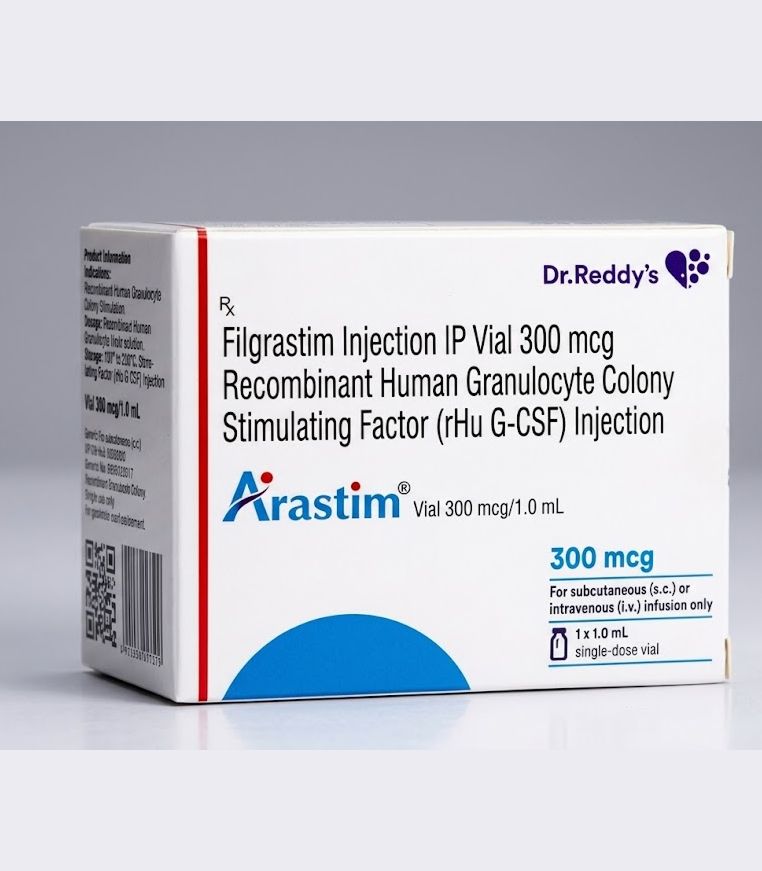


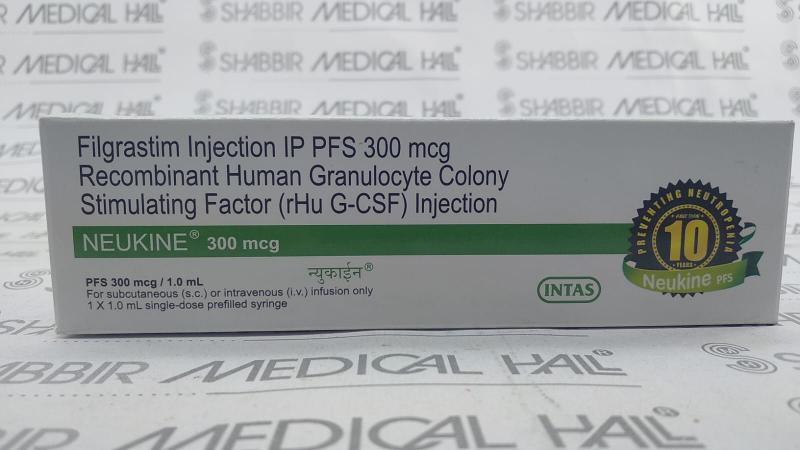
NEUKINE 300MCG INJECTION
 Item requires a valid prescription
Manufactured By Intas Pharmaceuticals Ltd
Composition Filgrastim 300mcg
RS 743.50
MRP RS 1239.17
(40% OFF)
Includes all taxes
Package SIZE
( PreFilled Syringe )

100% Authentic
Products

Free
Shipping*

Products
Return Policy
Description:
Neukine 300mcg Injection(Filgrastim 300mcg) is a recombinant human granulocyte colony-stimulating factor (G-CSF) manufactured by Intas Pharmaceuticals Ltd, used to stimulate the bone marrow to produce more white blood cells (neutrophils) in patients whose immune system has been suppressed by chemotherapy, radiation, or bone marrow disorders. It is a vital supportive medicine in oncology and haematology care, reducing the risk of serious, life-threatening infections during treatment. Available from Shabbir Medical Hall at the best price in India, this genuine prescription injection is available online with fast home delivery.
BENEFITS: Neukine 300mcg works by binding to G-CSF receptors on bone marrow progenitor cells, triggering rapid proliferation, differentiation, and activation of neutrophils — the primary white blood cells responsible for fighting bacterial and fungal infections. This dramatically reduces the duration of neutropenia following myelosuppressive chemotherapy, lowers the incidence of febrile neutropenia, and supports engraftment in stem cell transplantation protocols. It is also used in peripheral blood progenitor cell (PBPC) mobilisation before stem cell collection.
USAGE OVERVIEW: Neukine 300mcg is administered as a subcutaneous (under the skin) injection or, in certain hospital settings, as an intravenous infusion. The dose and duration depend on the clinical indication and are strictly determined by the treating oncologist. It is typically started 24 hours after completing a chemotherapy cycle and continued until neutrophil recovery. Never self-administer without medical training and supervision.
SAFETY OVERVIEW: The most common side effect is musculoskeletal pain (bone pain), which is manageable with non-opioid analgesics as advised by your doctor. Rare but serious effects include splenic enlargement or rupture, pulmonary reactions, and aortitis. Inform your doctor about all current conditions and medications before starting therapy.
Uses / Indications:
• Chemotherapy-Induced Neutropenia — reduces the duration and severity of neutropenia and lowers the risk of febrile neutropenia following cytotoxic chemotherapy
• Bone Marrow Transplant (BMT) Support — helps shorten the duration of severe neutropenia after transplantation
• Peripheral Blood Progenitor Cell (PBPC) Mobilisation — used for autologous and allogeneic stem cell transplantation procedures
• Severe Chronic Neutropenia (SCN) — treatment of congenital, cyclic, or idiopathic neutropenia in adults and selected patients under specialist care
ADDITIONAL / OFF-LABEL USES:
• Neutropenia in HIV patients receiving antiviral therapy (off-label)
• Stem cell mobilisation in healthy donors before allogeneic stem cell transplantation
• Supportive treatment for radiation injury-induced myelosuppression
Interactions / Warnings:
SPLEEN WARNING:
- Regular spleen size monitoring (clinical/ultrasound) recommended, especially in SCN patients.
- Splenic rupture, which can be fatal, has been reported. Report left upper abdominal pain immediately.
SICKLE CELL DISEASE:
- Use with extreme caution — life-threatening sickle cell crises have been reported.
MALIGNANT MYELOID CONDITIONS:
- NOT recommended in myeloid malignancies (AML, CML) except in protocol-approved settings.
RENAL / HEPATIC DISEASE:
- No dose adjustment for mild-moderate impairment. Severe impairment — limited data; specialist supervision required.
LATEX ALLERGY:
- Needle cap contains natural rubber (latex). Inform nurse/doctor before use if latex-allergic.
DRIVING & MACHINERY:
- May cause dizziness and fatigue. Assess personal response before driving.
ELDERLY USE (>=65 years):
- No age-specific dose adjustment, but elderly patients are at higher baseline infection risk; monitor closely.
Pregnancy interaction:
BENEFITS: Neukine 300mcg works by binding to G-CSF receptors on bone marrow progenitor cells, triggering rapid proliferation, differentiation, and activation of neutrophils — the primary white blood cells responsible for fighting bacterial and fungal infections. This significantly reduces the duration of neutropenia following myelosuppressive chemotherapy, lowers the incidence of febrile neutropenia, and supports engraftment in stem cell transplantation protocols. It is also used in peripheral blood progenitor cell (PBPC) mobilisation before stem cell collection.
USAGE OVERVIEW: Neukine 300mcg is administered as a subcutaneous (under the skin) injection or, in certain hospital settings, as an intravenous infusion. The dose and duration depend on the clinical indication and are strictly determined by the treating oncologist. It is typically started 24 hours after completing a chemotherapy cycle and continued until neutrophil recovery. Never self-administer without medical training and supervision.
SAFETY OVERVIEW: The most common side effect is musculoskeletal pain (bone pain), which is generally manageable with non-opioid analgesics as advised by your doctor. Rare but serious adverse effects include splenic enlargement or rupture, pulmonary reactions, capillary leak syndrome, and aortitis. Inform your doctor about all current medical conditions and medications before starting therapy.
Expert advice:
1. ADMINISTRATION ONLY BY TRAINED PERSONNEL: Neukine 300mcg should be administered by or under direct supervision of a qualified healthcare professional. If home self-administration is authorised by your oncologist, receive proper training on proper subcutaneous (SC) injection technique and sharps disposal.
2. STRICT TIMING RELATIVE TO CHEMOTHERAPY: Never administer Filgrastim within 24 hours before or after chemotherapy. Premature administration can sensitise bone marrow cells and potentially worsen chemotherapy-related toxicity.
3. MONITOR BLOOD COUNTS CLOSELY: Your oncologist will schedule regular CBC (Complete Blood Count) tests to monitor Absolute Neutrophil Count (ANC) and guide dose adjustments. Never skip scheduled blood tests during treatment.
4. REPORT BONE PAIN PROMPTLY: Musculoskeletal or bone pain is very common and often indicates Filgrastim is stimulating bone marrow activity. This is usually manageable with paracetamol (acetaminophen). Do NOT take NSAIDs without approval from your oncologist.
5. SPLEEN SAFETY AWARENESS: Report sudden or severe pain in the left upper abdomen or left shoulder tip immediately. This may indicate splenic enlargement or, rarely, splenic rupture — a serious medical emergency.
MONITORING ADVICE:
• ANC / CBC with differential: Regular monitoring during each chemotherapy cycle; Filgrastim is usually stopped once ANC recovers adequately
• Spleen size: Periodic clinical evaluation; ultrasound may be required in long-term therapy
• Uric acid and LDH: May increase due to rapid white blood cell production; monitored as per oncologist guidance
• Liver Function Tests (LFTs): Monitor during prolonged therapy or abnormal baseline liver function
• Platelet count: Monitor for thrombocytopenia during marrow recovery
• Pulmonary status: Watch for cough, fever, shortness of breath, or respiratory distress
COMPLIANCE TIPS:
• Store Neukine immediately in a refrigerator after delivery
• Use an insulated medical bag or cool carrier during transport
• Maintain a written or app-based log of injection dates, times, and injection sites
• Carry your oncologist’s prescription and medication alert card at all times
• Never reuse or share syringes or needles
• Dispose of used syringes in a puncture-resistant sharps disposal container
SAFETY TIPS:
• Wash hands thoroughly before and after handling the injection
• Inspect the solution before use — do not use if cloudy, discoloured, or containing visible particles
• Rotate injection sites regularly to prevent local skin irritation or hardening
• Avoid injecting into bruised, swollen, red, or damaged skin areas
• If you develop fever above 38°C (100.4°F), contact your oncology team immediately — fever during neutropenia is a medical emergency
Side Effects:
• Musculoskeletal / bone pain (most common; reflects bone marrow activation)
• Injection-site reactions: redness, bruising, swelling, or localised pain
• Headache and general fatigue
• Nausea, vomiting, and diarrhoea
• Elevated uric acid levels (hyperuricaemia)
• Transient elevation in liver enzymes (ALT, AST, LDH)
SERIOUS SIDE EFFECTS (contact your doctor immediately):
• Splenomegaly / Splenic Rupture — sudden severe left-sided abdominal pain or left shoulder pain (rare but life-threatening)
• Pulmonary reactions — cough, fever, rapid breathing, or difficulty breathing
• Aortitis — fever, abdominal pain, back pain, elevated inflammatory markers
• Sickle cell crisis in patients with sickle cell disease
• Capillary Leak Syndrome — swelling, rapid weight gain, low blood pressure (hypotension)
• Severe allergic reactions / anaphylaxis
EMERGENCY WARNING SIGNS — SEEK IMMEDIATE MEDICAL HELP:
• Sudden severe left upper abdominal pain or left shoulder pain
• Sudden shortness of breath, chest pain, or coughing up blood
• Swelling of face, lips, tongue, or throat
• Signs of cutaneous vasculitis — purplish rash (purpura), skin lesions, or joint pain
How to use:
• Chemotherapy-Induced Neutropenia: 5 mcg/kg/day subcutaneous (SC) injection, started at least 24 hours after chemotherapy; continued until Absolute Neutrophil Count (ANC) recovers post-nadir (typically 10–14 days)
• Bone Marrow Transplant: 10 mcg/kg/day IV infusion, started 24 hours after chemotherapy and at least 24 hours after bone marrow infusion
• Peripheral Blood Progenitor Cell (PBPC) Mobilisation: 10 mcg/kg/day SC for at least 4 days; leukapheresis generally performed on days 5–7
• Severe Chronic Neutropenia (SCN): Starting dose 12 mcg/kg/day SC; dose adjusted according to ANC response and clinical monitoring
ROUTE OF ADMINISTRATION:
• Subcutaneous (SC): Inject into thigh, abdomen, or upper arm — rotate injection sites regularly
• Intravenous (IV): Hospital administration only under medical supervision
TIMING:
• Start Filgrastim no earlier than 24 hours after completion of chemotherapy
• Administer at the same time each day for consistent therapeutic response
MISSED DOSE:
• Contact your oncologist or healthcare provider immediately for guidance
• Do not administer a double dose unless specifically instructed
STORAGE:
• Store refrigerated at 2°C–8°C (36°F–46°F)
• Do NOT freeze
• Keep in original carton to protect from light
• Allow syringe to reach room temperature naturally for up to 30 minutes before injection — do not use external heat sources
• Single-use only — discard unused portion after administration
• Keep out of reach of children
How it works:
Chemotherapy damages rapidly dividing cells, including neutrophil precursor cells in the bone marrow, resulting in neutropenia (critically low white blood cell count) and increased infection risk.
Filgrastim works by binding specifically to G-CSF receptors (G-CSFR) present on neutrophil precursor cells in the bone marrow, triggering:
• Accelerated proliferation and differentiation of neutrophil progenitor cells
• Faster release of mature neutrophils into the bloodstream
• Enhanced functional activity of mature neutrophils, including phagocytosis and antibody-dependent cellular cytotoxicity
Key advantages:
• Rapid onset of action — Absolute Neutrophil Count (ANC) may begin increasing within 24 hours of injection
• Clinically proven to reduce hospitalisation risk from febrile neutropenia following chemotherapy
• Helps oncologists maintain planned chemotherapy dose intensity and treatment schedules
• Mobilises haematopoietic progenitor cells (CD34+ stem cells) into peripheral blood for stem cell collection and transplantation procedures
Faq for medicine:
Neukine 300mcg Injection (Filgrastim 300mcg) is used to stimulate the production of white blood cells (neutrophils) in cancer patients undergoing chemotherapy. By boosting neutrophil counts, Neukine reduces the risk of febrile neutropenia, a serious infection complication that can lead to chemotherapy dose delays or hospitalizations.
2.How does Neukine 300mcg stimulate white blood cell production?
Neukine 300mcg works by binding to G-CSF (granulocyte colony-stimulating factor) receptors on bone marrow progenitor cells, stimulating their differentiation and rapid production of neutrophils. Filgrastim accelerates neutrophil recovery following myelosuppressive chemotherapy, shortening the duration of neutropenia.
3.When should Neukine 300mcg be administered after chemotherapy?
Neukine 300mcg is typically administered 24 to 72 hours after completing a chemotherapy cycle, not on the same day as chemotherapy. Daily subcutaneous or IV injections are continued until the absolute neutrophil count (ANC) reaches an acceptable level, as determined by the oncologist and serial blood counts.
4.Who can administer Neukine 300mcg injections at home?
Neukine 300mcg can be self-administered subcutaneously at home by patients or caregivers after adequate training from a healthcare professional. Injection technique, storage requirements (2–8°C refrigeration), dose timing, and recognition of adverse effects like bone pain should be clearly understood before home administration begins.
5.What side effects are commonly seen with Neukine 300mcg injection?
The most common side effect of Neukine 300mcg is bone pain, particularly in the lower back, hips, and sternum, resulting from stimulated marrow activity. Other effects include headache, fatigue, and injection site reactions. Rare but serious risks include splenic rupture and acute respiratory distress syndrome in certain patient populations.
6.Is Neukine 300mcg also used in stem cell transplantation?
Neukine 300mcg is used in stem cell mobilization for peripheral blood stem cell collection prior to autologous transplantation. Filgrastim drives hematopoietic stem cells from bone marrow into the bloodstream, where they are harvested by apheresis. It is also used to accelerate neutrophil engraftment after allogeneic transplantation.
Medicine interaction:
• Chemotherapy agents — Do NOT administer Filgrastim within 24 hours before or after cytotoxic chemotherapy, as this may increase bone marrow toxicity
• Lithium — May potentiate neutrophil release and enhance Filgrastim effect; monitor blood counts closely
• Bleomycin / Cyclophosphamide — Combined use may increase risk of pulmonary toxicity; monitor respiratory status carefully
• Fluorouracil (5-FU) — May worsen neutropenia severity in certain chemotherapy protocols; avoid without oncologist supervision
• Other myelosuppressive agents — May complicate interpretation of ANC response and bone marrow recovery monitoring
VACCINE INTERACTIONS:
• Live vaccines — Generally avoided during periods of active immunosuppression or chemotherapy; consult oncologist regarding appropriate vaccination timing
SUPPLEMENT INTERACTIONS:
• No major documented supplement interactions with Filgrastim; however, always inform your doctor about all herbal medicines, vitamins, immune boosters, or nutritional supplements before starting treatment