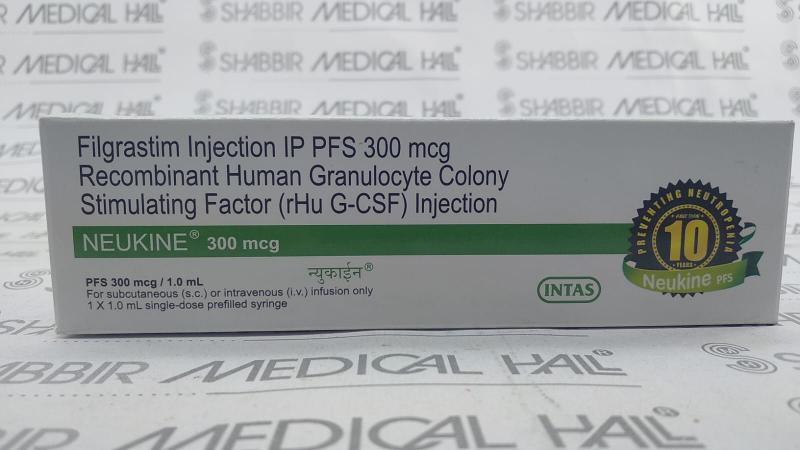


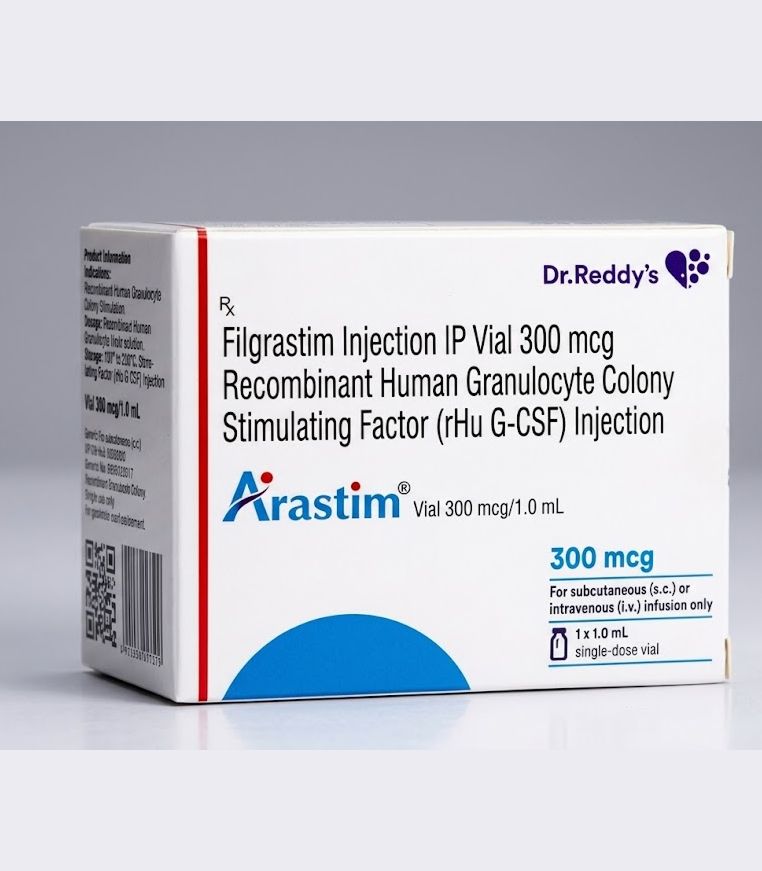
GRASTIM 300MCG INJECTION
Manufactured By DR REDDY S LABORATORIES LTD
Composition FILGRASTIM 300MCG
RS 974.25
MRP RS 1217.81
(20% OFF)
Includes all taxes
Package SIZE
( 1ML )

100% Authentic
Products

Free
Shipping*

Products
Return Policy
Description:
Grastim 300mcg Injection(Filgrastim 300mcg) is a recombinant human Granulocyte Colony-Stimulating Factor (G-CSF) manufactured by Dr. Reddy's Laboratories Ltd. It stimulates the bone marrow to produce and release neutrophils (white blood cells) rapidly, thereby reducing the duration and severity of neutropenia — a dangerous drop in white blood cell counts commonly caused by chemotherapy, radiation, or bone marrow disorders. Available from Shabbir Medical Hall at the best price in India, this genuine prescription injection is available online with fast delivery nationwide.
BENEFITS: Grastim 300mcg provides rapid and effective neutrophil recovery. By binding to G-CSF receptors on haematopoietic progenitor cells, it accelerates the proliferation, differentiation, and functional activation of neutrophils. Clinical data demonstrate that filgrastim significantly reduces the incidence and duration of febrile neutropenia, the number of hospitalisation days, and the need for intravenous antibiotics following myelosuppressive chemotherapy. It is also widely used for peripheral blood stem cell mobilisation prior to haematopoietic stem cell transplantation (HSCT).
USAGE OVERVIEW: Grastim 300mcg is administered as a subcutaneous injection (preferred) or intravenous infusion, typically starting 24 hours after the last dose of chemotherapy and continuing until neutrophil counts recover. The standard dose for chemotherapy-induced neutropenia is 5 mcg/kg/day; for stem cell mobilisation, higher doses (10 mcg/kg/day) may be used. Dosage, route, and duration are strictly determined by the treating oncologist or haematologist.
SAFETY OVERVIEW: The most common side effects include bone pain (medullary bone pain), musculoskeletal aches, headache, and injection site reactions. Rare but serious risks include Acute Respiratory Distress Syndrome (ARDS), splenic rupture, and sickle cell crisis in susceptible patients. Regular Complete Blood Count (CBC) monitoring is mandatory during therapy to prevent leucocytosis (WBC overshoot). This medicine requires a valid oncologist/haematologist prescription.
Uses / Indications:
• Chemotherapy-Induced Neutropenia (CIN): reduces the duration and severity of neutropenia and febrile neutropenia in adults and children receiving myelosuppressive anticancer chemotherapy
• Severe Congenital, Cyclic, or Idiopathic Neutropenia (Severe Chronic Neutropenia – SCN): long-term therapy to increase neutrophil counts and reduce the incidence of infection
• Bone Marrow Transplantation (BMT): reduces the duration of neutropenia following myeloablative therapy and bone marrow transplant
• Peripheral Blood Progenitor Cell (PBPC) Mobilisation: mobilises haematopoietic progenitor cells into the peripheral blood for collection and subsequent autologous transplantation
ADDITIONAL USES:
• HIV-related neutropenia (in selected treatment protocols)
• Aplastic anaemia (off-label use in selected centres)
• Myelodysplastic syndrome (MDS): in select patients under haematologist supervision
Interactions / Warnings:
LEUCOCYTOSIS WARNING:
- WBC counts >100 x 10⁹/L (leucocytosis) have been reported; associated with transient hypotension and organ dysfunction
- CBC must be monitored every 2-3 days during therapy; dose to be reduced or discontinued if WBC rises above safe threshold
SPLENIC RUPTURE:
- Potentially fatal; both asymptomatic (detected on imaging) and symptomatic cases reported
- Evaluate any patient reporting left upper quadrant abdominal pain or shoulder pain for splenic enlargement or rupture
ARDS:
- Patients on filgrastim who develop fever, pulmonary infiltrates, or respiratory distress should be evaluated for ARDS
- If ARDS is confirmed, filgrastim should be withheld and appropriate medical management initiated
SICKLE CELL DISEASE:
- Severe sickle cell crises, sometimes fatal, have been reported with filgrastim use
- Use with extreme caution, if at all, in patients with sickle cell trait or disease
RENAL / HEPATIC IMPAIRMENT:
- No dose adjustment formally required; however, monitor carefully in severe organ impairment
PREMATURE DISCONTINUATION:
- Do NOT stop filgrastim without oncologist advice — abrupt cessation before ANC recovery can lead to rebound neutropenia
DRIVING & MACHINERY:
- Filgrastim may cause fatigue and bone pain; assess individual response before driving
Pregnancy interaction:
• Filgrastim is Pregnancy Category C — use only if the potential benefit justifies the potential risk to the foetus
• Animal studies have shown adverse effects at high doses; limited human data available
• Use during pregnancy only under strict oncologist supervision
• Inform your doctor immediately if pregnancy occurs during treatment
BREASTFEEDING:
• It is unknown whether Filgrastim is excreted in human breast milk
• A decision should be made whether to discontinue breastfeeding or discontinue Filgrastim therapy based on clinical necessity
CONTRACEPTION WARNING:
• Women of childbearing potential should use effective contraception during Filgrastim therapy
• Consult your oncologist regarding reproductive planning before starting treatment
Expert advice:
1. TIMING IS CRITICAL — NEVER GIVE WITHIN 24 HOURS OF CHEMOTHERAPY:
• Grastim 300mcg MUST NOT be administered within 24 hours before or after cytotoxic chemotherapy.
• Filgrastim stimulates rapidly dividing myeloid cells, which are highly sensitive to chemotherapy — concurrent use can worsen myelosuppression or increase chemotherapy toxicity.
• Always confirm the exact administration schedule with your oncologist.
2. BONE PAIN IS EXPECTED — MANAGE PROACTIVELY:
• Medullary bone pain (lower back, sternum, hips, long bones) is the most common side effect.
• Pain usually begins 1–2 days after the first injection and resolves after stopping treatment.
• Paracetamol is the preferred first-line analgesic; NSAIDs may be used cautiously if approved by your doctor.
• Severe left-sided abdominal or shoulder pain may indicate splenic enlargement or rupture — seek urgent medical attention.
3. CBC MONITORING IS MANDATORY:
• Complete Blood Count (CBC with differential) must be checked every 2–3 days during therapy.
• Excessive rise in WBC count may require dose reduction or discontinuation.
• Never skip scheduled blood test appointments during treatment.
4. CORRECT STORAGE AND INJECTION TECHNIQUE:
• Store refrigerated at 2°C–8°C at all times.
• Remove from refrigerator 30 minutes before injection to allow natural warming to room temperature.
• Do NOT shake, freeze, microwave, or expose to direct heat.
• Rotate injection sites (abdomen, thigh, upper arm) to minimise injection-site reactions.
• Self-injection should only be done after proper training by healthcare professionals.
5. WATCH FOR SERIOUS WARNING SIGNS:
• Report sudden severe abdominal pain, breathing difficulty, blood in urine, severe swelling, or allergic reactions immediately.
• Persistent fever during chemotherapy may indicate febrile neutropenia and requires emergency evaluation.
MONITORING ADVICE:
• CBC with differential / ANC: every 2–3 days during therapy
• Serum uric acid, LDH, alkaline phosphatase: periodic monitoring
• Liver function tests (ALT, AST): during prolonged therapy
• Spleen size assessment if abdominal pain occurs
• Renal function and urinalysis if glomerulonephritis suspected
COMPLIANCE TIPS:
• Maintain consistent injection timing daily
• Keep a treatment diary with injection times, temperature readings, and side effects
• Carry oncologist prescription and medication alert card during treatment
• Discard single-dose vials immediately after use — do not reuse
• Allow syringe/vial to warm naturally before administration
SAFETY TIPS:
• Do NOT stop Grastim without oncologist approval
• Avoid crowds and sick individuals during neutropenic periods
• Seek urgent medical help for fever above 38°C during chemotherapy
• Inform all healthcare providers that you are receiving Filgrastim therapy
• Patients with sickle cell disease require strict specialist supervision during treatment
Side Effects:
• Filgrastim is classified as Pregnancy Category C — use only if the potential benefit justifies the potential risk to the foetus
• Animal studies have demonstrated adverse foetal effects at high doses; adequate controlled human studies are limited
• Grastim 300mcg should ONLY be used during pregnancy under strict oncologist or haematologist supervision
• Inform your doctor immediately if pregnancy is suspected, confirmed, or planned during treatment
BREASTFEEDING:
• It is unknown whether filgrastim is excreted in human breast milk
• A decision should be made whether to discontinue breastfeeding or discontinue filgrastim therapy, taking into account the clinical importance of treatment to the mother
• Breastfeeding during treatment should only occur after discussion with the treating specialist
CONTRACEPTION WARNING:
• Women of childbearing potential should use effective contraception during filgrastim therapy
• Discuss reproductive planning and fertility considerations with your oncologist before starting treatment
• Men and women undergoing chemotherapy should follow oncology team guidance regarding contraception and family planning
How to use:
CHEMOTHERAPY-INDUCED NEUTROPENIA:
• 5 mcg/kg/day subcutaneously or IV, starting 24 hours after the last chemotherapy dose
• Continue until ANC recovers to ≥10 x 10⁹/L after nadir (typically 10–14 days)
BONE MARROW TRANSPLANTATION:
• 10 mcg/kg/day IV infusion over 4–24 hours or as continuous 24-hour subcutaneous infusion
• Dose adjusted based on daily CBC monitoring
PBPC MOBILISATION (Autologous):
• 10 mcg/kg/day subcutaneously for 4–5 days before apheresis
SEVERE CHRONIC NEUTROPENIA:
• 5–12 mcg/kg/day subcutaneously
• Dose titrated by haematologist according to ANC response
ROUTE OF ADMINISTRATION:
• Subcutaneous injection (preferred for outpatient use): upper arm, abdomen, or thigh
• Intravenous infusion: hospital/inpatient setting as directed
• Do NOT administer within 24 hours before or after cytotoxic chemotherapy
PREPARATION:
• Allow vial/syringe to reach room temperature naturally for 30 minutes before administration
• Do NOT warm artificially using microwave, hot water, or direct heat
• Inspect visually before use — solution should be clear, colourless, and free of particulate matter
• Do NOT shake — shaking may denature the protein and reduce efficacy
• Use immediately once opened; discard any unused portion
MISSED DOSE:
• If a dose is missed, contact your oncologist/nurse immediately
• Do NOT double the next dose without medical advice
STORAGE:
• Refrigerate at 2°C–8°C (36°F–46°F)
• Do NOT freeze
• Keep in original carton to protect from light
• Once removed from refrigeration, stable at room temperature (up to 25°C) for up to 24 hours
• Keep out of reach of children
• Do NOT use after the expiry date printed on the label
How it works:
In healthy individuals, G-CSF is produced by stromal cells, macrophages, and endothelial cells in response to infection or tissue damage, stimulating neutrophil production. Chemotherapy destroys rapidly dividing bone marrow progenitor cells, leading to:
• Neutropenia: dangerously low neutrophil (ANC) counts
• Febrile Neutropenia: fever + neutropenia = life-threatening infection risk
Filgrastim acts by:
• Binding to G-CSF receptors (G-CSFR) on myeloid progenitor cells in the bone marrow
• Stimulating proliferation, differentiation, and maturation of neutrophil precursors into mature neutrophils
• Accelerating the release of mature neutrophils from the bone marrow into the bloodstream
• Enhancing the functional activity of mature neutrophils (phagocytosis, antibody-dependent cytotoxicity)
KEY ADVANTAGES:
• Significantly reduces febrile neutropenia episodes and hospitalisation duration after chemotherapy
• Enables dose-dense chemotherapy regimens that would otherwise be limited by neutropenia
• Essential for peripheral blood stem cell mobilisation before HSCT
• Once-daily subcutaneous dosing — convenient outpatient administration
• Clinically proven across multiple tumour types and chemotherapy regimens
Faq for medicine:
Grastim 300mcg Injection (Filgrastim 300mcg) is prescribed in oncology to reduce the duration and severity of neutropenia following chemotherapy. It stimulates bone marrow to produce more white blood cells (neutrophils), helping protect patients from potentially life-threatening infections during cancer treatment cycles.
2.How is Grastim 300mcg different from Neukine 300mcg injection?
Grastim 300mcg and Neukine 300mcg both contain Filgrastim 300mcg, the same active ingredient, and have identical therapeutic indications. The primary difference lies in the manufacturer and brand identity. Clinically, both are considered therapeutically equivalent G-CSF injections for neutropenia management and stem cell mobilization.
3.How should Grastim 300mcg injection be stored and handled?
Grastim 300mcg must be stored at 2–8°C (refrigerated) and must not be frozen. It should be protected from light. Before administration, allow the vial to reach room temperature for up to 30 minutes. Do not shake the vial vigorously. Use immediately after opening and discard any unused portion per healthcare instructions.
4.Can Grastim 300mcg be used in patients with severe chronic neutropenia?
Grastim 300mcg is an established treatment for severe chronic neutropenia (SCN), including congenital, cyclic, and idiopathic forms. Long-term Filgrastim therapy substantially reduces the frequency and severity of infections in SCN patients, improving quality of life. Dosing is individualized based on ANC response and tolerability.
5.What is the role of Grastim 300mcg in bone marrow transplantation?
Grastim 300mcg plays a key role in bone marrow and stem cell transplantation by accelerating neutrophil recovery after myeloablative conditioning therapy. Earlier neutrophil engraftment reduces infection risk post-transplant. Grastim is also used pre-transplant to mobilize CD34+ stem cells for peripheral blood harvest.
6.Are there any patients who should not receive Grastim 300mcg?
Grastim 300mcg should not be used in patients with known hypersensitivity to Filgrastim or E. coli-derived proteins. It is used with caution in patients with sickle cell disease due to risk of severe sickle cell crises. Patients with certain myeloid malignancies should only use Grastim under strict hematologist guidance.
Medicine interaction:
• Cytotoxic chemotherapy: NEVER administer Grastim within 24 hours before or after chemotherapy — increased risk of enhanced myelosuppression and marrow toxicity
• Lithium: May potentiate neutrophil release and increase WBC counts — monitor CBC closely
• Corticosteroids: May cause additive leukocytosis; monitor WBC and ANC carefully
• Myelosuppressive medicines: Concurrent use may alter bone marrow response — oncologist supervision mandatory
• Bleomycin and pulmonary-toxic drugs: Possible increased pulmonary toxicity risk (ARDS/interstitial lung disease) — monitor respiratory status closely
• Sickle cell medicines / hydroxyurea: Increased risk of sickle cell crisis in susceptible patients — specialist supervision required
VACCINE INTERACTIONS:
• Live vaccines should generally be avoided during periods of severe immunosuppression or active chemotherapy; consult oncologist before vaccination
SUPPLEMENT INTERACTIONS:
• No major direct interactions with vitamins or nutritional supplements documented
• Always inform your oncologist about all herbal products, supplements, and over-the-counter medicines being used concurrently
• Maintain adequate hydration during treatment to support renal clearance and reduce uric acid-related complications