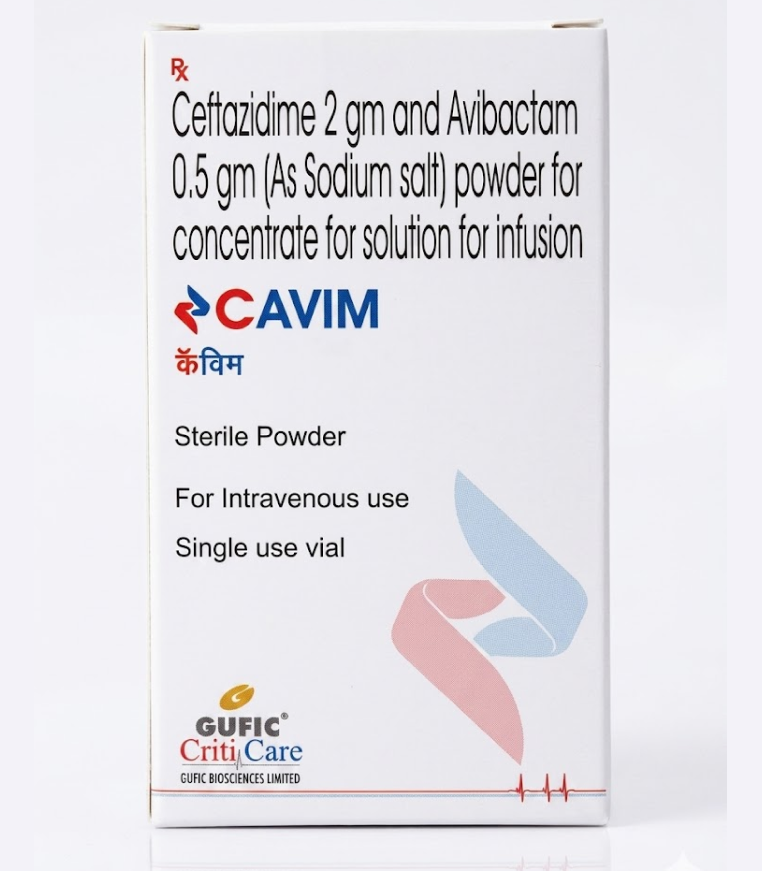


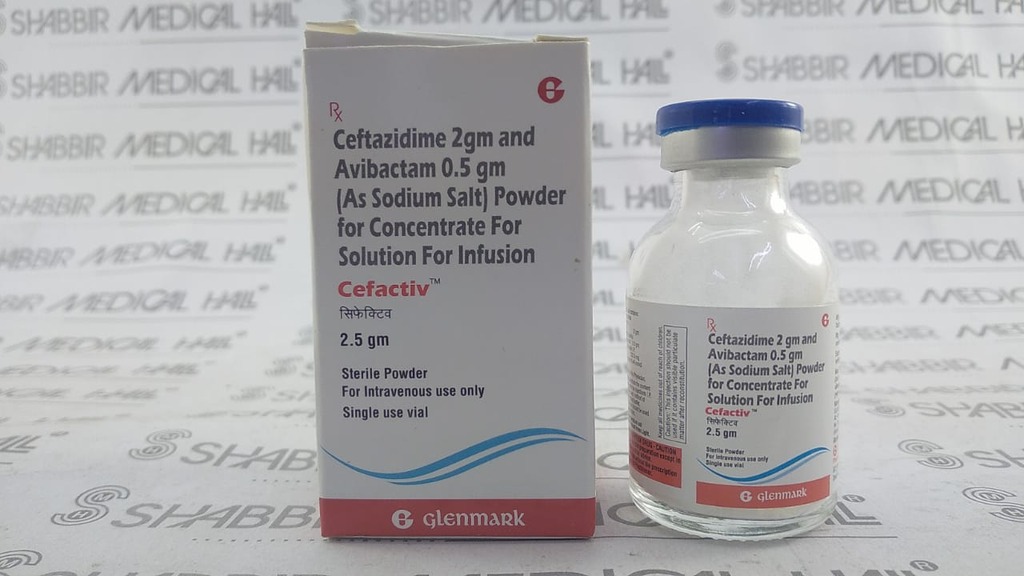
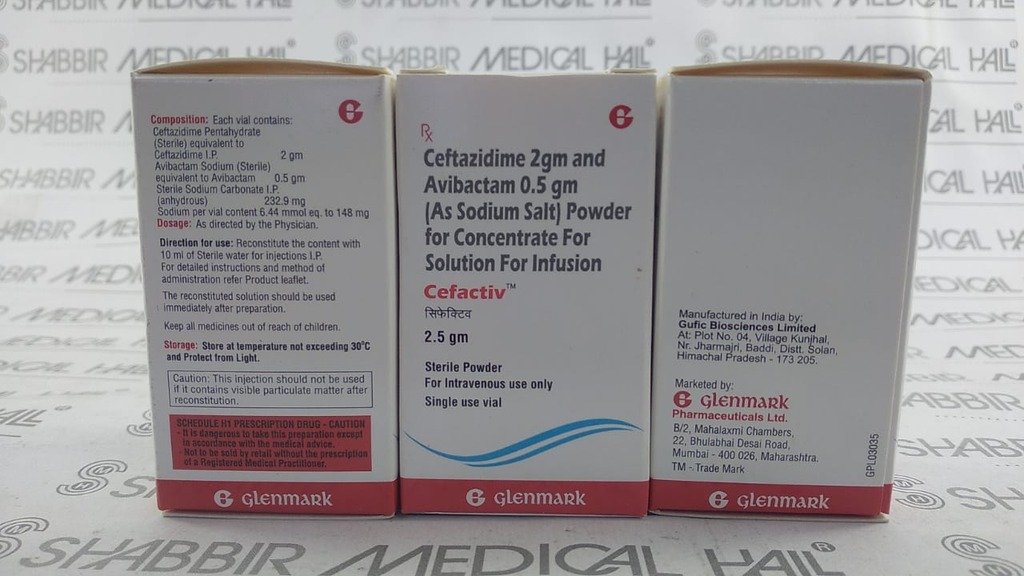
CEFACTIV 2 5 GM INJ
 Item requires a valid prescription
Manufactured By Glenmark
Composition Ceftazidime 2000mg Avibactam 500mg
RS 5396.40
MRP RS 5996.00
(10% OFF)
Includes all taxes
Package SIZE
( Vial )

100% Authentic
Products

Free
Shipping*

Products
Return Policy
Description:
Cefactiv 2.5 gm Injection(Ceftazidime 2000mg + Avibactam 500mg) is a next-generation beta-lactam / beta-lactamase inhibitor combination antibiotic manufactured by Glenmark Pharmaceuticals Limited, indicated for the treatment of serious and life-threatening infections caused by multidrug-resistant (MDR) and carbapenem-resistant gram-negative bacteria. Ceftazidime, a third-generation cephalosporin, disrupts bacterial cell-wall synthesis; Avibactam, a novel non-beta-lactam beta-lactamase inhibitor, protects ceftazidime from degradation by a wide spectrum of bacterial enzymes including Class A (ESBL, KPC), Class C (AmpC), and select Class D (OXA-48) beta-lactamases. Available from Shabbir Medical Hall at the best price in India, this genuine prescription injection is available online with fast delivery nationwide.
BENEFITS: Cefactiv 2.5 gm Injection provides broad-spectrum bactericidal activity against gram-negative pathogens — including Pseudomonas aeruginosa, Klebsiella pneumoniae, Escherichia coli, Enterobacter spp., and Acinetobacter spp. — that are resistant to most standard antibiotics and carbapenems. The addition of Avibactam restores susceptibility of otherwise resistant strains, making this combination a critical last-line therapy for complicated infections in ICU and hospital settings.
USAGE OVERVIEW: Cefactiv 2.5 gm Injection is administered intravenously (IV) by a trained healthcare professional in a clinical or hospital setting. The standard adult dose for most indications is 2.5 gm (Ceftazidime 2000mg + Avibactam 500mg) given as an IV infusion over 2 hours, every 8 hours (total 7.5 gm/day). Duration of therapy is determined by the treating infectious disease specialist or intensivist based on clinical response and culture sensitivity reports.
SAFETY OVERVIEW: Common side effects include nausea, diarrhoea, vomiting, injection-site reactions, and elevated liver enzymes. Serious but rare adverse events include Clostridioides difficile-associated diarrhoea (CDAD), hypersensitivity reactions (including anaphylaxis), and seizures in patients with renal impairment receiving unadjusted doses. Dose reduction is mandatory in moderate-to-severe renal impairment. This medicine is for use only in adults; safety in children has not been established for this combination.
Uses / Indications:
- Complicated Intra-Abdominal Infections (cIAI): in combination with metronidazole, for MDR gram-negative organisms
- Complicated Urinary Tract Infections (cUTI) including pyelonephritis: caused by Ceftazidime-susceptible but ESBL/KPC-producing organisms
- Hospital-Acquired Pneumonia (HAP) / Ventilator-Associated Pneumonia (VAP): caused by MDR Pseudomonas aeruginosa or carbapenem-resistant Enterobacteriaceae
- Bacteraemia / Septicaemia: associated with any of the above indications
ADDITIONAL USES:
- Febrile neutropenia (off-label, as per institutional protocol in immunocompromised oncology patients)
- Bone and joint infections caused by susceptible MDR gram-negative bacteria
- Central nervous system infections (meningitis) when other options are exhausted (specialist use only)
Interactions / Warnings:
RENAL IMPAIRMENT WARNING: Dose adjustment is MANDATORY in renal impairment (CrCl < 50 mL/min) — failure to reduce dose markedly increases seizure risk. Monitor serum creatinine and GFR at baseline and during therapy. Haemodialysis patients: supplemental doses required after each session.
NEUROTOXICITY / SEIZURE RISK: Encephalopathy, coma, myoclonus, and seizures reported with inappropriate doses in renal impairment. Discontinue immediately if neurological symptoms develop.
CLOSTRIDIOIDES DIFFICILE WARNING: All broad-spectrum antibiotics carry CDAD risk; symptoms may appear during or up to 2 months post-treatment. Discontinue Cefactiv and initiate appropriate therapy (metronidazole/vancomycin) if CDAD is confirmed.
HYPERSENSITIVITY / CROSS-REACTIVITY: Contraindicated in patients with documented hypersensitivity to ceftazidime, other cephalosporins, or avibactam. Cross-reactivity with penicillins possible (~1–2%); use with caution in patients with penicillin allergy; avoid in severe penicillin allergy.
HEPATIC IMPAIRMENT: No dose adjustment required for hepatic impairment alone; however, concurrent renal impairment must be assessed carefully.
DRIVING & MACHINERY: Dizziness and seizures have been reported; patients should not drive or operate heavy machinery if affected.
PAEDIATRIC USE: The Ceftazidime-Avibactam combination has limited safety data in paediatric populations; use in children only under specialist guidance.
Pregnancy interaction:
- Cefactiv 2.5 gm Injection should be used during pregnancy ONLY if clearly needed and the benefit outweighs potential risk
- Ceftazidime crosses the placental barrier; limited clinical data on avibactam in pregnancy
- Animal studies did not reveal direct teratogenic effects, but human data are insufficient
- Decision to use during pregnancy must be made by the treating specialist
BREASTFEEDING:
- Ceftazidime is excreted in human breast milk in small amounts
- The potential effect on the nursing infant is unknown; caution is advised
- Discuss with treating physician whether to discontinue breastfeeding or the medicine
CONTRACEPTION WARNING:
- No specific contraception requirements; standard clinical management applies
Expert advice:
1. ALWAYS ADJUST DOSE IN RENAL IMPAIRMENT:
Cefactiv 2.5 gm contains Ceftazidime, which is renally excreted. Failure to reduce the dose in patients with CrCl < 50 mL/min dramatically increases the risk of neurological toxicity including seizures, encephalopathy, and coma. Always check the patient's most recent eGFR before each prescription. The attending physician must specify the adjusted regimen clearly on the prescription.
2. ADMINISTER AS A 2-HOUR IV INFUSION — NOT IV PUSH:
Cefactiv 2.5 gm must be infused intravenously over 2 hours (120 minutes) — not as a bolus or rapid infusion. Extended infusion is critical to optimise pharmacokinetic/pharmacodynamic (PK/PD) target attainment (time above MIC), maximising bactericidal effect against MDR organisms. Always confirm infusion time with the administering nurse.
3. CONFIRM CULTURE & SENSITIVITY BEFORE DISPENSING:
Ceftazidime-Avibactam is a restricted antibiotic reserved for MDR and carbapenem-resistant infections. Confirm that the prescription is accompanied by a valid culture-sensitivity report, or that empirical use has been authorised by an infectious disease specialist or hospital antimicrobial stewardship team. Avoid use in routine infections where narrower-spectrum antibiotics are adequate.
4. WATCH FOR CLOSTRIDIOIDES DIFFICILE (CDAD):
All broad-spectrum antibiotics, including Ceftazidime-Avibactam, carry a risk of CDAD (antibiotic-associated colitis). Alert the patient's caregivers to report any new diarrhoea — particularly profuse watery or bloody stools — promptly. CDAD can occur up to 2 months after completing antibiotic therapy.
5. SCREEN FOR BETA-LACTAM ALLERGY HISTORY:
Before dispensing, confirm the patient has no documented allergy to cephalosporins, penicillins, or avibactam. In patients with a history of penicillin allergy, risk of cross-reactivity is low (~1–2%) but must be assessed. In documented severe penicillin or cephalosporin anaphylaxis, the drug is contraindicated.
MONITORING ADVICE:
- Renal function (serum creatinine, urea, eGFR): At baseline and every 48–72 hours during therapy, or more frequently in critically ill patients
- Liver function tests (ALT, AST): At baseline and weekly for prolonged therapy
- Serum electrolytes (K+, Na+): Monitor daily in ICU/critical care settings
- Full blood count (FBC/CBC): Weekly for prolonged courses (>7 days) to detect haematological changes
- Clinical response: Temperature, WBC count, CRP, procalcitonin — assess at 48–72 hours to confirm microbiological and clinical improvement
- Culture follow-up: Repeat blood/urine/BAL cultures at 72 hours where indicated
COMPLIANCE / HANDLING TIPS:
- Cefactiv 2.5 gm is administered only in hospital/clinical settings by trained professionals; home administration is NOT appropriate
- Reconstitute immediately before use; discard any unused reconstituted solution after 12 hours at room temperature
- Inspect reconstituted solution visually — it should be clear to slightly yellow; discard if particulate matter or discolouration is observed
- Store unreconstituted vials below 25°C, protected from light
- Do NOT freeze reconstituted solution
SAFETY TIPS:
- Do NOT use Cefactiv 2.5 gm without documented clinical indication and specialist authorisation — antimicrobial stewardship compliance is mandatory
- Always report culture results and clinical response at 48–72 hours to the prescribing team for de-escalation if appropriate
- In patients on renal replacement therapy (CRRT or haemodialysis), dose adjustments differ from standard renal impairment guidelines — refer to specialist nephrology/infectious disease guidance
Side Effects:
- Nausea, vomiting, diarrhoea — GI disturbances most common
- Elevated liver enzymes (ALT, AST) — typically mild and reversible
- Injection-site reactions: phlebitis, pain, swelling at IV site
- Headache, dizziness
- Hypokalaemia (low potassium) — monitor serum electrolytes
- Rash, urticaria — monitor for allergic reactions
SERIOUS SIDE EFFECTS (contact your doctor immediately):
- Clostridioides difficile-Associated Diarrhoea (CDAD): profuse watery or bloody diarrhoea, abdominal cramps — may occur up to 2 months after treatment; discontinue and treat immediately
- Anaphylaxis / Severe Hypersensitivity: urticaria, angioedema, bronchospasm, hypotension — DISCONTINUE immediately; requires emergency treatment
- Seizures / Encephalopathy: especially in patients with renal impairment who receive unadjusted doses — neurotoxicity risk
- Severe hepatotoxicity: jaundice, dark urine, severe abdominal pain
- Thrombocytopenia, leucopenia — haematological changes with prolonged use
EMERGENCY SIGNS — SEEK IMMEDIATE MEDICAL HELP:
- Sudden rash, throat swelling, difficulty breathing (anaphylaxis)
- Seizures or sudden confusion
- Profuse diarrhoea with blood (CDAD)
How to use:
- cIAI: 2.5 gm (Ceftazidime 2000mg + Avibactam 500mg) IV every 8 hours × 5–14 days (+ metronidazole)
- cUTI / pyelonephritis: 2.5 gm IV every 8 hours × 7–14 days
- HAP/VAP: 2.5 gm IV every 8 hours × 7–14 days
- RENAL IMPAIRMENT: Dose MUST be reduced — CrCl 31–50 mL/min: 1.25 gm q8h; CrCl 16–30 mL/min: 0.94 gm q12h; CrCl 6–15 mL/min: 0.94 gm q24h; CrCl ≤5 mL/min: 0.94 gm q48h
ROUTE OF ADMINISTRATION:
- Intravenous (IV) infusion ONLY — NOT for intramuscular (IM) use
- Reconstitute vial with 10 mL sterile water or 0.9% sodium chloride; further dilute in 100 mL NS or D5W
- Administer as IV infusion over 2 HOURS (120 minutes) — extended infusion improves PK/PD target attainment
- Administer by a trained nurse or healthcare professional in a clinical setting
MISSED DOSE:
- Administered in a clinical/hospital setting; dose scheduling is managed by the treating team
STORAGE:
- Unreconstituted vial: Store below 25°C, protect from light
- Reconstituted solution: Use immediately; stable up to 12 hours at room temperature or 24 hours refrigerated (2–8°C)
- Do not freeze reconstituted solution
- Keep out of reach of children
- Do not use after expiry date
How it works:
1. CEFTAZIDIME (2000mg) — Third-Generation Cephalosporin:
- Binds to penicillin-binding proteins (PBPs) — particularly PBP1b, PBP1c, and PBP3 — in the bacterial cell wall
- Inhibits transpeptidation (cross-linking) of peptidoglycan strands, disrupting structural integrity of the bacterial cell wall
- Results in bacteriolysis (cell lysis) and bacterial cell death
- Highly active against gram-negative bacteria including Pseudomonas aeruginosa
2. AVIBACTAM (500mg) — Novel Non-Beta-Lactam Beta-Lactamase Inhibitor:
- Inhibits Class A (ESBLs, KPC carbapenemases), Class C (AmpC cephalosporinases), and select Class D (OXA-48) beta-lactamases
- Forms a covalent but reversible bond with the beta-lactamase enzyme, preventing it from hydrolysing ceftazidime
- Does NOT inhibit Class B metallo-beta-lactamases (NDM, VIM, IMP)
KEY ADVANTAGES:
- Restores ceftazidime activity against KPC-producing Klebsiella pneumoniae (carbapenem-resistant)
- Effective against MDR Pseudomonas aeruginosa (unique among ceftazidime combinations)
- Clinically validated in Phase III trials (RECLAIM, REPRISE, RECAPTURE programmes)
- IV infusion over 2 hours improves pharmacodynamic target attainment
Faq for medicine:
Cefactiv 2.5gm Injection (Ceftriaxone 2.5gm) is a broad-spectrum third-generation cephalosporin antibiotic used to treat severe bacterial infections including lung infections (pneumonia), urinary tract infections, intra-abdominal infections, and skin and soft tissue infections in both adults and children, as prescribed by a physician.
2.How is Cefactiv 2.5gm injection administered in clinical settings?
Cefactiv 2.5gm is administered intravenously (IV) or intramuscularly (IM) in clinical settings by trained healthcare professionals. IV administration provides faster drug distribution for severe infections. The full prescribed course must be completed to prevent recurrence or antibiotic resistance development.
3.Can Cefactiv 2.5gm be used alongside other antibiotics like metronidazole?
Cefactiv 2.5gm can be used in combination with metronidazole for polymicrobial infections that include both gram-negative organisms and anaerobes. This combination is common in intra-abdominal infections. The combination is determined by the treating physician based on infection source, culture results, and severity.
4.What are the common side effects of Cefactiv 2.5gm injection?
Common side effects of Cefactiv 2.5gm include injection site pain, diarrhea, allergic reactions, and elevated liver enzymes. Serious adverse events include hypersensitivity reactions in patients with penicillin allergy (cross-reactivity exists) and biliary sludging with prolonged high-dose use. Probiotics may help reduce gastrointestinal discomfort.
5.Is Cefactiv 2.5gm effective against multidrug-resistant bacteria?
Cefactiv 2.5gm has activity against many gram-negative bacteria but may not cover all multidrug-resistant (MDR) organisms. For highly resistant strains such as ESBL-producing bacteria or carbapenem-resistant organisms, Cefactiv alone may be insufficient, and combination therapy or alternative agents would be considered by the specialist.
6.Why is completing the full course of Cefactiv 2.5gm injection critical?
Completing the full course of Cefactiv 2.5gm is critical to fully eradicate the infecting bacteria and prevent relapse. Premature discontinuation can leave residual bacteria, leading to recurrent infection that may be harder to treat due to acquired resistance. Always follow the duration prescribed by the treating physician.
Medicine interaction:
- Nephrotoxic agents (aminoglycosides, vancomycin, NSAIDs): increased risk of nephrotoxicity — monitor renal function closely
- Loop diuretics (furosemide): may enhance nephrotoxic risk — monitor renal parameters
- Probenecid: reduces renal tubular secretion of ceftazidime — increased plasma levels; avoid concurrent use
- Warfarin / anticoagulants: prolonged antibiotic use may alter gut flora and affect vitamin K metabolism — monitor INR
- Chloramphenicol: in vitro antagonism with ceftazidime — avoid combination
- Live vaccines (BCG, oral typhoid): broad-spectrum antibiotics may reduce efficacy — avoid vaccination during antibiotic course
VACCINE INTERACTIONS:
- Avoid live bacterial vaccines during treatment
SUPPLEMENT INTERACTIONS:
- No clinically significant herbal supplement interactions established; always disclose all medications to treating physician
Available Substitutes