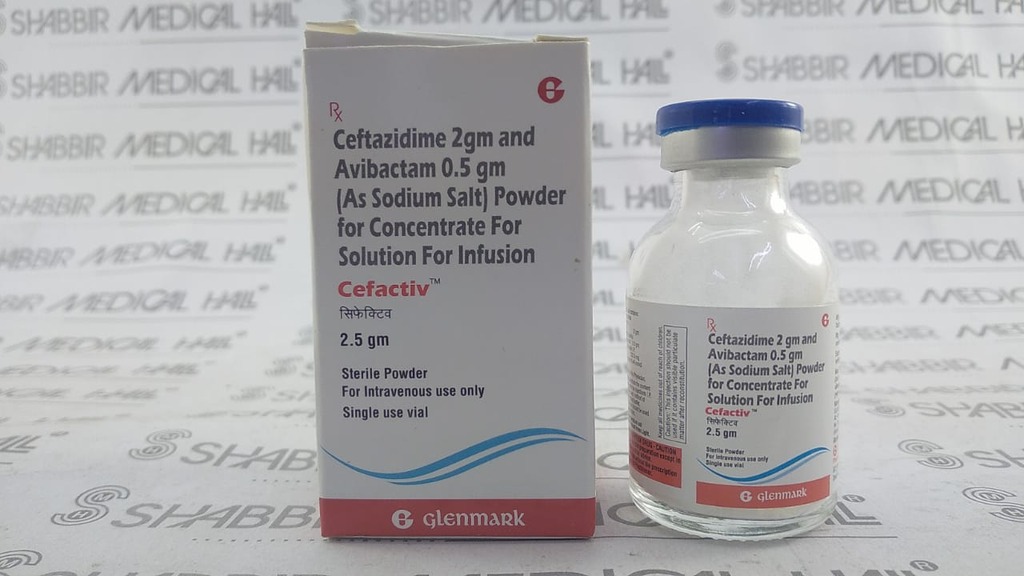


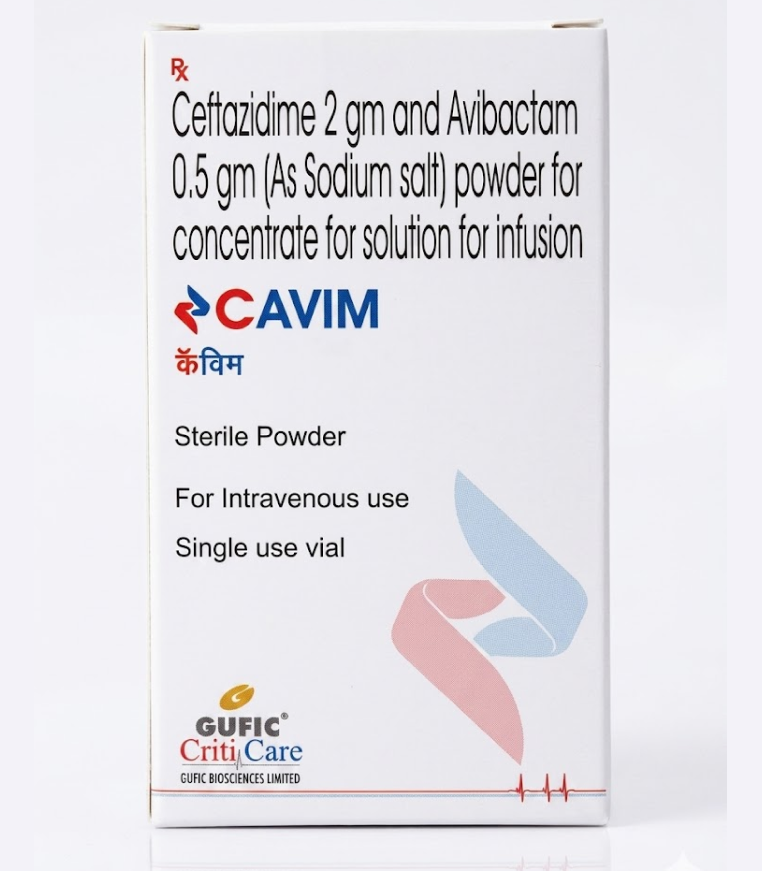
Cavim 2.5g
 Item requires a valid prescription
Manufactured By Gufic
Composition Ceftazidime 2000mg Avibactam 500mg
RS 4710.30
MRP RS 6729.00
(30% OFF)
Includes all taxes
Package SIZE
( Vial )

100% Authentic
Products

Free
Shipping*

Products
Return Policy
Description:
Cavim 2.5g Injection(Ceftazidime 2000mg + Avibactam 500mg) is a next-generation, fixed-dose beta-lactam/beta-lactamase inhibitor combination antibiotic manufactured by Gufic Biosciences Ltd, specifically engineered to combat serious, life-threatening infections caused by multidrug-resistant (MDR) Gram-negative bacteria, including carbapenem-resistant organisms (CROs). It is a critical last-resort antibiotic for hospital-acquired and ventilator-associated pneumonia, complicated urinary tract infections, and intra-abdominal infections. Available from Shabbir Medical Hall at the best price in India, this genuine prescription injection is available online with fast delivery.
BENEFITS: Cavim 2.5g works through a dual mechanism. Ceftazidime is a third-generation cephalosporin that disrupts bacterial cell wall synthesis by binding to penicillin-binding proteins (PBPs), leading to bacterial cell death. Avibactam is a novel non-beta-lactam beta-lactamase inhibitor that protects Ceftazidime from enzymatic destruction by extended-spectrum beta-lactamases (ESBLs), KPC-type carbapenemases, OXA-48-type enzymes, and AmpC beta-lactamases — the primary resistance mechanisms in MDR Gram-negative pathogens. Together, they restore clinical activity against organisms that have become resistant to carbapenems.
USAGE OVERVIEW: Cavim 2.5g is administered exclusively as a slow intravenous (IV) infusion over 2-3 hours in a hospital or clinical setting. Dosing is determined by infection type, severity, and renal function. It is never administered by injection as a bolus. The treatment course typically ranges from 5 to 14 days, as determined by the treating infectious disease specialist or intensivist.
SAFETY OVERVIEW: Cavim 2.5g is well tolerated in most patients. Common adverse effects include nausea, diarrhoea, and elevated liver enzymes. It requires dose adjustment in patients with renal impairment. Inform your specialist of all current medications, including nephrotoxic drugs, before starting therapy. Valid prescription from an infectious disease specialist or intensivist is mandatory.
Uses / Indications:
• Hospital-Acquired Pneumonia (HAP) and Ventilator-Associated Pneumonia (VAP): caused by MDR Gram-negative organisms including Pseudomonas aeruginosa and carbapenem-resistant Klebsiella pneumoniae (CRKP)
• Complicated Intra-Abdominal Infections (cIAI): in combination with metronidazole, for MDR Gram-negative bacterial infections
• Complicated Urinary Tract Infections (cUTI) including Pyelonephritis: caused by ESBL and carbapenem-resistant organisms
• Bacteraemia / Bloodstream Infections: when associated with the above indications or caused by susceptible organisms
ADDITIONAL USES:
• Febrile neutropenia in patients with resistant Gram-negative organism risk (specialist-guided)
• Infections caused by carbapenem-resistant Enterobacterales (CRE) based on local susceptibility data
• Last-resort treatment for KPC, OXA-48, and AmpC-producing organisms unresponsive to other antibiotics
Interactions / Warnings:
RENAL IMPAIRMENT WARNING (CRITICAL):
- Dose adjustment is MANDATORY in all patients with CrCl <50 mL/min. Failure to adjust doses in renal impairment causes Ceftazidime accumulation and severe neurotoxicity (encephalopathy, seizures).
- Monitor renal function (serum creatinine, eGFR) at least every 48 hours in critically ill patients.
C. DIFFICILE WARNING:
- Broad-spectrum antibiotic use including Cavim 2.5g disrupts normal gut flora. Monitor for CDAD — may present up to 2 months after antibiotic discontinuation.
PENICILLIN ALLERGY / CROSS-REACTIVITY:
- Ceftazidime is a cephalosporin. Cross-reactivity with penicillin allergy is rare (<1%) but anaphylaxis is possible. Obtain full allergy history before use.
RESISTANCE DEVELOPMENT:
- Use only for confirmed or strongly suspected susceptible organisms based on culture and sensitivity (C&S) data. Empirical use should be guided by local antibiogram data.
- Ceftazidime-Avibactam resistance (via MBL, porin loss, or target modification) can emerge on-therapy — monitor clinical response.
DRIVING & MACHINERY:
- May cause dizziness and confusion, especially in renal impairment. Patients should not drive during inpatient treatment.
ELDERLY USE (>=65 years):
- Elderly patients frequently have reduced renal function — calculate CrCl using Cockcroft-Gault formula before dosing. Monitor closely for neurotoxicity.
Pregnancy interaction:
• Ceftazidime-Avibactam crosses the placenta; clinical data in pregnant women are limited.
• Animal studies have not demonstrated direct teratogenicity for Ceftazidime; Avibactam data in pregnancy are insufficient.
• Cavim 2.5g should only be used in pregnancy when the benefit to the mother clearly outweighs the potential risk to the foetus — decision made by treating specialist.
• Women of childbearing potential: inform your doctor if planning pregnancy or if pregnancy is suspected.
BREASTFEEDING:
• Ceftazidime is excreted in human breast milk in small amounts. Avibactam excretion in breast milk is unknown.
• Breastfeeding is NOT recommended during treatment as a precautionary measure.
• If treatment is essential, breastfeeding should be discontinued for the duration of therapy.
DOCTOR CONSULTATION WARNING:
• Never discontinue Cavim 2.5g treatment prematurely — incomplete treatment can lead to antimicrobial resistance development and treatment failure.
Expert advice:
1. HOSPITAL-ONLY ADMINISTRATION — STRICTLY ICU/WARD SETTING:
Cavim 2.5g must ONLY be reconstituted and administered by trained hospital pharmacists, nurses, or ICU staff. This is NOT a home-use medication. Its use is restricted to inpatient settings with microbiological culture support, renal monitoring, and infectious disease or ICU specialist oversight.
2. CULTURE AND SENSITIVITY TESTING IS MANDATORY:
Cavim 2.5g should ideally be used based on confirmed culture and sensitivity (C&S) reports showing susceptibility to Ceftazidime-Avibactam. Empirical use should be based on local antibiogram data and institutional guidelines. Always send cultures before starting therapy.
3. RENAL FUNCTION MONITORING IS CRITICAL:
Calculate the patient's creatinine clearance (CrCl) before every dosing decision and repeat at least every 48 hours in critically ill patients. The dose must be adjusted immediately if renal function deteriorates during treatment. Neurotoxicity (seizures, encephalopathy) is the most serious consequence of underdosing or overdosing due to renal fluctuation.
4. MONITOR FOR CLINICAL RESPONSE AT 48-72 HOURS:
Reassess clinical response at 48-72 hours. If fever, inflammatory markers (CRP, PCT), and clinical status do not improve, reassess the culture data and consider the possibility of MBL-producing organisms (which are NOT covered by Ceftazidime-Avibactam) or other resistance mechanisms.
5. ANTIBIOTIC STEWARDSHIP:
Ceftazidime-Avibactam is a reserved-category antibiotic. Its use should be strictly documented in the antimicrobial stewardship programme (ASP). Do not prescribe for mild or community-acquired infections where other antibiotics are appropriate.
MONITORING ADVICE:
• Renal function (SCr, BUN, eGFR/CrCl): every 48 hours in ICU or renal impairment; adjust dose immediately
• CBC with differential: monitor for haematological effects (neutropenia, eosinophilia, thrombocytopenia)
• Liver function tests (LFTs): baseline and weekly for prolonged treatment courses
• Inflammatory markers (CRP, PCT): assess clinical response at 48-72 hours post-initiation
• C. difficile surveillance: monitor stool pattern throughout and up to 8 weeks post-treatment
• Neurological status: assess for confusion, tremor, myoclonus in renally impaired patients
COMPLIANCE TIPS:
• Ensure cold-chain compliant transport and storage of unreconstituted vials (below 25°C)
• Reconstitute vials only in a validated aseptic environment (laminar flow hood or BSC)
• Label reconstituted bags clearly with drug name, dose, time of preparation, and expiry
• Administer via a dedicated IV line — flush line before and after with 0.9% NaCl
• Document each dose in the medication administration record (MAR) with time and site
SAFETY TIPS:
• Never infuse as IV bolus — always over 2 hours minimum
• Do NOT co-infuse with aminoglycosides, metronidazole, or vancomycin in the same line
• Discard unused reconstituted solution — do not store for reuse
• Report any neurological changes (confusion, twitching, seizures) to the ICU team immediately
• For patients on haemodialysis, administer Cavim 2.5g after dialysis session
Side Effects:
• Gastrointestinal: nausea, vomiting, diarrhoea, abdominal discomfort
• Injection site reactions: phlebitis, inflammation along vein (from IV infusion)
• Elevated liver enzymes (ALT, AST, ALP) — usually transient
• Headache and dizziness
• Rash, pruritus (itching)
• Eosinophilia (elevated eosinophil count on CBC)
SERIOUS SIDE EFFECTS (contact your doctor immediately):
• Clostridioides difficile-Associated Diarrhoea (CDAD): watery or bloody diarrhoea, abdominal cramps (may occur weeks after treatment)
• Severe hypersensitivity / anaphylaxis: urticaria, angioedema, bronchospasm, hypotension — medical emergency
• Neurotoxicity (in renal impairment): encephalopathy, myoclonus, seizures — requires immediate dose review
• Severe skin reactions: Stevens-Johnson Syndrome (SJS), toxic epidermal necrolysis (TEN)
• Haematological: Coombs-positive haemolytic anaemia, neutropenia, thrombocytopenia (rare)
EMERGENCY SIGNS — SEEK IMMEDIATE MEDICAL HELP:
• Sudden confusion, seizures, or muscle twitching (neurotoxicity)
• Severe watery or bloody diarrhoea (C. difficile)
• Swelling of face, lips, or throat; difficulty breathing (anaphylaxis)
• Skin blistering, peeling, or widespread rash (SJS/TEN)
How to use:
• HAP/VAP & cUTI (Normal Renal Function CrCl >=50 mL/min): 2.5g (Ceftazidime 2g + Avibactam 0.5g) IV infusion over 2 hours, every 8 hours for 7-14 days
• cIAI: 2.5g IV every 8 hours for 5-14 days (combined with metronidazole for anaerobic coverage)
• Renal Dose Adjustment (MANDATORY):
– CrCl 31-50 mL/min: 1.25g every 8 hours
– CrCl 16-30 mL/min: 0.94g every 12 hours
– CrCl 6-15 mL/min: 0.94g every 24 hours
– CrCl <=5 mL/min or ESRD/HD: 0.94g every 48 hours
ROUTE OF ADMINISTRATION:
• Intravenous (IV) infusion ONLY — over 2 hours (3 hours in some protocols)
• NEVER give as IV bolus or intramuscular (IM) injection
• Reconstitute with sterile water for injection or 0.9% NaCl; further dilute in 100mL NS or D5W
TIMING:
• Administer every 8 hours (three times daily) as scheduled by ICU/hospital team.
MISSED DOSE:
• Contact your treating team immediately — do not double-dose without guidance.
STORAGE (reconstituted):
• Reconstituted vials: use within 30 minutes
• Diluted infusion bag: stable for 12 hours at room temperature or 24 hours refrigerated at 2°C-8°C
• Store unopened vials at room temperature (below 25°C), protected from light
• Keep out of reach of children
How it works:
MECHANISM:
Standard antibiotics such as carbapenems fail against MDR bacteria because resistance enzymes (KPC, OXA-48, ESBL, AmpC) hydrolyse (destroy) the antibiotic before it can act.
Avibactam covalently — but reversibly — binds to and inhibits these resistance enzymes, shielding Ceftazidime from destruction. Ceftazidime then freely binds to essential penicillin-binding proteins (PBP1, PBP2, PBP3) on the bacterial cell membrane, inhibiting cell wall peptidoglycan cross-linking and causing osmotic lysis of the bacterial cell.
Key advantages:
• Active against KPC-producing Klebsiella pneumoniae (CRKP), a frequent hospital superbug
• Inhibits OXA-48 carbapenemases — a major resistance enzyme in India
• Overcomes ESBL and AmpC mechanisms
• Does NOT inhibit MBL (metallo-beta-lactamase) enzymes; combination with aztreonam may be needed for NDM-producing organisms
• Avibactam is recycled after inhibition — it dissociates intact from the enzyme, allowing repeated inhibition
MECHANISM: Standard antibiotics such as carbapenems fail against MDR bacteria because resistance enzymes (KPC, OXA-48, ESBL, AmpC) hydrolyse (destroy) the antibiotic before it can act. Avibactam covalently — but reversibly — binds to and inhibits these resistance enzymes, shielding Ceftazidime from destruction. Ceftazidime then freely binds to essential penicillin-binding proteins (PBP1, PBP2, PBP3) on the bacterial cell membrane, inhibiting cell wall peptidoglycan cross-linking and causing osmotic lysis of the bacterial cell. Key advantages: - Active against KPC-producing Klebsiella pneumoniae (CRKP), a frequent hospital superbug - Inhibits OXA-48 carbapenemases — a major resistance enzyme in India - Overcomes ESBL and AmpC mechanisms - Does NOT inhibit MBL (metallo-beta-lactamase) enzymes; combination with aztreonam may be needed for NDM-producing organisms - Avibactam is recycled after inhibition — it dissociates intact from the enzyme, allowing repeated inhibition
Faq for medicine:
Cavim 2.5g Injection (Ceftazidime 2000mg + Avibactam 500mg) combines an advanced cephalosporin with a beta-lactamase inhibitor. Avibactam restores Ceftazidime's activity against beta-lactamase-producing resistant bacteria, including KPC, OXA-48, and AmpC-producing strains, making Cavim effective in carbapenem-resistant infections.
2.What serious infections is Cavim 2.5g injection indicated for?
Cavim 2.5g is indicated for complicated urinary tract infections (including pyelonephritis), complicated intra-abdominal infections (with metronidazole), hospital-acquired pneumonia, ventilator-associated pneumonia, and infections caused by gram-negative organisms when limited treatment options are available due to antibiotic resistance.
3.How is Cavim 2.5g injection administered and what is the usual dosing?
Cavim 2.5g is administered by slow IV infusion over 2 hours. The standard dose is 2.5g (Ceftazidime 2g + Avibactam 0.5g) every 8 hours for most adult patients with normal renal function. Dosing must be adjusted for renal impairment. Infusion duration and frequency are determined by the treating infectious disease specialist.
4.Is Cavim 2.5g active against carbapenem-resistant Klebsiella pneumoniae?
Cavim 2.5g is active against many carbapenem-resistant Klebsiella pneumoniae (CRKP) strains, particularly those producing KPC-type carbapenemases. Avibactam inhibits KPC enzymes, restoring Ceftazidime's bactericidal activity. However, Cavim has limited activity against MBL-producing (metallo-beta-lactamase) strains such as NDM-producing organisms.
5.What monitoring is required for patients receiving Cavim 2.5g injection?
Patients receiving Cavim 2.5g should be monitored for renal function (serum creatinine, urine output), signs of hypersensitivity, Clostridioides difficile-associated diarrhea, and neurological symptoms at high doses. Therapeutic drug monitoring may be considered in critically ill patients. Culture results should guide continuation or de-escalation.
6.How does Cavim 2.5g compare to meropenem for treating gram-negative infections?
Cavim 2.5g (Ceftazidime-Avibactam) is considered an alternative or preferred option over meropenem when carbapenem-resistant gram-negative infections are confirmed. In KPC-producing infections, Cavim has demonstrated superiority over carbapenem-based regimens in clinical studies. Choice depends on local resistance patterns and microbiological susceptibility results.
Medicine interaction:
• Nephrotoxic drugs (aminoglycosides, vancomycin, colistin, amphotericin B, NSAIDs): increased risk of renal toxicity; mandatory renal function monitoring
• Probenecid: inhibits renal tubular secretion of Ceftazidime, increasing plasma levels — avoid concurrent use
• Chloramphenicol: potential in vitro antagonism with Ceftazidime — avoid concurrent use
• Valproic acid: cephalosporins may reduce serum valproate levels, increasing seizure risk — monitor and adjust anticonvulsant dose
• Loop diuretics (furosemide): concurrent use may increase nephrotoxicity risk — monitor renal function
• Warfarin / anticoagulants: may potentiate anticoagulant effect — monitor INR closely
INCOMPATIBILITIES:
• Do NOT mix Cavim 2.5g with metronidazole, aminoglycosides, or vancomycin in the same IV line — administer through separate IV lines or flush thoroughly between drugs
VACCINE INTERACTIONS:
• Live bacterial vaccines (e.g., Ty21a typhoid): avoid during antibiotic therapy — antibiotic activity may reduce vaccine efficacy
Available Substitutes