


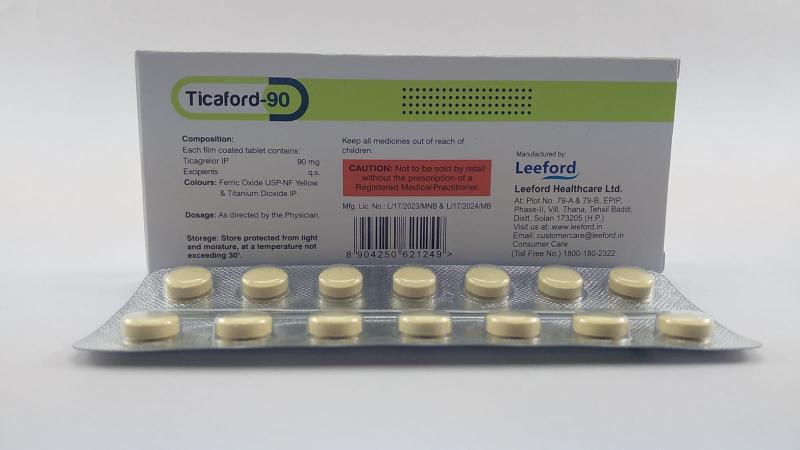
TICAGRELOR 90MG LEEFORD TABLETS
 Item requires a valid prescription
Manufactured By LEEFORD HEALTHCARE LTD
Composition TICAGRELOR 90MG
RS 262.50
MRP RS 328.13
(20% OFF)
Includes all taxes
Package SIZE
( 14`s )

100% Authentic
Products

Free
Shipping*

Products
Return Policy
Description:
Ticagrelor 90mg Leeford Tablet (Ticagrelor 90mg) is a potent, reversible, direct-acting P2Y12 ADP receptor antagonist and oral antiplatelet agent manufactured by Leeford Healthcare Ltd. It is indicated for the prevention of atherothrombotic events (cardiovascular death, myocardial infarction, and stroke) in adult patients with acute coronary syndrome (ACS) — including unstable angina (UA), non-ST-elevation myocardial infarction (NSTEMI), and ST-elevation myocardial infarction (STEMI) — and in patients with a history of myocardial infarction at high risk of atherothrombotic events. It is used in combination with aspirin as dual antiplatelet therapy (DAPT). Available from Shabbir Medical Hall at the best price in India, this genuine prescription tablet is available online with fast delivery nationwide.
BENEFITS: Ticagrelor 90mg provides faster, more consistent, and more potent platelet inhibition than clopidogrel, without requiring metabolic activation. The landmark PLATO (PLATelet inhibition and patient Outcomes) trial demonstrated that ticagrelor plus aspirin significantly reduced the rate of cardiovascular death, MI, and stroke compared to clopidogrel plus aspirin in ACS patients — with a particularly notable reduction in cardiovascular mortality. Its reversible binding means platelet function recovers faster after stopping, which is clinically important in patients requiring urgent surgery.
USAGE OVERVIEW: Ticagrelor 90mg is taken orally twice daily, with or without food, always in combination with a low daily maintenance dose of aspirin (75-100mg). Treatment is initiated with a 180mg loading dose (two 90mg tablets) followed by 90mg twice daily. The standard DAPT duration is 12 months post-ACS; longer durations may be recommended in high-risk patients. Dosage and duration are strictly as per the treating cardiologist's prescription.
SAFETY OVERVIEW: The most clinically significant adverse effects are bleeding (major and minor) and dyspnoea (shortness of breath, typically mild and transient). Ventricular pauses, bradycardia, and elevated serum creatinine and uric acid have also been reported. Ticagrelor is contraindicated in active pathological bleeding, prior intracranial haemorrhage, severe hepatic impairment, and concomitant use with strong CYP3A4 inhibitors. Prescription and cardiologist supervision required throughout therapy
Uses / Indications:
- Acute Coronary Syndrome (ACS) — all subtypes:
- Unstable Angina (UA): chest pain at rest or with minimal exertion; unstable coronary plaque
- Non-ST-Elevation MI (NSTEMI): partial coronary artery occlusion with myocardial injury
- ST-Elevation MI (STEMI): complete coronary artery occlusion; emergency reperfusion setting
- Used in combination with aspirin to reduce cardiovascular death, MI, and stroke
- Post-MI Secondary Prevention (High-Risk Patients): Patients with a history of MI ≥1 year ago with high atherothrombotic risk — 60mg BD dose used (PEGASUS-TIMI 54 trial); 90mg BD used in the first 12 months post-ACS
ADDITIONAL USES (SPECIALIST-GUIDED):
- Peripheral artery disease (PAD) secondary prevention — per specialist guidance
- Coronary stent thrombosis prevention as part of DAPT after PCI (percutaneous coronary intervention)
- Multi-vessel CAD patients with high ischaemic risk — per cardiologist protocol
Interactions / Warnings:
BLEEDING RISK — HIGHEST PRIORITY: Ticagrelor inhibits platelet function — all patients are at increased risk of bleeding from any cause. Carry a medication alert card/bracelet at all times. Inform ALL healthcare providers (surgeon, dentist, anaesthetist, emergency doctor) before any procedure. There is no specific reversal agent for ticagrelor; platelet transfusion may be required in severe uncontrolled bleeding (but platelets rapidly become inhibited by circulating ticagrelor).
PREMATURE DISCONTINUATION WARNING: Stopping ticagrelor prematurely — especially within the first 3-6 months post-ACS or post-PCI — carries a HIGH RISK of stent thrombosis and recurrent MI (potentially fatal). NEVER stop ticagrelor without explicit cardiologist approval, even for minor procedures.
SURGERY: Elective surgery: discontinue ticagrelor at least 5 days before procedure. Emergency surgery: inform surgical team; transfusion support may be needed. Restart as soon as haemostasis is achieved post-surgery — discuss timing with cardiologist.
DYSPNOEA: Transient dyspnoea occurs in ~14% of patients. It is typically mild, occurs early in treatment, and is not associated with worsening cardiac or pulmonary function. Distinguish from worsening heart failure (cardiologist assessment required). In most patients, dyspnoea resolves without stopping therapy.
BRADYCARDIA / CARDIAC MONITORING: Ticagrelor can cause transient ventricular pauses — avoid in patients with sick sinus syndrome, high-degree AV block, or symptomatic bradycardia without a pacemaker. Holter monitoring may be recommended in patients with bradycardia concerns.
RENAL IMPAIRMENT: No dose adjustment required; however, monitor renal function (ticagrelor may mildly increase serum creatinine — usually non-progressive).
HEPATIC IMPAIRMENT: Mild: use with caution; monitor carefully. Moderate-Severe (Child-Pugh B/C): CONTRAINDICATED — significant increase in drug exposure.
GOUT: Ticagrelor raises serum uric acid; use with caution in patients with gout or hyperuricaemia.
ELDERLY (≥75 years): Increased bleeding risk; monitor closely. Consider risk-benefit carefully.
Pregnancy interaction:
- Ticagrelor should NOT be used during pregnancy. Animal studies showed reproductive toxicity at clinically relevant doses. Human data are limited.
- Women of childbearing potential must use effective contraception during treatment.
- If pregnancy is suspected or confirmed, consult cardiologist immediately — risk-benefit must be assessed carefully; antiplatelet therapy may still be required in certain high-risk cardiac conditions.
BREASTFEEDING:
- Unknown whether ticagrelor is excreted in human breast milk. Animal studies show excretion in milk.
- Breastfeeding is NOT recommended during ticagrelor treatment. Discuss with your cardiologist.
CONTRACEPTION WARNING:
- Women of childbearing potential should use reliable contraception throughout therapy and for a washout period after stopping — discuss duration with your physician.
Expert advice:
1. NEVER STOP TICAGRELOR WITHOUT YOUR CARDIOLOGIST'S APPROVAL — EVER:
- This is the single most important instruction for patients on dual antiplatelet therapy. Premature discontinuation — even for a minor dental procedure or because of a side effect like dyspnoea — can lead to catastrophic stent thrombosis or recurrent heart attack within hours to days. If you are concerned about a side effect, call your cardiologist before stopping. Never self-discontinue.
2. ASPIRIN DOSE MUST STAY LOW (75-100mg DAILY):
- Taking higher doses of aspirin (e.g., 150mg, 300mg) while on ticagrelor is not more protective — it actually REDUCES ticagrelor's efficacy (shown in the PLATO trial). Stick strictly to 75-100mg aspirin as prescribed. Do not take additional aspirin-containing products (check labels of cold remedies, pain tablets).
3. UNDERSTAND DYSPNOEA — IT IS USUALLY NOT DANGEROUS:
- Many patients experience mild breathlessness in the first weeks of ticagrelor therapy. This is a known, common effect linked to adenosine pathways — it is typically not a sign of heart or lung deterioration. However, if dyspnoea is severe, worsening, or associated with chest pain or leg swelling, seek immediate medical review to rule out cardiac or pulmonary causes.
4. CARRY YOUR MEDICATION ALERT CARD AT ALL TIMES:
- All healthcare professionals treating you (dentist, GP, emergency doctor, surgeon, anaesthetist) MUST know you are on ticagrelor. Unrecognised antiplatelet therapy during a procedure can result in life-threatening uncontrolled bleeding. Keep a written card in your wallet and a digital note on your phone lock screen.
5. AVOID NSAID PAINKILLERS — USE PARACETAMOL FOR PAIN:
- Common over-the-counter painkillers like ibuprofen, aspirin (above 100mg), and naproxen add significantly to GI and systemic bleeding risk when combined with ticagrelor. Paracetamol is the safe alternative for most pain — but do not exceed recommended doses. Always check with your pharmacist before taking any new medicine.
MONITORING ADVICE:
- Full blood count (haemoglobin, haematocrit, platelets): baseline and if bleeding suspected
- Renal function (eGFR, serum creatinine): baseline; monitor periodically — ticagrelor may mildly increase creatinine (usually benign)
- Serum uric acid: monitor in patients with gout history or hyperuricaemia
- Liver function tests: baseline; essential before initiation; contraindicated in severe hepatic disease
- Blood pressure: regular monitoring — hypertension exacerbates cardiovascular and bleeding risk
- Holter monitoring (ECG): if bradycardia symptoms (dizziness, pre-syncope) develop
- Platelet function assay (VerifyNow P2Y12): in high-risk cases to confirm therapeutic platelet inhibition, especially post-PCI (used by interventional cardiologists)
COMPLIANCE TIPS:
- Set TWO phone alarms (morning and evening, ~12 hours apart) for BD dosing
- Take tablets at the same time each day — consistency is critical for platelet inhibition
- Tablets can be taken with or without food
- If crushing is needed (for NG tube): crush and mix with water immediately — do not store
- Keep a medication diary with dose times, blood pressure readings, and any side effects
- Store strips in original blister packaging below 30°C, away from moisture and direct sunlight
SAFETY TIPS:
- Use a soft toothbrush and electric razor to reduce minor cuts and gum bleeding
- Avoid contact sports or high-injury activities — risk of significant bleeding from trauma is elevated
- Inform dentist: most dental procedures can be done without stopping ticagrelor if cardiologist advises, but dentist must know to prepare for increased bleeding
- If surgery needed: discuss with BOTH your cardiologist and surgeon — the 5-day stop window for elective surgery applies, but decisions must be individualised
- For women: use effective contraception throughout treatment
- Do NOT drink grapefruit juice in large amounts — grapefruit inhibits CYP3A4 and may increase ticagrelor exposure
Side Effects:
- Bleeding: most clinically important — minor cuts bleed longer; bruising; nosebleeds; gum bleeding; blood in urine
- Dyspnoea (shortness of breath): occurs in ~14% of patients — typically mild, early, and transient; does not indicate cardiac worsening in most cases; usually resolves without stopping the drug
- Dizziness, headache
- Nausea, diarrhoea, dyspepsia
- Elevated serum creatinine (usually mild and reversible)
- Elevated serum uric acid — may precipitate gout in susceptible patients
- Bradycardia and ventricular pauses (transient, usually asymptomatic; detected on Holter monitoring)
SERIOUS SIDE EFFECTS (contact your doctor immediately):
- Major bleeding: gastrointestinal haemorrhage (tarry/black/bloody stools), haematuria, retroperitoneal bleed, intracranial haemorrhage (sudden severe headache, one-sided weakness, speech difficulty, vision changes) — DISCONTINUE and seek emergency care
- Severe dyspnoea unrelated to cardiac cause: rule out pulmonary causes
- Gout flare: sudden severe joint pain, swelling, warmth — report to physician
- Hypersensitivity/angioedema: facial swelling, throat tightening, rash
EMERGENCY SIGNS — SEEK IMMEDIATE MEDICAL HELP:
- Vomiting blood or passing black/tarry stools (GI bleed)
- Sudden severe headache, confusion, one-sided weakness or numbness (intracranial bleed)
- Prolonged or uncontrollable bleeding from any site
- Severe difficulty breathing not explained by heart condition
How to use:
LOADING DOSE (at ACS diagnosis / PCI):
- 180mg (TWO 90mg tablets) as a single loading dose
MAINTENANCE DOSE (ACS — first 12 months):
- 90mg TWICE DAILY (BD) — morning and evening, approximately 12 hours apart
- Always in combination with aspirin 75-100mg ONCE DAILY
ASPIRIN DOSE RESTRICTION (CRITICAL):
- Aspirin maintenance dose must NOT exceed 100mg/day when used with ticagrelor
- Higher aspirin doses reduce ticagrelor efficacy and increase bleeding risk
POST-MI SECONDARY PREVENTION (>12 months, high-risk):
- Ticagrelor 60mg BD (lower strength) — per PEGASUS trial; consult cardiologist
ROUTE OF ADMINISTRATION:
- Oral tablet — swallow whole with water
- Can be taken WITH or WITHOUT food
- For patients unable to swallow: tablets can be crushed and mixed with water and administered orally or via nasogastric tube
MISSED DOSE:
- If a dose is missed, take the next scheduled dose at its usual time — do NOT take a double dose
STOPPING TICAGRELOR:
- Do NOT stop without consulting your cardiologist — premature discontinuation significantly increases risk of stent thrombosis and recurrent MI
- If stopping for surgery: discontinue at least 5 days before elective surgery
STORAGE:
- Store below 30°C in original blister, protected from moisture and light
- Keep out of reach of children
- Do not use after expiry date
How it works:
MECHANISM OF ACTION:
Platelets play a central role in arterial thrombosis. When a coronary plaque ruptures, platelets are activated via multiple pathways — including the P2Y12 ADP receptor, which amplifies platelet aggregation and sustains the platelet plug.
Ticagrelor binds DIRECTLY and REVERSIBLY to the P2Y12 receptor at a site distinct from ADP binding (allosteric antagonism). This:
- Inhibits ADP-mediated platelet activation and aggregation
- Reduces thrombus formation on disrupted atheromatous plaques
- Decreases risk of coronary artery re-occlusion post-ACS or PCI
KEY ADVANTAGES OVER CLOPIDOGREL:
- Direct-acting: does NOT require hepatic metabolic activation (no CYP2C19 prodrug step) — avoids non-responder problem seen with clopidogrel in poor metabolisers
- Faster onset: peak plasma levels in ~1.5 hours; platelet inhibition within 30 minutes of loading dose
- Greater and more consistent platelet inhibition across all patients regardless of CYP2C19 genotype
- Reversible binding: platelet function recovers within ~3-5 days after stopping (vs 5-7 days for clopidogrel)
- Mortality benefit: unique reduction in cardiovascular death shown in PLATO trial (not seen with clopidogrel)
NOTE: Ticagrelor also weakly inhibits adenosine reuptake via ENT1 transporter — this may contribute to the dyspnoea side effect and some of the vasodilatory/cardioprotective effects observed.
Faq for medicine:
Ticagrelor 90mg Leeford Tablet is an antiplatelet medication that reversibly inhibits the P2Y12 ADP receptor on platelets, preventing platelet aggregation and reducing clot formation in coronary arteries. It is used alongside aspirin to lower the risk of myocardial infarction, stroke, and cardiovascular death in patients with acute coronary syndrome (ACS) or a history of heart attack.
2.What makes Ticagrelor 90mg Leeford different from clopidogrel in cardiac care?
Ticagrelor 90mg Leeford Tablet acts faster and more consistently than clopidogrel, as it directly and reversibly inhibits P2Y12 receptors without requiring metabolic activation. Clinical trials show Ticagrelor reduces cardiovascular death and myocardial infarction more effectively than clopidogrel in ACS patients. Unlike clopidogrel, Ticagrelor's effect is not influenced by CYP2C19 genetic polymorphisms.
3.What are the common side effects of Ticagrelor 90mg Leeford Tablets?
Common side effects of Ticagrelor 90mg Leeford Tablets include dyspnea (shortness of breath), which occurs in up to 14% of patients, and bleeding—including bruising, nosebleeds, and gastrointestinal bleeding. Some patients experience bradycardia or ventricular pauses. Dyspnea is typically non-cardiac and resolves upon discontinuation. Patients should not stop Ticagrelor without physician guidance due to thrombotic risk.
4.How should Ticagrelor 90mg Leeford be taken with aspirin for dual antiplatelet therapy?
Ticagrelor 90mg Leeford Tablets are taken twice daily, and the aspirin dose used concurrently should not exceed 100mg daily. High-dose aspirin reduces Ticagrelor's effectiveness. Dual antiplatelet therapy (DAPT) with Ticagrelor and low-dose aspirin is the standard of care for at least 12 months following ACS or coronary stent placement to prevent stent thrombosis and recurrent cardiac events.
5.Which patients should avoid taking Ticagrelor 90mg Leeford Tablets?
Ticagrelor 90mg Leeford Tablets are contraindicated in patients with active bleeding, history of intracranial hemorrhage, severe hepatic impairment, or hypersensitivity to Ticagrelor. It should not be used with strong CYP3A4 inhibitors like ketoconazole. Patients planning surgery should inform their surgeon and may need to stop Ticagrelor 5 days before the procedure to reduce surgical bleeding risk.
6.Can Ticagrelor 90mg Leeford be used in patients with chronic kidney disease?
Ticagrelor 90mg Leeford Tablets do not require dose adjustment in patients with chronic kidney disease, including those on dialysis. However, these patients have an inherently elevated bleeding risk that should be considered. Regular monitoring of renal function is advisable during therapy. Clinical benefit of Ticagrelor in reducing cardiovascular events is maintained across various stages of renal impairment.
Medicine interaction:
- Strong CYP3A4 inhibitors (ketoconazole, itraconazole, clarithromycin, ritonavir, atazanavir, nefazodone, nelfinavir, indinavir, saquinavir, telithromycin, voriconazole): markedly INCREASE ticagrelor plasma levels → significantly elevated bleeding risk — CONTRAINDICATED
- Strong CYP3A4 inducers (rifampicin, carbamazepine, phenytoin, phenobarbital, St John's Wort): substantially REDUCE ticagrelor levels → loss of efficacy — AVOID
VACCINE INTERACTIONS:
- No specific vaccine interactions documented for Ticagrelor; inform your cardiologist of any upcoming vaccinations or procedures during treatment
SUPPLEMENT INTERACTIONS:
- St John's Wort: strong CYP3A4 inducer — CONTRAINDICATED; reduces ticagrelor efficacy
- Fish oil (high dose), ginger, garlic, ginkgo biloba: additive antiplatelet effect — disclose to doctor
- Always inform all healthcare providers of ticagrelor therapy
IMPORTANT INTERACTIONS TO MANAGE:
- Aspirin: maintenance dose MUST NOT exceed 100mg/day — higher doses reduce ticagrelor efficacy (PLATO trial subgroup data)
- Digoxin: ticagrelor is a P-gp inhibitor — may increase digoxin levels; monitor digoxin levels closely
- Simvastatin/lovastatin: ticagrelor inhibits CYP3A4 — may increase statin exposure; use ≤40mg simvastatin with ticagrelor; monitor for myopathy
- Ciclosporin: ticagrelor may increase ciclosporin levels — monitor
- Other antiplatelet agents (clopidogrel, prasugrel): triple antiplatelet therapy significantly increases bleeding risk — only use if explicitly directed by cardiologist
- Anticoagulants (warfarin, heparin, LMWH, DOACs): additive bleeding risk — use only under specialist guidance
- NSAIDs (ibuprofen, naproxen): additive GI bleeding risk — avoid or use with gastroprotection
- SSRIs/SNRIs: modest additional bleeding risk
Available Substitutes