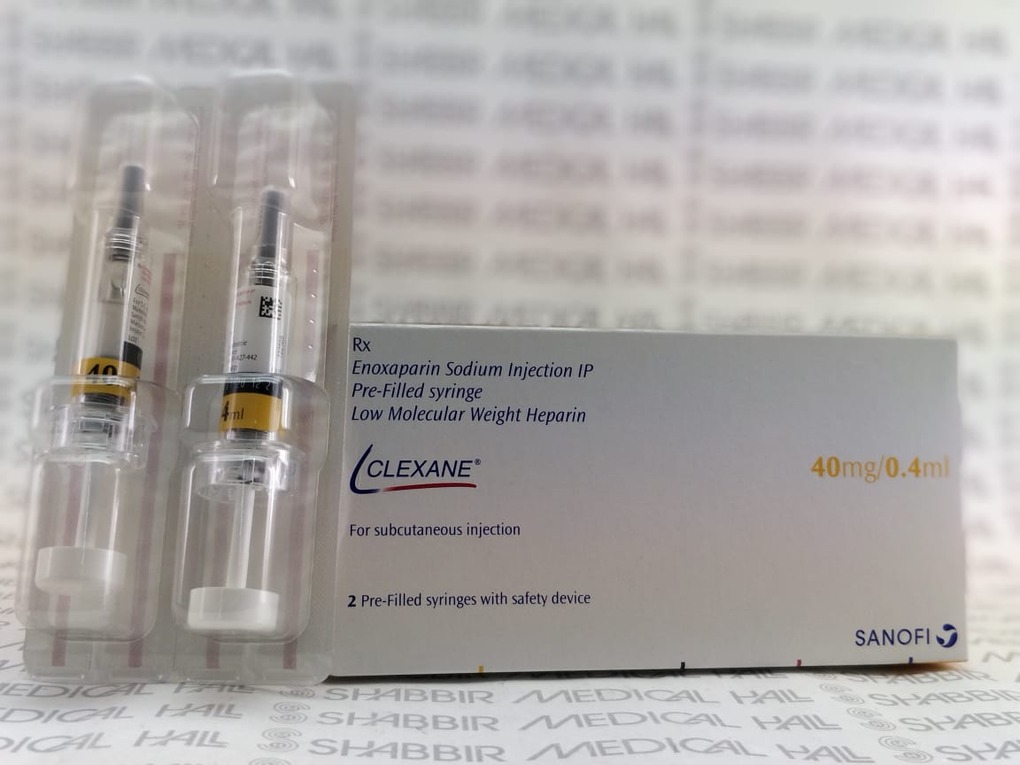


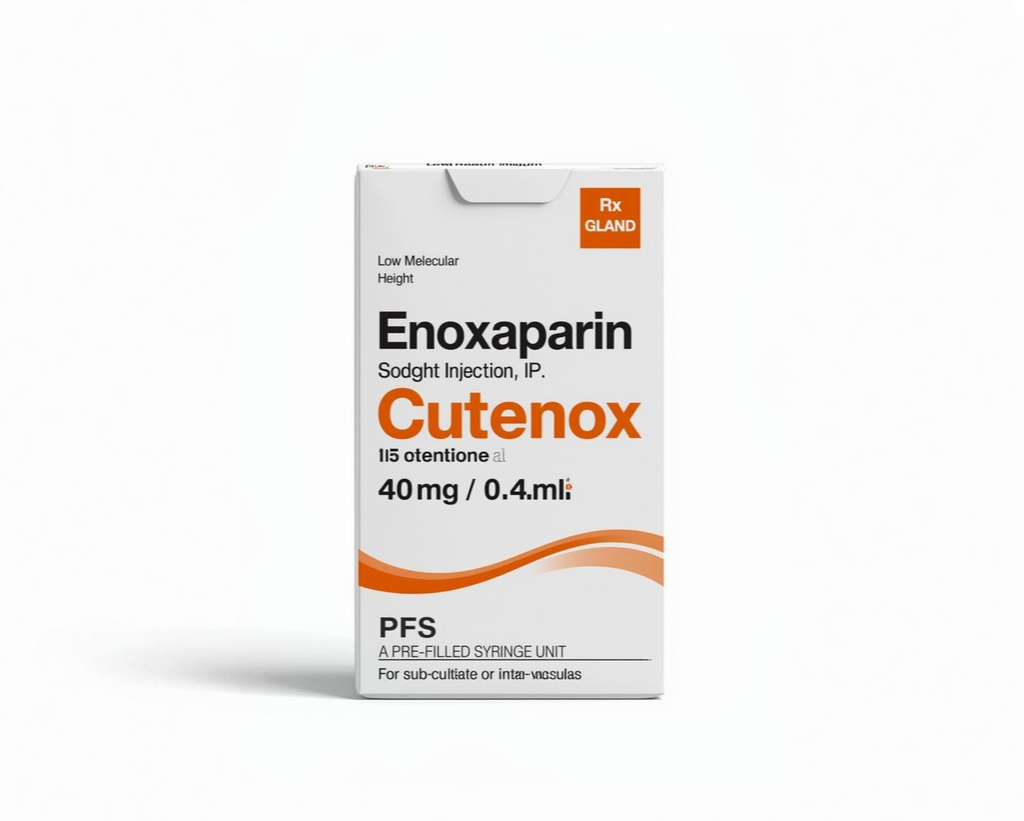
Cutenox 40mg Injection
 Item requires a valid prescription
Composition ENOXAPARIN 40MG
RS 433.35
MRP RS 481.50
(10% OFF)
Includes all taxes
Package SIZE
( Prefilled Syringe )

100% Authentic
Products

Free
Shipping*

Products
Return Policy
Description:
Cutenox 40mg Injection(Enoxaparin 40mg) is a Low Molecular Weight Heparin (LMWH) anticoagulant manufactured by Neon Laboratories Limited, indicated for the prevention and treatment of deep vein thrombosis (DVT), pulmonary embolism (PE), and thromboembolic complications in various clinical settings including surgery, prolonged immobilisation, and acute coronary syndromes (ACS). It works by inhibiting Factor Xa and thrombin (Factor IIa) in the coagulation cascade, thereby preventing blood clot formation. Available from Shabbir Medical Hall at the best price in India, this genuine prescription injection is available online with fast delivery nationwide.
BENEFITS: Cutenox 40mg provides predictable, dose-dependent anticoagulation with a favourable safety profile compared to unfractionated heparin. Enoxaparin's targeted Factor Xa inhibition delivers effective thrombo-prophylaxis with a lower risk of heparin-induced thrombocytopenia (HIT) and reduced need for routine aPTT monitoring. It is widely used in orthopaedic, abdominal, and general surgical prophylaxis, as well as medical patients with restricted mobility.
USAGE OVERVIEW: Cutenox 40mg Injection is administered subcutaneously (under the skin) into the abdominal wall. For DVT prophylaxis in surgical patients, the standard dose is 40mg (0.4 ml) once daily, initiated 2 hours before surgery or 12 hours before in high-risk orthopaedic procedures. Duration of therapy ranges from 7–10 days post-surgery to extended prophylaxis of up to 5 weeks in hip replacement. Dosage and duration are strictly determined by the treating physician/surgeon.
SAFETY OVERVIEW: The most common side effects include injection site reactions (bruising, pain, haematoma), bleeding, and thrombocytopenia. Serious haemorrhagic events, spinal/epidural haematomas (in patients receiving neuraxial anaesthesia), and hyperkalaemia have been reported. Regular platelet counts and monitoring for signs of bleeding are mandatory during therapy. This medicine requires a valid prescription.
Uses / Indications:
• Deep Vein Thrombosis (DVT) Prophylaxis: prevention of DVT in surgical patients (orthopaedic, abdominal, general surgery) and medically ill patients with reduced mobility
• Treatment of DVT: with or without symptomatic pulmonary embolism
• Unstable Angina / Non-ST-Elevation MI (NSTEMI / UA): in combination with aspirin
• Acute ST-Elevation Myocardial Infarction (STEMI): as adjunct to thrombolysis and primary PCI
ADDITIONAL USES:
• Prevention of clotting during haemodialysis (extracorporeal circulation)
• Thromboprophylaxis during pregnancy (off-label in some protocols under specialist guidance)
• Long-haul travel DVT prophylaxis in high-risk individuals (off-label)
Interactions / Warnings:
HAEMORRHAGIC RISK WARNING Enoxaparin significantly increases bleeding risk. Do NOT use in patients with active major bleeding, recent CNS surgery, or haemorrhagic stroke. Protamine sulphate can partially neutralise Enoxaparin (anti-Xa activity) in cases of serious overdose or haemorrhage.
SPINAL/EPIDURAL HAEMATOMA — CRITICAL BLACK BOX WARNING Epidural or spinal haematomas, including paralysis, have occurred in patients anticoagulated with LMWH/heparin during spinal/epidural anaesthesia or lumbar puncture. Risk is increased by use of indwelling epidural catheters, concurrent use of drugs affecting haemostasis (NSAIDs, platelet inhibitors), traumatic puncture, or prior spinal surgery. Monitor neurological function frequently; treat urgently if haematoma suspected.
RENAL IMPAIRMENT Enoxaparin is renally cleared — dose MUST be reduced in patients with CrCl < 30 ml/min (severe renal impairment). DVT prophylaxis dose: reduce to 20mg SC once daily; Treatment dose: reduce to 1 mg/kg SC once daily. Anti-Xa monitoring recommended in renal impairment, extremes of body weight, and pregnancy.
HEPATIC IMPAIRMENT Use with caution; no specific dose adjustment established but careful monitoring required.
HIT (HEPARIN-INDUCED THROMBOCYTOPENIA) Monitor platelet count before initiation, then regularly during therapy. If platelet count falls >50% or to <100,000/mm³ — DISCONTINUE immediately; investigate for HIT; switch to non-heparin anticoagulant.
DRIVING & MACHINERY No direct effect on driving ability, but dizziness/headache may occur in some patients.
ELDERLY USE (>=65 years) Increased bleeding risk — use with caution; renal function must be assessed; dose reduction may be required.
Pregnancy interaction:
• Enoxaparin does NOT cross the placenta — it is considered the anticoagulant of choice when anticoagulation is required during pregnancy (under specialist supervision).
• However, use requires careful benefit-risk assessment; maternal bleeding risk, especially around delivery, must be managed.
• Cutenox 40mg should ONLY be used during pregnancy under the supervision of a specialist physician (haematologist/obstetrician).
• Dosing and timing around delivery must be carefully planned — typically withheld 24 hours before planned delivery or epidural placement.
BREASTFEEDING:
• Enoxaparin is poorly absorbed orally and is not expected to reach clinically significant levels in breast milk. It is generally considered compatible with breastfeeding under physician guidance.
CONTRACEPTION WARNING:
• Not applicable for standard anticoagulation use; discuss reproductive planning with treating physician if long-term anticoagulation is required.
Expert advice:
1. CORRECT INJECTION TECHNIQUE IS CRITICAL:
• Cutenox 40mg must be injected subcutaneously into the abdominal wall — NOT into a vein or muscle. Administer while lying down. Pinch a fold of skin, insert needle fully at 90°, and inject slowly. Do NOT expel the small air bubble from the prefilled syringe before injection — it helps prevent leakage of the drug at the injection site. Do NOT rub the injection site after injection.
2. ROTATE INJECTION SITES:
• Always alternate between the left and right anterolateral or posterolateral abdominal wall. Rotating sites prevents cumulative bruising, haematoma formation, and subcutaneous tissue damage. Keep a simple injection diary noting site and time.
3. WATCH FOR BLEEDING SIGNS — KNOW YOUR EMERGENCY INDICATORS:
• The most dangerous risk of enoxaparin is haemorrhage. Educate patients and caregivers to immediately report: unusual bruising; bleeding from gums or nose that doesn't stop; blood in urine (pink/red/dark urine); black, tarry, or blood-stained stools; coughing up blood; sudden severe back pain or leg weakness (spinal haematoma — EMERGENCY). Report to treating physician IMMEDIATELY and do NOT administer next dose without medical advice.
4. NEVER INJECT IF SCHEDULED FOR SPINAL ANAESTHESIA OR LUMBAR PUNCTURE:
• If surgical or anaesthetic procedure involving spinal/epidural route is planned, the physician MUST be informed. The last dose of Cutenox must be administered at least 12 hours (prophylactic dose) or 24 hours (therapeutic dose) before spinal/epidural procedures. Early removal of epidural catheters should be timed at least 12 hours after last dose.
5. RENAL FUNCTION MUST BE ASSESSED BEFORE STARTING:
• Since Enoxaparin is renally cleared, patients with impaired kidney function — especially the elderly — are at significantly higher risk of drug accumulation and haemorrhage. A baseline serum creatinine and eGFR/CrCl must be checked. Dose reduction is mandatory for CrCl < 30 ml/min. Anti-Xa level monitoring may be required.
MONITORING ADVICE:
• Platelet count (CBC): Baseline before starting; then at days 3–5, then regularly thereafter — to detect HIT
• Anti-Xa levels: Recommended in renal impairment, extreme body weight (<45 kg or >100 kg), and pregnancy — to optimise dosing
• Serum potassium: Baseline; monitor regularly, especially in renal impairment and diabetics — risk of hyperkalaemia
• Renal function (eGFR/CrCl): Baseline and periodically, especially in elderly patients
• Signs of bleeding: Clinical assessment at every follow-up visit
• Neurological assessment: After neuraxial procedures — monitor for back pain, weakness, sensory deficits
COMPLIANCE TIPS:
• Set a daily phone alarm for consistent dosing time
• Store Cutenox at room temperature below 25°C — never freeze
• Do NOT use if the solution is discoloured or contains particles
• Carry your prescription and a list of all current medicines to every medical appointment
• If you are self-injecting at home, ensure proper sharps disposal container is available
• Do NOT share syringes — each prefilled syringe is for single use only
SAFETY TIPS:
• Inform ALL treating doctors (surgeon, anaesthesiologist, dentist, GP) that you are on Enoxaparin before any procedure
• Carry a Medical Alert Card or anticoagulation therapy card at all times
• Avoid over-the-counter NSAIDs (ibuprofen, aspirin beyond prescribed dose) without physician approval — these increase bleeding risk
• Do NOT stop Cutenox without your doctor's advice — premature discontinuation significantly increases clot risk
• If hospitalised for any reason, inform nursing staff immediately that you are on anticoagulant therapy
Side Effects:
• Injection site reactions: pain, bruising (ecchymosis), haematoma, erythema — most common
• Haemorrhage (bleeding): epistaxis (nosebleed), gum bleeding, haematuria (blood in urine)
• Thrombocytopenia (low platelet count) — monitor platelet count regularly
• Elevated liver enzymes (ALT, AST) — usually reversible on discontinuation
• Hyperkalaemia (high potassium) — especially in patients with renal impairment or diabetes
• Headache, nausea
SERIOUS SIDE EFFECTS (contact your doctor immediately):
• Major haemorrhage: GI bleeding (black/tarry stools, blood in vomit), intracranial haemorrhage (sudden severe headache, vision changes, weakness), haemoptysis — DISCONTINUE and seek urgent care
• Spinal/Epidural Haematoma: sudden severe back pain, leg weakness/numbness, bladder/bowel dysfunction — EMERGENCY in patients who received spinal anaesthesia; requires immediate neurosurgical intervention
• Heparin-Induced Thrombocytopenia (HIT): paradoxical thrombosis with falling platelet count — DISCONTINUE enoxaparin immediately
• Severe allergic/anaphylactic reaction: urticaria, angioedema, bronchospasm, hypotension — EMERGENCY
EMERGENCY SIGNS — SEEK IMMEDIATE MEDICAL HELP:
• Sudden weakness or numbness in legs, loss of bladder/bowel control (spinal haematoma)
• Coughing or vomiting blood, black/tarry stools (GI bleed)
• Severe, sudden headache with neurological symptoms (intracranial bleed)
How to use:
• DVT Prophylaxis (moderate surgical risk): 20mg SC once daily, initiated 2 hours pre-op; continue 7–10 days
• DVT Prophylaxis (high surgical/orthopaedic risk): 40mg SC once daily, initiated 12 hours pre-op; continue up to 5 weeks post hip replacement
• DVT Prophylaxis (medical patients): 40mg SC once daily for 6–14 days
• DVT Treatment (with/without PE): 1 mg/kg SC twice daily OR 1.5 mg/kg SC once daily
• Unstable Angina/NSTEMI: 1 mg/kg SC every 12 hours with aspirin, for minimum 2 days until stable (usually 2–8 days)
• STEMI: 30 mg IV bolus + 1 mg/kg SC followed by 1 mg/kg SC twice daily
ROUTE OF ADMINISTRATION:
• Subcutaneous injection into the abdominal wall (anterolateral or posterolateral)
• Administer in lying-down (supine) position
• Alternate injection sites — do NOT inject into same site repeatedly
INJECTION TECHNIQUE:
• Do not expel the air bubble from the prefilled syringe before injection
• Pinch a fold of skin between thumb and forefinger; insert needle at 45–90° angle
• Do not rub the injection site after administration — this causes bruising
MISSED DOSE:
• If a dose is missed, administer as soon as possible unless it is almost time for the next dose. Do NOT double up.
STORAGE:
• Store below 25°C; do not freeze
• Keep in original packaging to protect from light
• Keep out of reach of children
• Do not use after the expiry date printed on the label
How it works:
Blood clots form when the coagulation cascade activates thrombin (Factor IIa), which converts fibrinogen into fibrin. Enoxaparin works by:
• Binding to antithrombin III (ATIII) — a natural anticoagulant protein — and dramatically accelerating its activity
• Preferential inhibition of Factor Xa (anti-Xa activity ~100 IU/mg) — blocking the common pathway of clot formation
• Partial inhibition of thrombin (Factor IIa) — reducing fibrin generation
KEY ADVANTAGES OVER UNFRACTIONATED HEPARIN:
• More predictable pharmacokinetics — weight-based dosing without routine aPTT monitoring required for prophylaxis
• Higher bioavailability (~90%) after subcutaneous injection vs ~30% for UFH
• Longer half-life (~4.5 hours) — once or twice daily dosing
• Lower risk of Heparin-Induced Thrombocytopenia (HIT)
• Does not cross the placenta — safer option in pregnancy when indicated
Faq for medicine:
Cutenox 40mg contains Enoxaparin, a low molecular weight heparin used for DVT and PE prophylaxis, pulmonary embolism prevention, and management of acute coronary syndromes including NSTEMI and unstable angina. Cutenox provides predictable anticoagulation by selectively inhibiting Factor Xa, offering a reliable alternative to unfractionated heparin with once-daily dosing for most prophylactic indications.
2.How does Cutenox 40mg Enoxaparin work compared to unfractionated heparin?
Cutenox 40mg selectively inhibits Factor Xa with minimal thrombin activity, providing more predictable anticoagulation than unfractionated heparin. Unlike UFH, Cutenox has high subcutaneous bioavailability (~90%), a longer half-life, and does not require continuous IV infusion or routine aPTT monitoring. Cutenox also carries lower rates of heparin-induced thrombocytopenia compared to unfractionated heparin.
3.What is the risk of heparin-induced thrombocytopenia with Cutenox 40mg?
Cutenox 40mg carries a lower HIT risk than unfractionated heparin, with a reported incidence below 1%. However, HIT can still occur and should be suspected if platelet count falls by more than 50% or below 100,000/µL during therapy. If HIT is confirmed, Cutenox must be stopped immediately and replaced with a non-heparin anticoagulant such as Fondaparinux or Argatroban.
4.Is Cutenox 40mg safe to use during pregnancy for DVT prevention?
Cutenox 40mg is the anticoagulant of choice during pregnancy for DVT prevention and treatment, as Enoxaparin does not cross the placenta and poses no direct fetal risk. It is used safely throughout all three trimesters. Dose adjustments may be needed as pregnancy progresses. Cutenox should be stopped 24 hours before planned delivery or epidural placement to minimize epidural hematoma risk.
5.What injection technique is recommended for Cutenox 40mg administration?
Cutenox 40mg is injected subcutaneously in the anterolateral or posterolateral abdominal wall, rotating sites to reduce bruising. Hold the syringe vertically, pinch the skin into a fold, and insert the needle at 90 degrees. The air bubble in the Cutenox syringe should not be expelled before injection, as it helps clear residual drug. Avoid massaging the injection site after administration.
6.What precautions are needed when using Cutenox 40mg before spinal anesthesia?
Cutenox 40mg requires careful timing around neuraxial anesthesia to prevent spinal hematoma. The last prophylactic dose should be given at least 12 hours before needle placement; therapeutic doses require a 24-hour gap. Post-procedure, Cutenox should not resume for at least 4 hours after catheter placement and 6–8 hours after catheter removal. Back pain or neurological changes warrant urgent imaging.
Medicine interaction:
• Antiplatelet agents (aspirin, clopidogrel, prasugrel, ticagrelor): combined use increases bleeding risk — use with caution; often co-prescribed in ACS per protocol
• NSAIDs (ibuprofen, diclofenac, naproxen): increase bleeding risk — avoid concurrent use unless essential
• Other anticoagulants (warfarin, DOACs — rivaroxaban, apixaban, dabigatran): additive anticoagulant effect — avoid concurrent use unless transitioning therapy under specialist supervision
• Thrombolytics (streptokinase, alteplase): concurrent use in STEMI managed per protocol — heightened bleeding risk
• Dextran: additive antiplatelet effect — use with caution
• Systemic glucocorticoids: may mask signs of bleeding; also associated with thrombocytopenia risk
VACCINE INTERACTIONS:
• Consult physician regarding timing of vaccinations, particularly IM vaccines, during anticoagulant therapy — risk of haematoma at injection site
SUPPLEMENT INTERACTIONS:
• Fish oil / Omega-3 supplements: mild antiplatelet effect — inform physician
• Ginkgo biloba, garlic, ginger (high dose): may increase bleeding risk — inform physician
• Always inform your doctor of all medicines, vitamins, herbal products, and supplements
Available Substitutes