


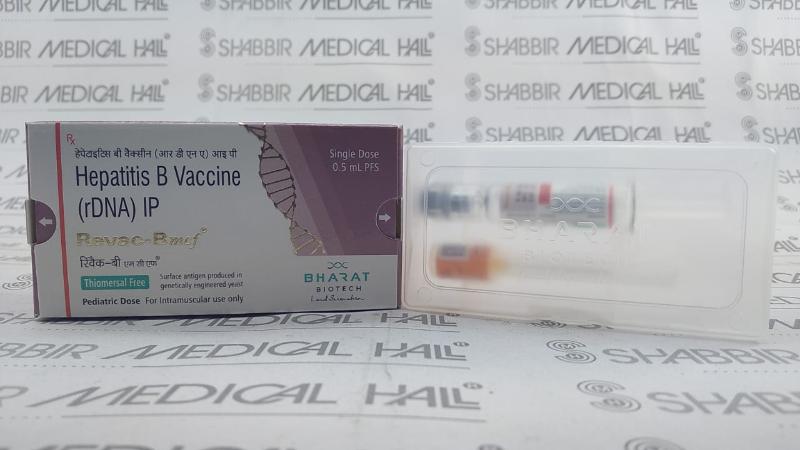
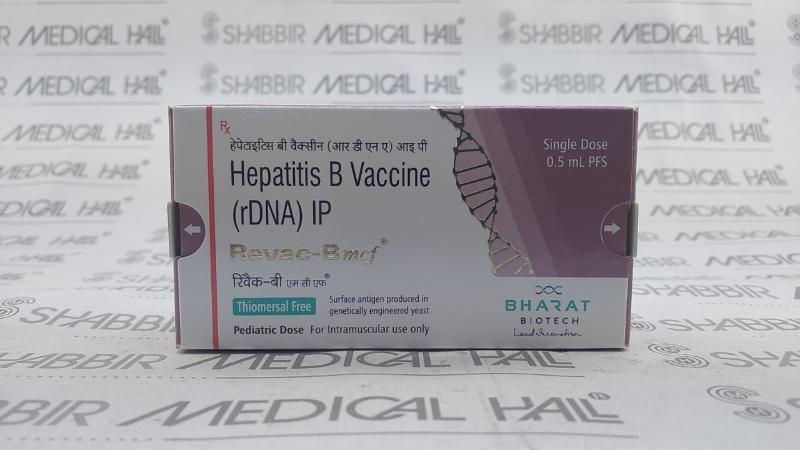
REVAC B MCF PFS VACCINE
 Item requires a valid prescription
Manufactured By Bharath Biotech
Composition Hepatitis B Vaccines
RS 531.43
MRP RS 664.29
(20% OFF)
Includes all taxes
Package SIZE
( PreFilled Syringe )

100% Authentic
Products

Free
Shipping*

Products
Return Policy
Description:
Revac B MCF PFS Vaccine is a recombinant Hepatitis B vaccine manufactured by Bharat Biotech International Limited, India's leading vaccine innovator. Each prefilled syringe contains 10 mcg of Hepatitis B surface antigen (HBsAg) adsorbed on aluminium hydroxide, specifically formulated for active immunisation against infection caused by all known subtypes of the Hepatitis B virus (HBV) in individuals of all age groups. Available from Shabbir Medical Hall at the best price in India, this genuine prescription vaccine is available online with fast delivery nationwide.
BENEFITS: Revac B MCF PFS Vaccine provides high-performance, long-lasting protection against Hepatitis B, a potentially life-threatening liver infection. It stimulates the body's immune system to produce protective anti-HBs antibodies, creating durable immunity against HBV. The vaccine is recommended by WHO, IAP, and global health organisations for universal immunisation of infants, children, adolescents, and adults, including healthcare workers and individuals at occupational or lifestyle risk of HBV exposure. The prefilled syringe format ensures accurate dosing, minimises contamination risk, and streamlines administration in clinical and field settings.
USAGE OVERVIEW: Revac B MCF PFS Vaccine is administered by intramuscular injection (preferably deltoid in adults; anterolateral thigh in infants). The standard adult schedule is three doses (0, 1, and 6 months). An accelerated four-dose schedule (0, 7, 21 days + 12-month booster) is available for rapid pre-exposure protection. Neonates receive the first dose within 24 hours of birth. Dosage, schedule, and site of injection are strictly as directed by the treating physician or immunisation provider.
SAFETY OVERVIEW: The most common side effects are injection site reactions (pain, redness, swelling) and mild systemic reactions (fever, fatigue, headache). Serious adverse events are rare. This vaccine is NOT for use if the patient has a known hypersensitivity to any vaccine component. Always consult your doctor before administration.
Uses / Indications:
• Active immunisation against Hepatitis B virus (HBV) infection in all age groups (infants, children, adolescents, adults)
• Universal infant immunisation as part of the National Immunisation Schedule (birth dose + EPI schedule)
• Pre-exposure prophylaxis in high-risk groups: healthcare workers, laboratory personnel, patients on haemodialysis, individuals with multiple sexual partners, travellers to HBV-endemic areas
• Post-exposure prophylaxis (in combination with Hepatitis B Immunoglobulin / HBIG)
ADDITIONAL USES:
• Neonates born to HBsAg-positive mothers (always combined with HBIG)
• Catch-up vaccination for unvaccinated older children and adults
• Institutional vaccination programmes: healthcare facilities, schools, defence personnel
Interactions / Warnings:
CONTRAINDICATIONS: Known hypersensitivity to any component of the vaccine (including yeast proteins). Severe febrile illness — defer vaccination until recovery.
FAINTING (SYNCOPE): Vasovagal reactions (fainting) can occur post-injection — recipients should be observed for 15 minutes after administration. Facilities for managing anaphylaxis must be immediately available.
PREMATURE INFANTS: Vaccination should not be delayed based on gestational age; administer at chronological age per schedule. May exhibit reduced immune response — anti-HBs titres should be checked.
HEPATIC / RENAL IMPAIRMENT: No dose adjustment required; consult physician in severe cases.
ELDERLY USE (≥65 years): Immunogenicity may be reduced; anti-HBs monitoring recommended post-vaccination.
COLD CHAIN INTEGRITY: NEVER use vaccine that has been frozen — freezing destroys the aluminium adjuvant structure and reduces immunogenicity. Always verify cold-chain compliance before use.
Pregnancy interaction:
• Animal reproductive studies do not indicate direct or indirect harmful effects.
• Hepatitis B vaccination during pregnancy is recommended by WHO when the benefit outweighs risk (e.g., high-risk healthcare workers, endemic areas).
• Consult your obstetrician before vaccination during pregnancy.
BREASTFEEDING:
• No known harmful effects. Vaccination of breastfeeding mothers is considered safe.
• Consult your doctor for individual assessment.
FERTILITY:
• No evidence of impairment of fertility.
Expert advice:
• 1. NEVER FREEZE THE VACCINE: Revac B MCF PFS must be stored between 2°C and 8°C. Freezing irreversibly destroys the aluminium adjuvant, rendering the vaccine ineffective — even if it appears normal after thawing. Always verify cold-chain integrity on receipt.
• 2. COMPLETE THE FULL SCHEDULE: A single dose provides partial protection only. The standard 3-dose series (0, 1, 6 months) is essential for achieving seroprotective anti-HBs titres (≥10 mIU/mL) in >95% of healthy recipients. Do not stop after 1 or 2 doses.
• 3. VERIFY SEROPROTECTION IN HIGH-RISK GROUPS: Healthcare workers, haemodialysis patients, and immunocompromised individuals should have anti-HBs titres tested 1–2 months after completing the primary series. Non-responders (titres <10 mIU/mL) may require a repeat series or higher-dose formulation.
• 4. OBSERVE FOR 15 MINUTES POST-INJECTION: Vasovagal reactions (dizziness, fainting) can occur. Advise recipients to remain seated or lying down for 15 minutes after vaccination. Ensure resuscitation equipment is available at the vaccination site.
• 5. CORRECT INJECTION TECHNIQUE: Administer by intramuscular injection ONLY — deltoid for adults, anterolateral thigh for infants. Subcutaneous or intradermal injection significantly reduces immunogenicity and should never be used as a substitute.
MONITORING ADVICE:
• Anti-HBs titre (1–2 months post-series): Routine in healthcare workers and dialysis patients
• HBsAg / HBeAg status: Neonates born to HBsAg-positive mothers should be tested at 9–18 months
• Booster doses: Not routinely recommended for immunocompetent individuals; monitor titre in high-risk groups
COMPLIANCE TIPS:
• Maintain a vaccination record card for all doses received
• Note batch number and expiry for pharmacovigilance
• Set calendar reminders for dose 2 (1 month) and dose 3 (6 months)
• If dose 2 or 3 is overdue, do NOT restart the series — continue from where you left off
SAFETY TIPS:
• Inform the vaccinating doctor of any history of egg or yeast allergy
• Inform all treating doctors that you have received / are receiving Hepatitis B vaccine
• Women who are pregnant or breastfeeding should discuss risk-benefit with their obstetrician before vaccination
• Do NOT use a syringe that has been dropped, damaged, or whose integrity is in doubt
Side Effects:
• Injection site pain, redness, swelling, and induration
• Mild fever (≤38.5°C), fatigue, headache
• Myalgia (muscle ache), malaise
• Nausea, dizziness (mild and transient)
LESS COMMON SIDE EFFECTS (1 in 10 to 1 in 100 people):
• Moderate injection site reactions (haematoma, pruritus)
• Arthralgia (joint pain)
• Upper respiratory tract symptoms
• Lymphadenopathy (enlarged lymph nodes, rare)
SERIOUS SIDE EFFECTS (rare — contact your doctor immediately):
• Anaphylaxis / severe allergic reaction: urticaria, angioedema, bronchospasm, hypotension — DISCONTINUE and seek emergency care
• High fever (>39°C with convulsions in children): report to physician immediately
• Neurological reactions (extremely rare): paraesthesia, encephalitis
EMERGENCY SIGNS — SEEK IMMEDIATE MEDICAL HELP:
• Difficulty breathing, wheezing, throat tightness
• Swelling of face, lips, tongue
• Sudden drop in blood pressure / fainting shortly after injection
How to use:
ADULT & ADOLESCENT SCHEDULE (>15 years):
• Standard: 10 mcg (0.5 mL) at 0, 1, and 6 months — 3 doses total
• Accelerated: 10 mcg at 0, 7, 21 days + booster at 12 months
INFANT & CHILDREN SCHEDULE (0–14 years):
• Birth dose within 24 hours of birth (especially if mother is HBsAg-positive)
• EPI schedule: birth, 6 weeks, 10 weeks, 14 weeks (combined with pentavalent vaccine)
ROUTE OF ADMINISTRATION:
• Intramuscular (IM) injection ONLY
• Adults & older children: deltoid muscle
• Infants & young children: anterolateral thigh
• NEVER administer intravenously or intradermally
PRE-ADMINISTRATION:
• Inspect for particulates or discolouration — do not use if present
• Shake well before use; homogeneous suspension expected
• Use immediately after opening
MISSED DOSE:
• Do not restart the series; complete the remaining doses as scheduled
• Contact your doctor for guidance on revised timing
STORAGE:
• Store between 2°C and 8°C (refrigerator); do NOT freeze
• Protect from light; keep in original carton
• Keep out of reach of children
• Do not use after expiry date printed on label
How it works:
Revac B MCF PFS Vaccine contains recombinant Hepatitis B surface antigen (HBsAg) produced by yeast cells (Saccharomyces cerevisiae) using recombinant DNA technology.
Upon intramuscular injection:
• The HBsAg antigen is recognised by the immune system as a foreign protein
• B-lymphocytes are activated and differentiate into plasma cells, producing anti-HBs antibodies
• Memory B-cells and T-cells are generated, providing long-term immunological memory
• Anti-HBs titres ≥10 mIU/mL are considered seroprotective
The vaccine does NOT contain live virus and CANNOT cause Hepatitis B infection.
KEY ADVANTAGES:
• Protects against all known subtypes of HBV (adw, ayw, adr, ayr)
• Seroconversion rates >95% in healthy individuals on standard schedule
• Long-duration immunity (>20 years documented in responders)
• Prefilled syringe (PFS) format: accurate dosing, needle-stick safety, no reconstitution required
Faq for medicine:
Revac-B MCF PFS is a recombinant Hepatitis B surface antigen vaccine used to immunize individuals against Hepatitis B virus infection. It is indicated for unvaccinated adults, adolescents, children, healthcare workers, dialysis patients, travelers to endemic regions, and household contacts of HBV-infected individuals. Revac-B MCF stimulates anti-HBs antibody production, providing active immunity against HBV.
2.What is the vaccination schedule for Revac-B MCF PFS in adults?
The standard 3-dose Revac-B MCF PFS schedule follows a 0, 1, and 6-month plan. An accelerated 0, 1, 2-month schedule with a booster at 12 months is used when rapid protection is needed. For dialysis patients and immunocompromised individuals, a higher antigen dose schedule may be required. Anti-HBs titer testing 1–2 months after the last dose confirms adequate seroprotection.
3.What is the minimum protective anti-HBs level after Revac-B MCF PFS vaccination?
A post-vaccination anti-HBs level of ≥10 mIU/mL is considered protective after Revac-B MCF PFS immunization. Levels below this threshold indicate non-response, particularly in obese patients, heavy smokers, immunocompromised individuals, and those over 40 years. Non-responders may receive a repeat 3-dose Revac-B MCF series. Persistent non-responders should be screened for active HBV infection.
4.What are the common side effects of Revac-B MCF PFS injection?
Common side effects of Revac-B MCF PFS include local injection site reactions such as pain, redness, and swelling, typically mild and resolving within 1–3 days. Systemic reactions like low-grade fever, headache, and fatigue can also occur. Serious allergic reactions including anaphylaxis are rare but require post-injection observation for at least 15 minutes. Revac-B MCF is well tolerated across all age groups.
5.Can Revac-B MCF PFS vaccine be given to people who are already HBV-infected?
Revac-B MCF PFS vaccine is ineffective and not recommended for individuals already chronically infected with Hepatitis B. Serological testing for HBsAg, anti-HBc, and anti-HBs before vaccination is recommended in high-risk individuals to avoid unnecessary vaccination. Chronically infected individuals require antiviral treatment, not HBV vaccination with Revac-B MCF, as the vaccine does not treat existing infection.
6.Is booster vaccination with Revac-B MCF PFS required after primary immunization?
In immunocompetent individuals who achieve a protective anti-HBs response after primary Revac-B MCF PFS vaccination, routine boosters are not generally recommended, as immunity typically persists for 20+ years. However, dialysis patients and transplant recipients should have periodic anti-HBs titer checks and may require booster doses if levels fall below 10 mIU/mL.
Medicine interaction:
• Immunosuppressants (corticosteroids, chemotherapy, biologics): may reduce vaccine immunogenicity — check anti-HBs titres post-vaccination; revaccination may be needed
CONCURRENT VACCINATION:
• Can be co-administered with other EPI vaccines (DTP, OPV, Hib, MMR) at separate injection sites using separate syringes
• Co-administration with Hepatitis B Immunoglobulin (HBIG): use separate sites; does not impair seroconversion
HAEMODIALYSIS PATIENTS:
• May require higher doses (20–40 mcg) or additional booster doses; anti-HBs monitoring essential
SUPPLEMENT INTERACTIONS:
• No known significant interactions with vitamins or dietary supplements