


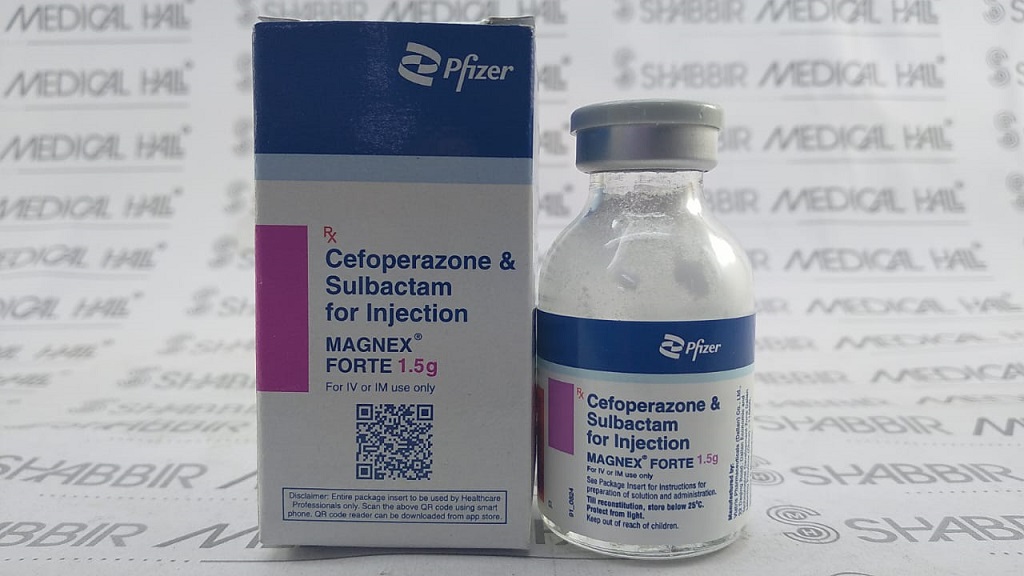
Magnex Forte 1 5g Injection
 Item requires a valid prescription
Manufactured By Pfizer Limited
Composition Sulbactam 0 5 G Cefoperazone 1 G
RS 817.61
MRP RS 908.46
(10% OFF)
Includes all taxes
Package SIZE
( 1 Injection )

100% Authentic
Products

Free
Shipping*

Products
Return Policy
Description:
Magnex Forte 1.5g Injection (Cefoperazone 1g + Sulbactam 0.5g) is a powerful combination antibiotic manufactured by Pfizer Limited, combining a third-generation cephalosporin with a beta-lactamase inhibitor to deliver broad-spectrum bactericidal activity against a wide range of Gram-positive and Gram-negative bacteria. It is a hospital-grade prescription injection used for moderate-to-severe bacterial infections across multiple organ systems. Available from Shabbir Medical Hall at the best price in India, this genuine Pfizer product is available online with fast delivery and valid prescription requirement.
BENEFITS: Magnex Forte 1.5g combines two complementary mechanisms. Cefoperazone disrupts bacterial cell wall synthesis by inhibiting penicillin-binding proteins (PBPs), causing bacterial lysis and death. Sulbactam, a beta-lactamase inhibitor, protects Cefoperazone from enzymatic degradation by beta-lactamase-producing resistant organisms, dramatically extending the antibacterial spectrum to include many strains that would otherwise be resistant to Cefoperazone alone. This synergistic combination is effective against Staphylococci, Enterobacteriaceae, Pseudomonas aeruginosa, Bacteroides fragilis, and other clinically important pathogens, making it one of the most versatile injectable antibiotics in Indian hospital practice.
USAGE OVERVIEW: Magnex Forte 1.5g is administered intravenously (IV) or intramuscularly (IM) by trained healthcare professionals in a clinical or hospital setting. The dose, frequency, and duration are determined by the treating physician based on the site and severity of infection, renal and hepatic function, and culture-sensitivity results. Complete the full prescribed course even if symptoms improve earlier.
SAFETY OVERVIEW: Most common side effects include mild diarrhoea, injection site reactions, and transient liver enzyme elevations. Serious risks include hypersensitivity reactions (anaphylaxis), antibiotic-associated colitis (C. difficile), and nephrotoxicity when combined with aminoglycosides. Avoid alcohol during and for 72 hours after therapy due to disulfiram-like reaction risk.
Uses / Indications:
- Urinary Tract Infections (UTIs): complicated UTIs caused by E. coli, Klebsiella, Proteus, Pseudomonas
- Respiratory Tract Infections: pneumonia, lung abscess, bronchopneumonia, hospital-acquired pneumonia
- Skin & Soft Tissue Infections: cellulitis, wound infections, diabetic foot infections
- Intra-Abdominal Infections: peritonitis, biliary tract infections (cholangitis, cholecystitis)
- Pelvic Inflammatory Disease (PID) & Gynaecological Infections: endometritis, pelvic abscess
- Bone & Joint Infections: osteomyelitis, septic arthritis
- Surgical Prophylaxis: peri-operative infection prevention in abdominal, gynaecological, and orthopaedic surgery
- Septicaemia / Bacteraemia: bloodstream infections requiring broad-spectrum IV coverage
ADDITIONAL USES:
- Meningitis (adjunct therapy in selected cases)
- Infections in immunocompromised patients (neutropenic fever — off-label)
Interactions / Warnings:
HYPERSENSITIVITY / ALLERGY WARNING: Do NOT use in patients with known allergy to Cefoperazone, any cephalosporin, or penicillin-class antibiotics. Cross-reactivity between cephalosporins and penicillins occurs in 1–2% of patients. Always screen for beta-lactam allergy history before initiating therapy. Emergency resuscitation equipment must be available during first dose administration.
HEPATIC / BILIARY WARNING: Cefoperazone is primarily excreted via bile. Patients with severe hepatic disease or biliary obstruction require dose reduction and close monitoring. Do not use in active jaundice without specialist guidance.
ANTIBIOTIC RESISTANCE: Always use based on culture & sensitivity reports where possible. Empirical use should follow local hospital antibiogram guidelines to preserve efficacy.
RENAL IMPAIRMENT: Sulbactam is renally cleared; dose adjustment is mandatory in renal impairment (see Dosage Sheet).
ELDERLY USE (>=65 years): Increased risk of nephrotoxicity and Clostridium difficile colitis. Monitor renal function and bowel habits closely.
DRIVING & MACHINERY: May cause dizziness. Assess individual response before driving or operating machinery.
PROLONGED USE: Risk of superinfection (fungal overgrowth, C. difficile colitis) with extended courses. Monitor for oral thrush, vaginal candidiasis, and diarrhoea.
Pregnancy interaction:
- Cefoperazone-Sulbactam crosses the placental barrier. Safety in human pregnancy has not been fully established through controlled trials.
- Should only be used during pregnancy when the benefit clearly outweighs the potential risk, and only under direct specialist supervision.
- Animal reproductive studies have not demonstrated direct foetal harm, but adequate human data is limited.
- Inform your doctor immediately if you are pregnant or planning to become pregnant.
BREASTFEEDING:
- Low levels of Cefoperazone are excreted in human breast milk.
- Use with caution in breastfeeding mothers; monitor the infant for diarrhoea, candidiasis, or allergic symptoms.
- Consider temporary interruption of breastfeeding during treatment if clinically feasible.
DOCTOR CONSULTATION WARNING:
- Never self-administer or stop a prescribed antibiotic course early. Incomplete courses promote antibiotic resistance and can lead to treatment failure or relapse.
Expert advice:
- 1. ABSOLUTE ALCOHOL BAN DURING THERAPY: Magnex Forte 1.5g contains Cefoperazone, which causes a dangerous disulfiram-like reaction when alcohol is consumed. This means NO alcohol in any form — beer, wine, spirits, or alcohol-containing mouthwash/cough syrups — during treatment AND for at least 72 hours (3 full days) after the last injection. Failure to observe this can cause severe flushing, vomiting, hypotension, and cardiac symptoms.
- 2. HOSPITAL-ONLY ADMINISTRATION: Magnex Forte 1.5g must be reconstituted and administered by trained medical or nursing staff only. Incorrect reconstitution, incompatible diluents, or co-administration with aminoglycosides in the same IV line can cause serious adverse outcomes.
- 3. COMPLETE THE FULL COURSE: Never stop the antibiotic course early because symptoms improve. Premature discontinuation allows surviving bacteria to rebound and develop resistance, leading to treatment failure and harder-to-treat secondary infections.
- 4. MONITOR FOR DIARRHOEA — C. DIFFICILE RISK: Diarrhoea during or after broad-spectrum antibiotic therapy may indicate Clostridium difficile infection. Severe, persistent, or bloody diarrhoea must be reported to the treating doctor immediately — do NOT self-treat with anti-diarrhoeal agents without medical advice.
- 5. MONITOR BLEEDING RISK: Cefoperazone can interfere with vitamin K metabolism and clotting factor synthesis, especially in malnourished or elderly patients or those on anticoagulants. Watch for unusual bruising, prolonged wound bleeding, or blood in urine/stools and report promptly.
MONITORING ADVICE:
- Renal function (serum creatinine, BUN, eGFR): Baseline and every 2–3 days during therapy, especially if concurrent aminoglycoside use or pre-existing renal impairment
- Liver function tests (ALT, AST, bilirubin, ALP): Baseline; repeat if treatment exceeds 7–10 days
- CBC with differential: Monitor for neutropenia, eosinophilia, and anaemia — especially with prolonged courses
- Coagulation profile (PT/INR): Essential in patients on warfarin, malnourished patients, or those receiving prolonged courses; consider prophylactic Vitamin K
- Culture & Sensitivity: Obtain specimens (blood, urine, sputum, wound swab) before first dose whenever possible; de-escalate therapy based on results
- Bowel pattern monitoring: Daily assessment for diarrhoea — severity, frequency, character
COMPLIANCE TIPS:
- Ensure cold chain integrity during transport — store vials at room temperature, away from heat
- Keep prescription and medication documentation with patient records
- Ensure adequate hydration during therapy to support renal clearance of Sulbactam
- Maintain a treatment log: date, dose, route, batch number of each injection
SAFETY TIPS:
- Screen all patients for penicillin/cephalosporin allergy history before first dose
- Have emergency anaphylaxis kit (adrenaline, antihistamine, corticosteroid) available during first dose
- Rotate IV insertion sites every 72–96 hours to prevent thrombophlebitis
- If IM route is used, mix with 0.5% lidocaine to minimise injection pain — confirm no lidocaine allergy first
- Inform dentists, surgeons, and all other healthcare providers of current antibiotic therapy
- If diarrhoea worsens or blood appears in stool, send stool sample for C. difficile toxin testing before any anti-motility treatment
Side Effects:
- Diarrhoea (most common; may be managed with probiotics and adequate hydration)
- Injection site reactions: pain, redness, phlebitis at IV site; induration at IM site
- Transient elevation of liver enzymes: SGOT (AST), SGPT (ALT), alkaline phosphatase
- Eosinophilia (elevated eosinophil count on CBC)
- Nausea and vomiting
- Reversible neutropenia (with prolonged therapy)
- Positive direct Coombs test (haemolytic anaemia, rare)
- Reduced haematocrit / mild anaemia
SERIOUS SIDE EFFECTS (contact your doctor immediately):
- Hypersensitivity / Anaphylaxis: rash, urticaria, swelling of face/lips/throat, difficulty breathing — life-threatening
- C. difficile-associated diarrhoea (CDAD) / Pseudomembranous Colitis: severe, watery or bloody diarrhoea — stop antibiotic immediately
- Hepatotoxicity: jaundice, severe abdominal pain, dark urine — rare but serious
- Nephrotoxicity: especially with concurrent aminoglycoside use — monitor renal function
- Disulfiram-like reaction with alcohol: severe flushing, vomiting, hypotension, tachycardia
- Coagulopathy / Bleeding: Hypoprothrombinemia due to vitamin K interference (especially with poor nutrition)
EMERGENCY SIGNS — SEEK IMMEDIATE MEDICAL HELP:
- Sudden shortness of breath, wheezing, or severe skin rash after injection
- Severe or bloody diarrhoea during or after antibiotic course
- Jaundice (yellowing of skin or eyes), dark urine, severe upper abdominal pain
- Unusual bruising or prolonged bleeding
How to use:
- Mild to Moderate Infections: 1.5g (Cefoperazone 1g + Sulbactam 0.5g) every 12 hours IV/IM
- Severe or Life-Threatening Infections: 3g (double vial) every 12 hours IV, up to 4g every 12 hours
- Maximum Daily Dose: 8g Sulbactam component (i.e. total daily Sulbactam not to exceed 4g)
- Surgical Prophylaxis: Single 1.5g IV dose 30–60 minutes before incision
RENAL DOSE ADJUSTMENT:
- CrCl 15–30 mL/min: Maximum 1g Sulbactam/day (i.e. 3g Magnex Forte/day)
- CrCl <15 mL/min: Maximum 0.5g Sulbactam/day; specialist supervision required
- Haemodialysis: Give dose after dialysis session
HEPATIC IMPAIRMENT:
- Dose reduction required in severe hepatic disease or combined hepatic + renal impairment
ROUTE OF ADMINISTRATION:
- Intravenous (IV) bolus: over 3–5 minutes, or IV infusion over 15–60 minutes
- Intramuscular (IM): reconstituted with lidocaine 0.5% to reduce injection pain — thigh or gluteal
- HOSPITAL/CLINIC USE ONLY — must be prepared and administered by trained medical staff
RECONSTITUTION & STORAGE:
- Reconstitute with compatible diluent (Normal Saline, 5% Dextrose, or Sterile Water for Injection)
- Use immediately after reconstitution or within 24 hours if refrigerated (2°C–8°C)
- Do NOT freeze reconstituted solution
- Store dry vials at room temperature (below 25°C), away from light and moisture
- Keep out of reach of children
How it works:
- Binds to penicillin-binding proteins (PBPs) in the bacterial cell wall
- Inhibits transpeptidation — the final cross-linking step of peptidoglycan synthesis
- Causes cell wall instability → bacterial lysis and death
- Active against a wide range of Gram-positive cocci (Staph, Strep) and Gram-negative rods (E. coli, Klebsiella, Pseudomonas, Haemophilus, Enterobacter)
SULBACTAM (0.5g) — Beta-Lactamase Inhibitor:
- Irreversibly inhibits class II, III, IV, and V beta-lactamase enzymes produced by resistant bacteria
- Protects Cefoperazone from enzymatic destruction, restoring activity against beta-lactamase-producing strains
- Has intrinsic antibacterial activity against Acinetobacter baumannii (important in nosocomial infections)
COMBINED EFFECT:
- Dramatically extended spectrum vs Cefoperazone alone
- Active against Bacteroides fragilis (major anaerobe in abdominal infections)
- Clinically effective against many ESBL-producing organisms
- Bactericidal — kills bacteria rather than merely inhibiting growth
Faq for medicine:
1.What is Magnex Forte 1.5g Ampicillin/Sulbactam used for?
Magnex Forte 1.5g contains Ampicillin 1g and Sulbactam 0.5g, a beta-lactam/beta-lactamase inhibitor combination used for intra-abdominal infections, pelvic inflammatory disease, pneumonia, skin and soft tissue infections, and UTIs. Sulbactam also has direct activity against Acinetobacter baumannii, making Magnex Forte particularly useful in some nosocomial Acinetobacter infections.
2.How does Magnex Forte 1.5g compare to Amoxicillin-Clavulanate?
Magnex Forte 1.5g is the parenteral equivalent of oral Amoxicillin-Clavulanate, offering similar broad-spectrum coverage against beta-lactamase-producing organisms. Both cover common Gram-positive, Gram-negative, and anaerobic bacteria. Magnex Forte is used when IV administration is required due to infection severity, inability to take oral medication, or when higher systemic drug concentrations are clinically needed.
3.What is the dosing frequency for Magnex Forte 1.5g in adults?
Magnex Forte 1.5g is typically administered every 6–8 hours by IV infusion or IM injection in adults. For severe infections, doses up to 3g may be given every 6 hours. Treatment duration varies from 5 to 14 days based on infection type and clinical response. Renal dose adjustment is required when CrCl falls below 30mL/min to prevent Ampicillin accumulation and toxicity.
4.Can Magnex Forte 1.5g be used for Acinetobacter baumannii infections?
Magnex Forte 1.5g has specific activity against some Acinetobacter baumannii strains due to Sulbactam's direct inhibition of Acinetobacter enzymes. High-dose Sulbactam is used in MDR and XDR Acinetobacter infections, often combined with Colistin or Tigecycline. Magnex Forte remains an option for carbapenem-sparing strategies in Acinetobacter infections under infectious disease specialist oversight.
5.What are the key contraindications for Magnex Forte 1.5g?
Magnex Forte 1.5g is contraindicated in patients with documented severe hypersensitivity to penicillins or other beta-lactam antibiotics. In patients with mononucleosis (Epstein-Barr virus infection), Ampicillin causes a characteristic maculopapular rash and Magnex Forte should be avoided. Cross-reactivity with cephalosporins is low but must be assessed in patients with any documented beta-lactam allergy.
6.Is Magnex Forte 1.5g effective against ESBL-producing organisms?
Magnex Forte 1.5g has limited activity against ESBL-producing organisms. Sulbactam inhibits some but not all ESBL enzymes, and clinical failure with ESBL-producing Enterobacteriaceae is common. For confirmed ESBL infections, carbapenems, Ceftazidime-Avibactam, or Ceftolozane-Tazobactam are more appropriate. Magnex Forte is not recommended as monotherapy for bacteremia from ESBL-producing bacteria.
Medicine interaction:
- Alcohol: STRICT CONTRAINDICATION — causes severe disulfiram-like reaction (flushing, vomiting, hypotension, chest pain). Avoid alcohol during treatment AND for at least 72 hours after the last dose.
- Aminoglycosides (Amikacin, Gentamicin, Tobramycin): Additive nephrotoxicity and ototoxicity risk. Do NOT mix in the same IV line. Monitor renal function and drug levels closely.
- Anticoagulants (Warfarin, Heparin): Cefoperazone may enhance anticoagulant effect by reducing vitamin K-dependent clotting factor synthesis. Monitor INR/PT closely.
- Probenecid: May increase plasma concentration of Cefoperazone; monitor for increased side effects.
- Tetracyclines: Possible pharmacodynamic antagonism (bacteriostatic vs bactericidal); avoid concurrent use.
- Allopurinol: Increased risk of skin rash with concurrent use.
- NSAIDs: Increased risk of bleeding due to additive antiplatelet effects.
INCOMPATIBILITIES (IV line):
- Do not mix with Aminoglycosides, Metronidazole (undiluted), Labetalol, or Promethazine in the same syringe/infusion line.
VACCINE INTERACTIONS:
- No specific vaccine interactions documented for Magnex Forte 1.5g; consult your doctor before any vaccination during antibiotic therapy.
SUPPLEMENT INTERACTIONS:
- Vitamin K: Patients on inadequate nutrition may need vitamin K supplementation to prevent hypoprothrombinemia.
- Always inform your doctor and pharmacist of all medications, vitamins, and herbal products.