


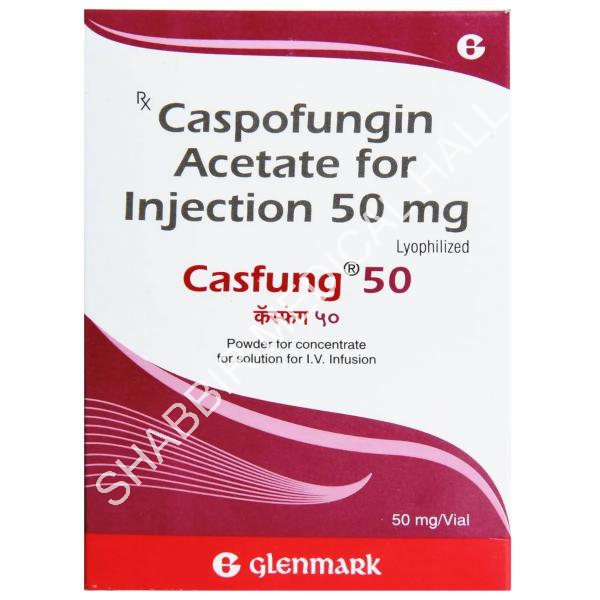
CASFUNG 50 INJECTION
 Item requires a valid prescription
Manufactured By Glenmark
Composition Caspofungin Acetate 50mg
RS 3065.30
MRP RS 4379.00
(30% OFF)
Includes all taxes
Package SIZE
( Vial )

100% Authentic
Products

Free
Shipping*

Products
Return Policy
Description:
Casfung 50 Injection(Caspofungin Acetate 50mg) is a prescription-only echinocandin antifungal manufactured by Glenmark Pharmaceuticals Ltd, indicated for the treatment of serious, life-threatening invasive fungal infections including invasive candidiasis (candidaemia and deep-tissue Candida infections) and invasive aspergillosis in adult patients who are refractory to or intolerant of other antifungal therapies. It is a critical medicine in hospital and intensive care settings where aggressive fungal infections must be controlled rapidly. Available from Shabbir Medical Hall at the best price in India, this genuine prescription vial is available online with fast, temperature-controlled delivery.
BENEFITS: Casfung 50 (Caspofungin) works by non-competitively inhibiting beta-(1,3)-D-glucan synthase, an enzyme essential for synthesising beta-glucan — a critical structural component of the fungal cell wall absent in human cells. This targeted mechanism selectively destroys the fungal cell wall, causing osmotic instability, cell lysis, and death of the fungal organism, while minimising toxicity to human cells. The result is rapid, broad-spectrum antifungal activity against Candida species (including azole-resistant strains) and Aspergillus species.
USAGE OVERVIEW: Casfung 50 Injection is administered exclusively as a slow intravenous (IV) infusion over approximately one hour, strictly in a hospital or clinical setting under the supervision of an infectious disease specialist or intensivist. A loading dose of 70mg is given on Day 1, followed by 50mg once daily thereafter. Duration is guided by clinical response. It must NEVER be given as an IV bolus injection.
SAFETY OVERVIEW: Common side effects include fever, nausea, phlebitis at the infusion site, and elevated liver enzymes. Rare but serious effects include hepatotoxicity and anaphylactic reactions. Patients with pre-existing liver disease require close monitoring. Inform your doctor of all current medications, particularly cyclosporine and tacrolimus, before commencing therapy.
Uses / Indications:
• Invasive Candidiasis: candidaemia and deep-tissue Candida infections (peritonitis, pleural infections)
• Invasive Aspergillosis: salvage therapy in patients refractory to or intolerant of amphotericin B or itraconazole
• Empirical Antifungal Therapy: in febrile neutropenic adult patients with suspected fungal infections
• Oesophageal Candidiasis: in patients intolerant of other therapies
ADDITIONAL USES (off-label / specialist-guided):
• Combination antifungal therapy in severe or refractory aspergillosis
• Antifungal prophylaxis in high-risk immunocompromised patients
• Candida infections in patients post solid-organ transplant
Interactions / Warnings:
HEPATOTOXICITY WARNING:
- Monitor liver function tests (LFTs) at baseline and throughout therapy, especially if on cyclosporine.
- Discontinue Casfung 50 if significant hepatic dysfunction develops.
HYPERSENSITIVITY REACTIONS:
- Anaphylaxis and anaphylactoid reactions have been reported. Ensure resuscitation facilities are available during infusion.
ENZYME INDUCERS — DOSE ADJUSTMENT:
- Patients co-administered rifampicin or other potent CYP inducers should receive Casfung 50 at 70mg/day maintenance dose.
RENAL IMPAIRMENT:
- No dose adjustment required regardless of degree of renal impairment.
HEPATIC IMPAIRMENT:
- Moderate hepatic impairment (Child-Pugh 7-9): reduce maintenance dose to 35mg/day.
- Severe impairment: limited pharmacokinetic data; specialist supervision mandatory.
PAEDIATRIC USE:
- Casfung 50 (50mg vial) is used in paediatric patients >=3 months; dosing is weight-based (50mg/m² BSA). Seek specialist paediatric ID guidance.
ELDERLY USE (>=65 years):
- No dose adjustment required; however, elderly patients with hepatic impairment warrant closer monitoring.
DRIVING & MACHINERY:
- As Casfung 50 is administered in hospital/clinical settings, driving is not an immediate concern; fatigue and dizziness may occur post-infusion.
Pregnancy interaction:
• Caspofungin is classified as Pregnancy Category C.
• Animal reproduction studies have shown foetal toxicity at doses comparable to human therapeutic doses.
• Casfung 50 should NOT be used during pregnancy unless the potential benefit to the mother clearly outweighs the risk to the foetus.
• Women of childbearing potential must use effective contraception during treatment.
• Inform your infectious disease specialist immediately if pregnancy is suspected or confirmed during treatment.
BREASTFEEDING:
• It is not known whether Caspofungin is excreted in human breast milk.
• As a precautionary measure, breastfeeding is NOT recommended during Casfung 50 therapy.
• Discuss the risk-benefit balance with your specialist before making feeding decisions.
DOCTOR CONSULTATION WARNING:
• Never discontinue Casfung 50 without consulting your treating specialist.
• Premature discontinuation risks treatment failure and the emergence of antifungal resistance.
Expert advice:
1. HOSPITAL-ONLY ADMINISTRATION:
Casfung 50 must ONLY be administered in a hospital, ICU, or specialist clinical setting by trained healthcare professionals. Self-administration at home is NOT appropriate for this medicine.
2. STRICT IV INFUSION PROTOCOL:
Infuse slowly over approximately 1 hour. Never administer as an IV push or bolus — rapid infusion increases risk of histamine-like infusion reactions. NEVER dilute in glucose-containing solutions.
3. MONITOR LIVER FUNCTION REGULARLY:
Your treating team will schedule regular LFTs throughout the course of therapy. Do not skip any scheduled blood tests. Report any onset of jaundice, dark urine, or unusual fatigue immediately.
4. WATCH FOR INFUSION SITE REACTIONS:
Phlebitis (redness and pain along the vein) is common. Nursing staff will monitor the infusion site and may rotate IV access points.
5. ELECTROLYTE MONITORING — POTASSIUM:
Hypokalaemia (low serum potassium) is commonly associated with antifungal therapy. Monitor serum potassium regularly and supplement as directed by your physician.
MONITORING ADVICE:
• Liver Function Tests (LFTs — ALT, AST, ALP, bilirubin): Baseline and during therapy; especially critical if on cyclosporine
• Serum Electrolytes (potassium, magnesium): Checked regularly throughout treatment
• Renal function (creatinine, BUN): Monitored as baseline and periodically
• Complete Blood Count (CBC): Monitor for haematological changes
• Tacrolimus / Cyclosporine blood levels: Adjust doses based on therapeutic drug monitoring
• Clinical response assessment: Repeat cultures and imaging as directed by infectious disease team
COMPLIANCE TIPS:
• Ensure the product is transported in a validated cold-chain carrier from pharmacy to administration site
• Reconstituted vials must be used within the specified time limits (see dosage sheet)
• Visually inspect reconstituted solution before infusion — discard if turbid, discoloured, or contains particulate matter
• Maintain a complete medication list and share with all treating clinicians to facilitate interaction screening
• Ensure prescription from a registered infectious disease specialist or intensivist accompanies the order
SAFETY TIPS:
• Always check reconstituted solution is clear and colourless to faintly yellow before infusion
• Use a dedicated IV line for Casfung 50 where possible; avoid co-infusing with other medications through the same line
• Have adrenaline (epinephrine) and antihistamines on hand during first infusion in case of hypersensitivity reaction
• If patient develops fever or chills during infusion, slow the rate and notify the treating physician immediately
• Ensure all empty vials are disposed of as medical waste in accordance with local hospital protocols
Side Effects:
• Fever (pyrexia) — very common, especially during first infusions
• Phlebitis / infusion site reactions: redness, swelling, pain along the vein
• Nausea, vomiting, diarrhoea, and abdominal pain
• Elevated liver enzymes (ALT, AST, ALP) — transient in most cases
• Headache and fatigue
• Skin rash and pruritus (itching)
• Hypokalaemia (low potassium) — monitor electrolytes regularly
SERIOUS SIDE EFFECTS (contact your doctor immediately):
• Hepatotoxicity: jaundice, dark urine, right upper quadrant pain, markedly elevated liver enzymes
• Anaphylaxis / severe hypersensitivity: facial swelling, bronchospasm, hypotension, rash (rare but life-threatening)
• Stevens-Johnson Syndrome (SJS) / toxic epidermal necrolysis: severe blistering skin reaction (very rare)
• Severe hypokalaemia: muscle weakness, cardiac arrhythmias
• Haemolytic uraemic syndrome (reported rarely)
EMERGENCY SIGNS — SEEK IMMEDIATE MEDICAL HELP:
• Sudden shortness of breath, chest tightness, or wheezing during infusion
• Swelling of face, lips, tongue, or throat
• Jaundice (yellowing of skin or eyes)
• Severe skin blistering or peeling
• Collapse or loss of consciousness
How to use:
Invasive Candidiasis / Empirical Therapy:
• Loading dose: 70mg IV on Day 1
• Maintenance dose: 50mg IV once daily from Day 2 onwards
• Duration: minimum 14 days after last positive culture and resolution of symptoms
Invasive Aspergillosis (salvage):
• Loading dose: 70mg IV on Day 1
• Maintenance dose: 50mg IV once daily
• Duration: determined by clinical response (weeks to months in some cases)
Hepatic Impairment:
• Mild (Child-Pugh 5-6): no dose adjustment required
• Moderate (Child-Pugh 7-9): reduce maintenance dose to 35mg/day (loading dose unchanged)
• Severe (Child-Pugh >9): limited data — specialist guidance required
ROUTE OF ADMINISTRATION:
• Intravenous (IV) infusion ONLY — infuse slowly over approximately 1 hour
• NEVER administer as IV bolus
• NEVER mix with glucose-containing solutions (incompatible)
RECONSTITUTION & PREPARATION (hospital pharmacy / trained staff only):
1. Equilibrate vial to room temperature (~30 min)
2. Reconstitute with 10.8 ml of 0.9% NaCl or Sterile Water for Injection
3. Mix gently — do not shake vigorously
4. Transfer to 250 ml bag of 0.9% NaCl, 0.45% NaCl, or Lactated Ringer's solution
5. Administer within 24 hours if stored at room temperature (up to 25°C), or within 48 hours if refrigerated (2°C-8°C)
MISSED DOSE:
• Contact your treating physician immediately.
STORAGE:
• Store unopened vial at 2°C-8°C (refrigerated)
• Do NOT freeze
• Protect from light
• Reconstituted solution: see above time limits
• Keep out of reach of children
How it works:
Fungal pathogens such as Candida and Aspergillus rely on a cell wall composed of beta-(1,3)-D-glucan for structural integrity and protection.
Caspofungin non-competitively inhibits the enzyme beta-(1,3)-D-glucan synthase (encoded by the FKS gene), which is responsible for synthesising this critical glucan polymer.
Disruption of glucan synthesis causes:
• Loss of structural integrity in the fungal cell wall
• Osmotic imbalance leading to cell swelling and lysis
• Rapid, dose-dependent fungicidal activity against Candida spp.
• Fungistatic activity against Aspergillus hyphae tips (inhibits growth without complete lysis)
Key advantages:
• Highly selective — beta-(1,3)-D-glucan synthase is absent in human cells, minimising off-target toxicity
• Effective against azole-resistant and amphotericin B-resistant Candida strains
• Rapid onset — clinically meaningful plasma concentrations achieved within the first dosing interval
• Excellent tolerability profile compared to older antifungals (amphotericin B deoxycholate)
Faq for medicine:
Casfung 50 contains Caspofungin, the first echinocandin antifungal approved for clinical use. It is indicated for invasive aspergillosis refractory to standard therapy, invasive candidiasis including candidemia, and empirical antifungal therapy in febrile neutropenic patients. Casfung inhibits beta-1,3-D-glucan synthesis, disrupting the fungal cell wall and causing irreversible fungal death.
2.How is Casfung 50 Caspofungin dosed for invasive candidiasis?
Casfung 50 is given intravenously with a 70mg loading dose on Day 1, followed by 50mg once daily. The infusion is administered slowly over approximately one hour. For moderate hepatic impairment (Child-Pugh score 7–9), the maintenance dose is reduced to 35mg daily. Casfung dosing must be reviewed by an infectious disease specialist based on clinical response and organ function.
3.What are the clinical advantages of Casfung 50 over amphotericin B?
Casfung 50 offers significant advantages over amphotericin B including much lower nephrotoxicity, fewer infusion-related reactions, and less treatment discontinuation due to side effects. Clinical trials show Casfung is non-inferior to amphotericin B for invasive candidiasis with superior tolerability. This safety profile makes Casfung preferred in patients with renal impairment or those at risk for amphotericin B toxicity.
4.Can Casfung 50 be used in pediatric patients with invasive fungal infections?
Casfung 50 is approved for pediatric patients from 3 months of age for invasive candidiasis, invasive aspergillosis, and empirical therapy in febrile neutropenic children. Pediatric dosing is weight-based at 70mg/m² loading followed by 50mg/m² daily, not exceeding adult doses. Casfung has a well-documented safety and efficacy profile across multiple pediatric clinical studies.
5.What drugs interact significantly with Casfung 50 Caspofungin?
Casfung 50 interacts notably with cyclosporine, which increases Caspofungin exposure and requires liver function monitoring during concurrent use. Enzyme inducers like rifampicin, phenytoin, carbamazepine, and dexamethasone reduce Caspofungin levels, and the Casfung maintenance dose may need to increase to 70mg daily. Tacrolimus levels may also decrease with Caspofungin co-administration.
6.Does Casfung 50 require dose adjustment in patients with kidney disease?
Casfung 50 does not require dose adjustment in patients with renal impairment, including those on hemodialysis. Caspofungin is not significantly renally cleared, making Casfung a safe and convenient antifungal option for critically ill patients with concurrent renal failure. This is a key advantage of Casfung over nephrotoxic antifungals such as amphotericin B.
Medicine interaction:
• Cyclosporine: Concomitant use increases caspofungin AUC by ~35%; use only if benefit outweighs hepatotoxicity risk; monitor LFTs closely
• Tacrolimus: Caspofungin reduces tacrolimus trough levels by ~20%; monitor tacrolimus blood levels and adjust dose accordingly
• Rifampicin (and other enzyme inducers — efavirenz, nevirapine, phenytoin, dexamethasone, carbamazepine): May reduce caspofungin plasma levels; consider increasing maintenance dose to 70mg/day
• Sirolimus: Caspofungin may reduce sirolimus levels; therapeutic drug monitoring required
• Amphotericin B: Additive antifungal activity; combined hepatotoxicity risk — monitor LFTs
VACCINE INTERACTIONS:
• Live vaccines: Avoid during active immunosuppressive antifungal therapy; consult specialist for timing
SUPPLEMENT INTERACTIONS:
• No major documented interactions; always inform your doctor of all herbal products, vitamins, or complementary medicines being taken concurrently.