


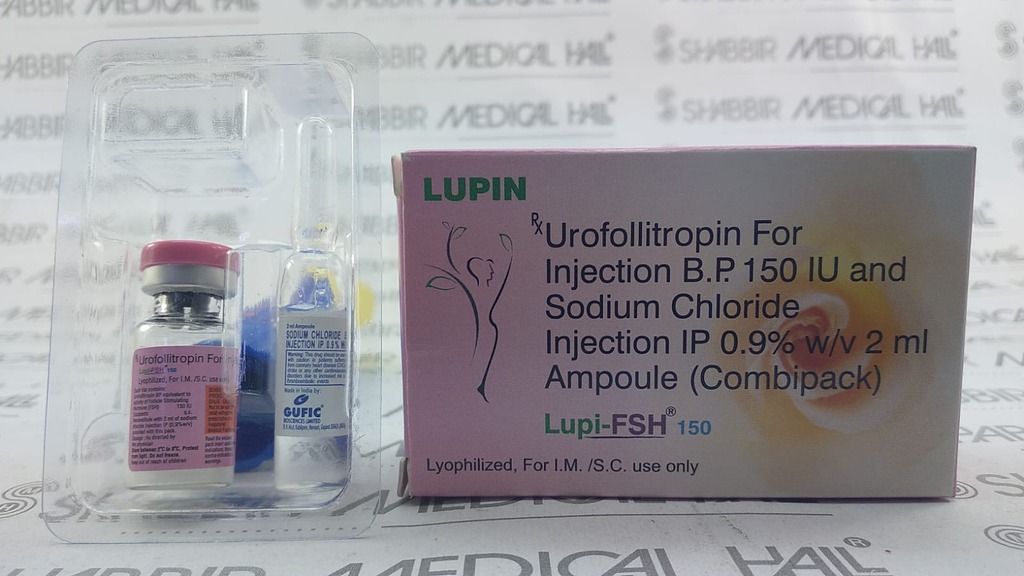
LUPI FSH 150 IU INJECTION
Manufactured By LUPIN LTD
Composition UROFOLLITROPIN 150 I U INJ
RS 1648.87
MRP RS 2536.73
(35% OFF)
Includes all taxes
Package SIZE
( 2ML )

100% Authentic
Products

Free
Shipping*

Products
Return Policy
Description:
Lupi-FSH 150 Injection (Urofollitropin 150 IU) is a highly purified, urinary-derived follicle-stimulating hormone (FSH) manufactured by Lupin Ltd, indicated for controlled ovarian stimulation (COS) in women undergoing assisted reproductive technology (ART) procedures such as in vitro fertilisation (IVF) and intrauterine insemination (IUI), and for ovulation induction in women with anovulatory infertility including polycystic ovary syndrome (PCOS) and hypogonadotropic hypogonadism. It works by directly stimulating ovarian follicle growth and development, promoting egg maturation and preparing the ovary for ovulation trigger. Available from Shabbir Medical Hall at the best price in India, this genuine prescription injection is available online with fast delivery nationwide.
BENEFITS: Lupi-FSH 150 Injection contains highly purified Urofollitropin, which is extracted from the urine of post-menopausal women and purified to contain predominantly FSH with minimal LH activity. This makes it particularly suitable for women requiring pure FSH stimulation, such as those with polycystic ovary syndrome (PCOS) where endogenous LH levels are already elevated. Clinical evidence supports its efficacy in achieving adequate follicular development, improving oocyte yield in IVF cycles, and inducing mono-follicular ovulation in anovulatory patients managed in fertility clinics.
USAGE OVERVIEW: Lupi-FSH 150 Injection is administered subcutaneously (SC) or intramuscularly (IM) under the strict supervision of a fertility specialist / reproductive endocrinologist. The dosage is highly individualised based on ovarian response monitoring via transvaginal ultrasound and serum oestradiol levels. Treatment is always followed by a human chorionic gonadotropin (hCG) trigger injection to induce final oocyte maturation and ovulation. The duration and dose of each cycle are determined entirely by the treating specialist.
SAFETY OVERVIEW: The most significant risk is ovarian hyperstimulation syndrome (OHSS), which can range from mild (bloating, discomfort) to severe (ascites, pleural effusion, thromboembolic events). Strict monitoring of follicular response is mandatory throughout treatment. Multiple pregnancies and ectopic pregnancy risks are also increased with gonadotropin therapy. This medicine requires a valid prescription from a registered fertility specialist.
Uses / Indications:
• Controlled Ovarian Stimulation (COS) for ART (IVF/ICSI): stimulates development of multiple follicles in women undergoing egg retrieval for IVF or ICSI protocols
• Ovulation Induction for IUI: stimulates mono-follicular or oligo-follicular development in women undergoing intrauterine insemination
• Anovulatory Infertility: women who fail to ovulate spontaneously, including:
• Polycystic Ovary Syndrome (PCOS) — WHO Group II anovulation
• Hypogonadotropic Hypogonadism — WHO Group I anovulation
• Idiopathic anovulation
ADDITIONAL USES:
• Superovulation in donor egg cycles (stimulation of oocyte donors)
• Fertility preservation cycles (ovarian stimulation before chemotherapy or surgery)
• Off-label: male infertility due to hypogonadotropic hypogonadism (in combination with hCG, as per specialist protocol)
Interactions / Warnings:
OHSS PREVENTION & MONITORING: Transvaginal ultrasound follicle monitoring: typically every 2–3 days from Day 6 of stimulation onwards. Serum oestradiol (E2) monitoring: every 2–3 days during stimulation — rapidly rising E2 (>3,000–4,000 pg/mL) signals OHSS risk. Cycle cancellation criteria: >3 follicles >16 mm, or serum E2 >4,000 pg/mL — specialist may advise coasting, cycle cancellation, or freeze-all embryo strategy. OHSS risk factors: young age, low body weight, PCOS, high antral follicle count (AFC), previous OHSS.
CARDIOVASCULAR RISK: Severe OHSS increases risk of venous thromboembolism (VTE) — assess baseline coagulation parameters in high-risk patients. Hydration, early ambulation, and thromboprophylaxis may be recommended by specialist in severe cases.
CONTRAINDICATIONS: Known hypersensitivity to Urofollitropin or any component. Primary ovarian failure (premature ovarian insufficiency / menopause) — FSH will not be effective. Ovarian cysts or enlarged ovaries unrelated to PCOS (rule out before starting). Uterine fibroids or structural abnormalities incompatible with pregnancy. Uncontrolled thyroid or adrenal disorders. Active thromboembolic disease. Hormone-dependent tumours (ovarian, uterine, breast, pituitary).
DRIVING & MACHINERY: Generally safe; however, dizziness or abdominal discomfort during treatment may impair concentration — assess individually.
ELDERLY USE: Not applicable: Lupi-FSH 150 Injection is indicated for women of reproductive age only.
Pregnancy interaction:
• Lupi-FSH 150 Injection IS used as part of fertility treatment to ACHIEVE pregnancy — it is not contraindicated during the stimulation phase.
• Once pregnancy is confirmed, FSH injections are STOPPED immediately.
• Lupi-FSH must NOT be used during an established pregnancy — risk of foetal harm.
• All fertility treatment cycles require a negative pregnancy test before commencing stimulation.
BREASTFEEDING:
• Lupi-FSH 150 Injection is NOT indicated during breastfeeding.
• Women who are breastfeeding should inform their fertility specialist before commencing any gonadotropin therapy.
CONTRACEPTION WARNING:
• Not applicable during active fertility treatment; however, women who achieve pregnancy must stop treatment immediately and inform their fertility specialist.
• Gonadotropin therapy significantly increases the risk of multiple gestations (twins, triplets). All patients must be counselled about this risk before commencing treatment. Careful ultrasound monitoring and cycle cancellation (if excessive follicles develop) are mandatory to reduce multiple pregnancy risk.
Expert advice:
1. NEVER SELF-PRESCRIBE OR SELF-ADJUST DOSE:
• Lupi-FSH 150 Injection is a specialist fertility medicine that MUST be prescribed and monitored by a qualified fertility specialist or reproductive endocrinologist. The dose is individually titrated for each woman based on her age, ovarian reserve, body weight, and response to stimulation. Never increase or decrease the dose without specialist guidance — under-stimulation means treatment failure; over-stimulation risks life-threatening OHSS.
2. ATTEND ALL MONITORING SCANS AND BLOOD TESTS:
• Transvaginal ultrasound monitoring (every 2–3 days during stimulation) and serum oestradiol measurements are mandatory safety tools, not optional. Missing monitoring appointments can result in undetected OHSS risk, premature ovulation, or missed trigger timing. Never skip a monitoring appointment during an active cycle.
3. RECOGNISE OHSS WARNING SIGNS EARLY:
• Ovarian Hyperstimulation Syndrome (OHSS) can develop rapidly. Patients and caregivers should monitor for: rapid weight gain (>1 kg in 24 hours), increasing abdominal bloating, nausea and vomiting, reduced urine output, or difficulty breathing. Report any of these signs to your fertility specialist immediately — do NOT wait for the next scheduled appointment.
4. CORRECT RECONSTITUTION AND INJECTION TECHNIQUE:
• The lyophilised powder must be dissolved in the supplied Sterile Water for Injection diluent immediately before use. Swirl gently — do NOT shake vigorously. Use the solution immediately after reconstitution; do NOT store reconstituted solution. Rotate injection sites (abdomen or thigh for SC administration) to prevent local skin reactions. Maintain strict aseptic technique throughout preparation and administration.
5. TAKE hCG TRIGGER ON TIME — PRECISELY:
• The hCG ovulation trigger injection timing is critical. It must be administered at the exact time specified by your fertility specialist (typically 34–36 hours before planned egg retrieval or timed intercourse/IUI). A missed or delayed trigger can result in cycle failure or spontaneous ovulation before planned retrieval.
MONITORING ADVICE:
• Transvaginal Ultrasound: Every 2–3 days from Day 5–6 of stimulation to assess follicle number, size, and ovarian volume
• Serum Oestradiol (E2): Every 2–3 days — monitors follicular activity and early OHSS risk
• Serum LH: Checked in antagonist protocols to detect premature LH surge
• Progesterone (Day of trigger): Elevated progesterone may indicate poor cycle outcome in IVF
• Body weight: Self-monitor daily during stimulation — rapid gain signals fluid retention and early OHSS
• Urine output: Self-monitor daily — reduced output is a OHSS warning sign
COMPLIANCE TIPS:
• Set a phone alarm for your injection time each day — consistency in timing is important for optimal follicular response
• Store vials as instructed (below 25°C, away from sunlight, do NOT freeze) until use
• Keep all vials, diluent, syringes, and needles in a clean, cool place
• Never reuse needles or syringes
• Dispose of sharps safely in an approved sharps container
• Carry your prescription and specialist's contact details at all times during treatment
SAFETY TIPS:
• Inform your fertility specialist if you experience any unusual symptom — no matter how minor it seems
• Do NOT start a new cycle without completing full baseline assessment (transvaginal scan on Day 2–3 confirming no residual cysts)
• Lupi-FSH treatment cycles require a confirmed negative pregnancy test before commencement
• Emotional wellbeing: fertility treatment is physically and emotionally demanding — seek counselling or peer support as needed
Side Effects:
• Injection site reactions: pain, redness, bruising, swelling at the injection site
• Ovarian enlargement (mild): bloating, pelvic discomfort, abdominal fullness
• Headache, fatigue
• Nausea, abdominal pain
• Breast tenderness
• Mood changes, irritability
SERIOUS SIDE EFFECTS (contact your fertility specialist immediately):
• Ovarian Hyperstimulation Syndrome (OHSS):
• Mild-Moderate: abdominal bloating, nausea, vomiting, diarrhoea, weight gain, ovarian cysts
• Severe OHSS: rapid weight gain (>1 kg/day), tense ascites, oliguria, severe dyspnoea (breathing difficulty), pleural effusion, haemoconcentration — SEEK EMERGENCY CARE IMMEDIATELY
• Critical OHSS: thromboembolic events (DVT, pulmonary embolism), ovarian torsion, acute kidney injury — life-threatening
• Multiple Pregnancy: high risk of twins or higher-order multiples (associated with complications for mother and babies)
• Ectopic Pregnancy: increased risk in women with tubal disease
• Allergic / Hypersensitivity Reactions: rash, urticaria, anaphylaxis (rare)
EMERGENCY SIGNS — SEEK IMMEDIATE MEDICAL HELP:
• Sudden severe abdominal or pelvic pain
• Rapid abdominal swelling or weight gain >1 kg in 24 hours
• Difficulty breathing, chest pain, or leg pain/swelling
• Reduced or absent urine output
How to use:
CONTROLLED OVARIAN STIMULATION (IVF/ICSI):
• Starting dose: 150–225 IU/day SC or IM from Day 2 or Day 3 of the menstrual cycle (or as per down-regulation protocol)
• Dose adjustments: every 4–5 days based on ultrasound monitoring and serum oestradiol response
• Maximum daily dose: typically 450 IU/day; treatment duration 10–12 days per cycle
• Ovulation trigger (hCG 5,000–10,000 IU or recombinant hCG): administered 34–36 hours before planned egg retrieval once follicles reach ≥18 mm
OVULATION INDUCTION (IUI / Timed Intercourse):
• Starting dose: 75–150 IU/day SC or IM from Day 2–3 of menstrual cycle
• Gradual dose escalation as needed based on ultrasound monitoring (step-up protocol)
• Aim for mono-follicular or bi-follicular response to reduce multiple pregnancy risk
• hCG trigger once dominant follicle reaches ≥18 mm
ROUTE OF ADMINISTRATION:
• Subcutaneous (SC): abdomen or thigh — preferred for self-administration under specialist guidance
• Intramuscular (IM): upper outer gluteal region — administered by healthcare professional
RECONSTITUTION:
• Dissolve lyophilised powder in the supplied diluent (Sterile Water for Injection) immediately before use
• Use freshly reconstituted solution — do not store after reconstitution
• Rotate injection sites to prevent local irritation
MISSED DOSE:
• If a dose is missed, contact your fertility specialist immediately — do NOT self-adjust the dose or timing
STORAGE:
• Store below 25°C in a cool, dry place away from direct sunlight
• Do NOT freeze
• Keep in original packaging until use
• Keep out of reach of children
• Do not use after the expiry date on the vial
How it works:
In women, the natural FSH secreted by the pituitary gland normally drives follicular development in the ovaries each menstrual cycle.
Urofollitropin (exogenous FSH) works by:
• Binding to FSH receptors on granulosa cells of ovarian follicles
• Stimulating proliferation of granulosa cells and growth of antral follicles
• Promoting aromatase enzyme activity — converting androgens to oestrogens within the follicle
• Increasing follicular fluid volume and oestradiol production
• Supporting maturation of the oocyte within each developing follicle
In IVF protocols:
• Multiple follicles are stimulated simultaneously to maximise egg yield
• Transvaginal ultrasound and serum oestradiol are used to monitor follicular response
• An hCG or GnRH agonist trigger is administered once follicles reach 18–20 mm mean diameter to complete oocyte maturation
KEY ADVANTAGES:
• Highly purified FSH with minimal LH activity — ideal for PCOS patients with elevated endogenous LH
• Well-established clinical track record in ART and ovulation induction
• Subcutaneous administration option for patient convenience
• Produced by Lupin Ltd — a trusted Indian pharmaceutical manufacturer
Faq for medicine:
Lupi-FSH 150 IU Injection contains Urofollitropin, a purified urinary-derived FSH that directly stimulates ovarian follicle development. It triggers follicular growth and maturation in women undergoing ART procedures like IVF and IUI, or those with anovulatory infertility including PCOS. Administered under medical supervision, it is effective in controlled ovarian stimulation protocols.
2.Who should use Lupi-FSH 150 IU Injection for fertility treatment?
Lupi-FSH 150 IU Injection is indicated for women with anovulatory infertility, PCOS, or hypogonadotropic hypogonadism, and for those undergoing assisted reproductive technology such as IVF or IUI. It is prescribed by reproductive endocrinologists and must be used under strict medical supervision with regular ultrasound and hormonal monitoring.
3.What is the difference between Lupi-FSH and recombinant FSH injections?
Lupi-FSH 150 IU Injection contains urinary-derived Urofollitropin, while recombinant FSH is biosynthetically produced. Both stimulate follicular development, but urinary FSH may contain trace LH activity. Lupi-FSH is manufactured by Lupin Ltd and is considered a cost-effective option in ovarian stimulation protocols with comparable clinical outcomes in many patients.
4.What monitoring is required during Lupi-FSH 150 IU Injection therapy?
During Lupi-FSH 150 IU Injection therapy, regular transvaginal ultrasound monitoring is required to assess follicular development and prevent ovarian hyperstimulation syndrome (OHSS). Serum estradiol levels are also tracked. Dose adjustments are made based on ovarian response. Close medical supervision is mandatory throughout the treatment cycle to ensure patient safety.
5.Can Lupi-FSH 150 IU Injection cause ovarian hyperstimulation syndrome?
Yes, Lupi-FSH 150 IU Injection carries a risk of ovarian hyperstimulation syndrome (OHSS), a potentially serious complication. Symptoms include abdominal bloating, pain, nausea, and in severe cases, fluid accumulation. Risk is higher in women with PCOS or high ovarian reserve. Careful dose titration and monitoring significantly reduce this risk under specialist care.
6.How is Lupi-FSH 150 IU Injection administered and stored?
Lupi-FSH 150 IU Injection is administered subcutaneously or intramuscularly as directed by a fertility specialist. The dose and duration are individualized based on ovarian response. It should be stored in a refrigerator between 2–8°C, protected from light, and must not be frozen. Administration should follow aseptic technique under medical guidance.
Medicine interaction:
• hCG (human chorionic gonadotropin): used intentionally as ovulation trigger in all Lupi-FSH treatment cycles — this is a planned therapeutic combination, NOT an adverse interaction
• GnRH agonists (buserelin, leuprorelin, nafarelin): used concurrently in long-protocol IVF to prevent premature LH surge — co-administration is standard clinical practice; increases FSH dose requirement
• GnRH antagonists (cetrorelix, ganirelix): used concurrently in antagonist-protocol IVF to prevent premature LH surge — requires dose monitoring
• Clomifene Citrate: sometimes used in combination protocols; specialist to advise on sequencing
• Letrozole: used in some ovulation induction protocols alongside FSH; specialist to advise
• No significant interactions with common medications (antibiotics, antihistamines, analgesics) at standard doses
VACCINE INTERACTIONS:
• No specific vaccine interactions documented for Urofollitropin; inform your fertility specialist of any recent or upcoming vaccinations during treatment
SUPPLEMENT INTERACTIONS:
• Herbal supplements with hormonal activity (phytoestrogens, black cohosh, dong quai): potential interference with ovarian stimulation — inform fertility specialist of all supplements
• Always disclose all vitamins, herbal products, and supplements to your fertility specialist before commencing treatment
Available Substitutes