


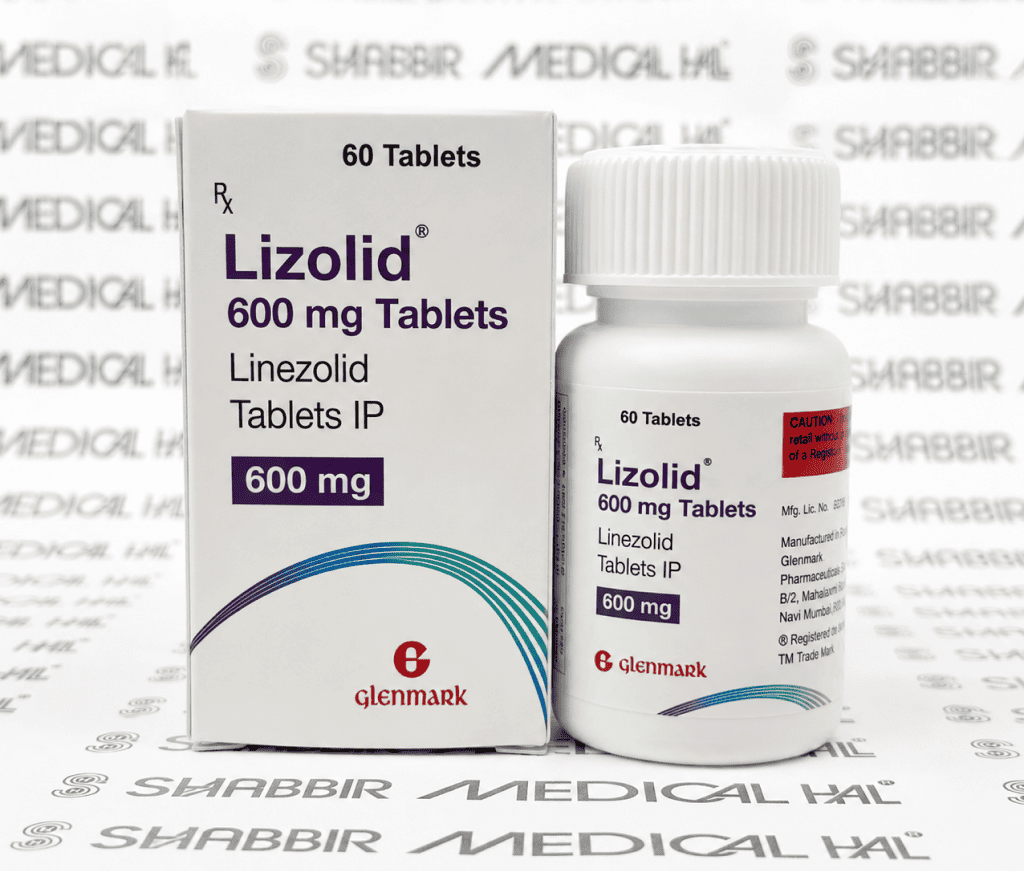
LIZOLID 600MG TABLETS
Manufactured By GLENMARK PHARMACEUTICALS LTD
Composition LINEZOLID 600MG
RS 342.51
MRP RS 380.57
(10% OFF)
Includes all taxes
Package SIZE
( 10`s )

100% Authentic
Products

Free
Shipping*

Products
Return Policy
Description:
Lizolid 600mg Tablet Lizolid 600mg Tablet contains Linezolid 600mg, a first-in-class oxazolidinone antibiotic manufactured by Glenmark Pharmaceuticals Ltd. Linezolid was the first entirely synthetic antibiotic class developed in over three decades and remains one of the most important reserve antibiotics for treating serious, life-threatening infections caused by multi-drug resistant (MDR) gram-positive bacteria — including methicillin-resistant Staphylococcus aureus (MRSA), vancomycin-resistant Enterococcus (VRE), and drug-resistant Streptococcus pneumoniae. Lizolid 600mg is used in hospital and specialist outpatient settings and is prescribed only when other antibiotics have failed or are inappropriate. Available from Shabbir Medical Hall at the best price in India with 10% OFF MRP and fast doorstep delivery, this genuine prescription antibiotic can be conveniently ordered online with verified prescription.
BENEFITS: The key clinical advantage of Linezolid is its activity against bacteria that are resistant to beta-lactams (penicillins, cephalosporins), glycopeptides (vancomycin, teicoplanin), and other major antibiotic classes. Its unique mechanism of action — inhibiting bacterial protein synthesis at the 50S ribosomal subunit by binding to the 23S ribosomal RNA — means there is no cross-resistance with other antibiotic classes, making it effective even when most other options have failed. Linezolid also has excellent oral bioavailability (approximately 100%), allowing seamless step-down from IV to oral therapy, which is critical for reducing hospitalisation duration and cost in India.
USAGE OVERVIEW: Lizolid 600mg tablets are taken orally twice daily (every 12 hours) for a duration determined by the infection type and clinical response, typically 10–28 days. Tablets may be taken with or without food. The total course should NEVER be extended beyond 28 days without specialist review due to the risk of serious haematological and neurological toxicity.
SAFETY OVERVIEW: The most important side effects are myelosuppression (bone marrow suppression causing anaemia, thrombocytopenia, and leucopenia) and serotonin syndrome when combined with serotonergic drugs. Weekly full blood count (FBC) monitoring is mandatory throughout the course. Linezolid is a weak, reversible monoamine oxidase inhibitor (MAOI), requiring important dietary and drug interaction precautions.
Uses / Indications:
• Nosocomial (Hospital-Acquired) Pneumonia: caused by MRSA or Streptococcus pneumoniae (including penicillin-resistant strains)
• Community-Acquired Pneumonia (CAP): caused by susceptible Streptococcus pneumoniae including multidrug-resistant strains (MDRSP)
• Complicated Skin and Skin Structure Infections (cSSSI): including diabetic foot infections, cellulitis, and wound infections caused by MRSA, Streptococcus, or Enterococcus faecalis
• Uncomplicated Skin and Skin Structure Infections (uSSSI): caused by MSSA or pyogenic Streptococcus
• Vancomycin-Resistant Enterococcal (VRE) Infections: including bacteraemia — Linezolid is one of very few approved options
• Bacteraemia / Bloodstream Infections: associated with the above infections when caused by susceptible gram-positive organisms
ADDITIONAL / SPECIALIST-GUIDED USES (off-label):
• Drug-Resistant Tuberculosis (DR-TB): Linezolid is included in WHO Group C regimens for MDR-TB and XDR-TB — one of the most critically important uses in India
• Prosthetic joint infections and bone/joint infections (osteomyelitis) caused by MRSA — in combination regimens
• CNS infections caused by gram-positive organisms including MRSA — due to good CNS penetration
• Nocardiosis (Nocardia infections) in immunocompromised patients
• Enterococcal endocarditis unresponsive to glycopeptides
IMPORTANT: Linezolid is a RESERVE antibiotic. It should only be used when culture and sensitivity testing confirms susceptibility, or when standard antibiotics are contraindicated or ineffective. Inappropriate use drives antimicrobial resistance.
Interactions / Warnings:
HAEMATOLOGICAL MONITORING (MANDATORY): Complete Blood Count (CBC/FBC) must be checked at BASELINE and then WEEKLY throughout the treatment course. Immediately reduce dose, interrupt, or discontinue if: Platelets fall below 100 x 10⁹/L (severe thrombocytopenia); Neutrophils fall below 1.0 x 10⁹/L (severe neutropenia); Haemoglobin falls significantly below baseline. Patients with pre-existing myelosuppression, on myelosuppressive therapy, or with chronic infection are at substantially higher risk.
28-DAY MAXIMUM DURATION WARNING: Courses longer than 28 days are associated with significantly increased risk of: Peripheral neuropathy (may be irreversible); Optic neuropathy (potentially permanent vision loss); Severe myelosuppression; Lactic acidosis. Extended use (e.g., for DR-TB) must only be under specialist supervision with regular ophthalmic and neurological assessments.
SEROTONIN SYNDROME VIGILANCE: Take a comprehensive medication history before prescribing — screen for all serotonergic drugs. If serotonin syndrome is suspected: STOP linezolid immediately, start supportive therapy, and seek emergency care.
TYRAMINE DIET COUNSELLING: Counsel ALL patients and caregivers on tyramine-restricted diet at prescription and dispensing. Provide written dietary guidance listing high-tyramine foods to avoid.
C. DIFFICILE WARNING: As with all broad-spectrum antibiotics, linezolid can disrupt gut flora and precipitate Clostridioides difficile infection (CDI). Report persistent or severe diarrhoea to treating specialist immediately.
ELDERLY USE (>=65 years): No dose adjustment required, but elderly patients are at higher baseline risk of myelosuppression and peripheral neuropathy — monitor more frequently.
DRIVING & MACHINERY: Dizziness and visual disturbances may occur — assess individual patient response before driving.
Pregnancy interaction:
• Linezolid is classified as Pregnancy Category C.
• Animal studies have demonstrated embryotoxic and foetotoxic effects at doses comparable to human therapeutic doses — reduced foetal body weight, increased post-implantation loss, and rib abnormalities have been observed.
• There are no adequate and well-controlled studies in pregnant women.
• Lizolid 600mg should NOT be used during pregnancy unless the potential benefit clearly justifies the potential risk to the foetus.
• Women of childbearing potential must use effective contraception during Linezolid therapy.
• Inform your infectious disease specialist immediately if pregnancy is suspected or confirmed during treatment.
Breastfeeding:
• Linezolid is excreted in human breast milk.
• Due to the potential for serious adverse effects in breastfed infants (particularly myelosuppression and potential for adverse GI effects), breastfeeding is NOT recommended during Lizolid 600mg therapy.
• Discuss the risk-benefit balance with your specialist before making feeding decisions.
Doctor Consultation Warning:
• Never discontinue Lizolid 600mg before completing the prescribed course without consulting your infectious disease specialist.
• Premature discontinuation risks treatment failure, relapse, and the emergence of linezolid resistance — a serious public health concern.
Expert advice:
1. Reserve Antibiotic — Culture First:
• Lizolid 600mg (Linezolid) is a RESERVE antibiotic of last resort for resistant gram-positive infections. Verify that your infectious disease specialist has confirmed susceptibility on culture and sensitivity testing before dispensing, or that linezolid is being prescribed as definitive therapy for a confirmed indication (e.g., MRSA, VRE, DR-TB). Challenge any prescription that lacks clinical justification — appropriate antimicrobial stewardship is every pharmacist's responsibility.
2. Mandatory Weekly Blood Count Counselling:
• At every dispensing interaction, reinforce that weekly full blood count (FBC/CBC) is non-negotiable during Lizolid therapy. Explain clearly what symptoms suggest myelosuppression: unusual bruising, unexplained bleeding (gums, nose, prolonged cuts), fever without obvious cause, or extreme fatigue. Patients must know to report these immediately — do not wait for the next scheduled appointment.
3. Tyramine Diet Counselling — Provide Written Guidance:
• Linezolid is a weak MAOI. Counsel every patient verbally AND provide a printed tyramine-restricted food list. High-risk foods in the Indian diet to highlight:
• Aged cheeses (e.g., cheddar, processed aged cheese)
• Fermented/pickled foods: soy sauce, fish sauce, pickled vegetables
• Tap/draught beer and red wine
• Overripe or dried fruits (figs, raisins in large quantities)
• Broad beans (fava beans / sem phali)
• Cured/smoked meats (sausages, salami)
• Fresh vegetables, most dals, roti, rice, and fresh Indian curries with fresh ingredients are generally safe.
4. Serotonin Syndrome Screening at Dispensing:
• Review the full medication list before dispensing. If the patient is on any SSRI (e.g., escitalopram, fluoxetine, sertraline), SNRI (venlafaxine), tramadol, or other serotonergic agent, ALERT the prescriber immediately — this is a high-risk drug interaction requiring specialist review before dispensing.
5. Maximum 28-Day Course — Do Not Dispense Beyond Without Specialist Review:
• For standard infections, do not dispense quantities exceeding 28 days without explicit specialist documentation. For DR-TB use, dispensing must follow the treating TB specialist's protocol.
Monitoring Advice:
• Complete Blood Count (CBC/FBC): Baseline → WEEKLY throughout treatment → on completion. Focus parameters: platelets, haemoglobin, total WBC, neutrophil count
• Liver Function Tests (LFTs): Baseline; repeat if symptoms of hepatotoxicity develop
• Blood Pressure: Monitor at each clinical visit (MAOI activity — hypertensive crisis risk)
• Ophthalmic Assessment: Baseline visual acuity and fields for courses anticipated to exceed 28 days
• Peripheral Neurological Assessment: Monitor for paraesthesias (numbness/tingling) at each clinical review in prolonged courses
• Blood Lactate: If patient develops unexplained nausea, vomiting, or metabolic acidosis — rule out lactic acidosis
Compliance Tips:
• Take tablets at strict 12-hour intervals to maintain consistent plasma levels — set phone alarms for 8 AM and 8 PM (or as directed)
• Complete the FULL prescribed course even if symptoms improve early — stopping early risks relapse and resistance
• Keep a medication diary noting any new symptoms, especially unusual bleeding, tingling in hands/feet, visual changes, or diarrhoea
• Carry a medication alert card noting Linezolid therapy and its MAOI interaction risk — particularly important in emergency situations
• Attend ALL scheduled blood test appointments without exception
Safety Tips:
• Avoid all serotonergic OTC medicines (e.g., dextromethorphan-containing cough syrups) without pharmacist/doctor approval during Linezolid therapy
• Avoid decongestants containing pseudoephedrine or phenylephrine (found in many cold & flu combinations in Indian pharmacies) — MAOI interaction risk
• Do not consume alcohol during treatment — increases CNS adverse effects and risk of serotonin-related events
• Use a soft toothbrush and electric razor during therapy in case of thrombocytopenia (bleeding precaution)
• Report any new visual disturbance, colour vision change, or blurring immediately to your prescribing specialist
Side Effects:
• Myelosuppression (Bone Marrow Suppression): anaemia (low red blood cells), thrombocytopenia (low platelets — bleeding risk), leucopenia/neutropenia (low white blood cells — infection risk) — this is the most important and frequent serious adverse effect; occurs in ~2-3% of patients at standard doses
• Diarrhoea, nausea, vomiting, and abdominal pain
• Headache and dizziness
• Skin rash
• Elevated liver enzymes (ALT, AST)
• Taste disturbance (metallic taste)
• Insomnia
Serious Side Effects (contact your doctor immediately):
• Severe Myelosuppression: unusual bruising, bleeding gums/nose, petechiae (pin-point skin haemorrhages), prolonged bleeding, unexpected infections or fever (neutropenia)
• Serotonin Syndrome: agitation, confusion, rapid heart rate, high fever, muscle twitching, excessive sweating, tremor, diarrhoea — medical emergency; most likely when combined with SSRIs, SNRIs, or MAOIs
• Peripheral Neuropathy (prolonged use >28 days): numbness, tingling, burning sensation in hands and feet; may be irreversible with extended use
• Optic Neuropathy (prolonged use): visual disturbances, blurred vision, or visual field changes — report to ophthalmologist immediately
• Lactic Acidosis: nausea, vomiting, low bicarbonate — rare but potentially fatal metabolic emergency
• C. difficile-Associated Diarrhoea (CDAD): severe, watery or bloody diarrhoea during or after treatment
• Hypertensive Crisis: severe headache, visual disturbance, chest pain with blood pressure surge — triggered by tyramine-rich foods or sympathomimetic/serotonergic drugs (MAOI interaction)
Emergency Signs — Seek Immediate Medical Help:
• Sudden or unusual bleeding or bruising (thrombocytopenia)
• High fever with no known cause (neutropenia / agranulocytosis)
• Mental confusion, agitation, or muscle rigidity with high temperature (serotonin syndrome)
• Sudden severe headache with very high blood pressure
• New visual disturbances or sudden change in vision
How to use:
Adults (18 years and above):
• Nosocomial Pneumonia / Community-Acquired Pneumonia / Complicated SSSI / VRE Infections: 600mg orally TWICE DAILY (every 12 hours) for 10–14 days (VRE infections including concurrent bacteraemia: up to 14–28 days)
• Uncomplicated Skin & Skin Structure Infections (SSSI): 400mg orally TWICE DAILY for 10–14 days (Note: Lizolid 600mg tablets used — dose as per specialist prescription)
• DR-TB (Specialist Protocol): 600mg once or twice daily as part of a multi-drug regimen — duration guided by WHO/national TB treatment guidelines (months to years)
Paediatric Use (birth to 11 years):
• 10mg/kg every 8 hours (maximum 600mg per dose) — requires separate paediatric formulation (oral suspension); specialist dosing required
Renal Impairment:
• No dose adjustment required for any degree of renal impairment; however, the two primary metabolites accumulate — monitor for adverse effects
Hepatic Impairment:
• Mild to moderate (Child-Pugh A and B): No dose adjustment required
• Severe (Child-Pugh C): Limited data — use with caution under specialist supervision
Route of Administration:
• Oral tablet — swallow whole with water
• Take with OR without food
• AVOID large quantities of tyramine-rich foods (see Expert Advice)
• Take doses at consistent 12-hour intervals (e.g., 8 AM and 8 PM)
Duration Limit:
• MAXIMUM 28 DAYS for standard infections — do NOT extend without specialist review
• For DR-TB use, duration is protocol-specific and managed by specialist TB teams only
Missed Dose:
• Take as soon as remembered if it is well before the next scheduled dose
• If close to next dose time: skip and resume next scheduled dose
• NEVER double-dose
Storage:
• Store below 25°C in a cool, dry place
• Keep in original blister pack; protect from moisture
• Keep out of reach of children
• Do NOT use beyond expiry date on pack
How it works:
Lizolid 600mg contains Linezolid, the first clinically approved oxazolidinone antibiotic — a completely novel synthetic class with a unique mechanism not shared by any other antibiotic.
Mechanism of Action:
• All bacteria require functional ribosomes to synthesise proteins essential for growth, replication, and survival.
• Linezolid inhibits bacterial protein synthesis by binding selectively to the 23S ribosomal RNA (rRNA) component of the 50S large ribosomal subunit.
• This binding prevents the formation of the 70S initiation complex — the critical first step in bacterial protein synthesis — effectively blocking protein production before it begins.
• Because linezolid acts at an earlier stage of ribosomal function than other antibiotic classes (e.g., macrolides, aminoglycosides, tetracyclines), there is NO cross-resistance with existing antibiotics.
Key Pharmacological Features:
• Spectrum: Active exclusively against GRAM-POSITIVE bacteria (including MRSA, VRE, MDRSP, Enterococcus faecalis, E. faecium, Streptococcus spp., Staphylococcus spp., Listeria monocytogenes)
• Action Type: Primarily BACTERIOSTATIC against Enterococcus and Staphylococcus; BACTERICIDAL against some Streptococcus species
• Oral Bioavailability: ~100% — nearly complete absorption when taken orally; serum levels equivalent to IV linezolid. This allows smooth, cost-effective IV-to-oral switch (step-down therapy) — reducing hospital stay
• Tissue Penetration: Excellent penetration into lungs, skin/soft tissue, bone, and cerebrospinal fluid (CSF)
• MAOI Activity: Linezolid is a weak, reversible, non-selective monoamine oxidase inhibitor (MAOI) — clinically significant for drug and food interactions
Resistance Profile:
• Resistance to linezolid is rare but emerging — primarily mediated by mutations in the 23S rRNA gene (G2576T mutation) or cfr gene-mediated methylation
• Prudent, culture-guided use is essential to preserve linezolid efficacy
Faq for medicine:
Lizolid 600mg Tablets contain Linezolid, an oxazolidinone antibiotic used to treat serious Gram-positive bacterial infections including nosocomial and community-acquired pneumonia, complicated skin and soft tissue infections, and bacteremia. Lizolid 600mg is particularly effective against methicillin-resistant Staphylococcus aureus (MRSA), vancomycin-resistant Enterococcus (VRE), and other multidrug-resistant organisms resistant to conventional antibiotics.
2.How does Linezolid in Lizolid 600mg differ from other antibiotics for MRSA?
Linezolid in Lizolid 600mg Tablets works by inhibiting bacterial protein synthesis at the 50S ribosomal subunit initiation step, a unique mechanism distinct from beta-lactams, glycopeptides, and aminoglycosides. This novel action makes Lizolid effective against MRSA and VRE that are resistant to vancomycin or other first-line agents. As an oral tablet achieving systemic exposure, Lizolid enables step-down therapy from intravenous antibiotics in hospitalized patients.
3.What is the standard dose and duration of Lizolid 600mg Tablet treatment?
Lizolid 600mg Tablets are typically administered as 600mg twice daily (every 12 hours), with or without food. Treatment duration varies by infection: 10–14 days for pneumonia and skin infections, and up to 28 days for certain serious infections. The full prescribed course must be completed. Lizolid treatment beyond 28 days requires careful monitoring due to cumulative toxicity risks including myelosuppression and peripheral neuropathy.
4.What serious side effects are associated with long-term Lizolid 600mg use?
Prolonged use of Lizolid 600mg Tablets beyond 28 days is associated with myelosuppression (decreased white blood cells and platelets), peripheral neuropathy, optic neuropathy with potential vision loss, and lactic acidosis. Weekly complete blood counts (CBC) are recommended during treatment. Patients should report numbness, tingling, or visual disturbances immediately. Lizolid should be discontinued if significant myelosuppression or neuropathy develops.
5.Can Lizolid 600mg Tablets interact with antidepressants or other medications?
Lizolid 600mg Tablets have monoamine oxidase (MAO) inhibitory activity and must not be used within 14 days of other MAO inhibitors. Concurrent use with serotonergic drugs (SSRIs, SNRIs, tricyclics) risks serotonin syndrome—a potentially life-threatening condition. Lizolid also interacts with adrenergic drugs and pressor amines. Patients should avoid tyramine-rich foods (aged cheese, cured meats, red wine) as interactions may cause dangerous hypertension.
6.Is Lizolid 600mg Tablet safe for use in patients with kidney or liver impairment?
Lizolid 600mg Tablets do not require dose adjustment in patients with mild-to-moderate renal or hepatic impairment. However, metabolite accumulation may occur in severe renal failure, though clinical significance is uncertain. Both Linezolid and its metabolites are eliminated by dialysis, so Lizolid should be administered after hemodialysis sessions. Severe hepatic impairment has not been adequately studied, requiring caution and close clinical monitoring during Lizolid therapy.
Medicine interaction:
• MAOIs (phenelzine, tranylcypromine, isocarboxazid, selegiline — oral): Linezolid itself is a weak MAOI; combining with other MAOIs greatly increases hypertensive crisis and serotonin syndrome risk. Washout required: allow at least 2 weeks after stopping an MAOI before starting linezolid; allow at least 1 week after stopping linezolid before starting an MAOI.
Major Drug Interactions (monitor closely / specialist decision required):
• SSRIs (fluoxetine, sertraline, escitalopram, paroxetine, citalopram) and SNRIs (venlafaxine, duloxetine): HIGH risk of serotonin syndrome — avoid concurrent use; if unavoidable, monitor intensively
• Tricyclic Antidepressants (amitriptyline, clomipramine): Serotonin syndrome risk via MAOI interaction
• Triptans (sumatriptan, zolmitriptan): Serotonin syndrome risk
• Pethidine (meperidine) and tramadol: Serotonin syndrome risk
• Sympathomimetics (pseudoephedrine, phenylephrine, dopamine, adrenaline): Risk of hypertensive crisis via MAOI activity — monitor blood pressure closely
• Rifampicin: May reduce linezolid plasma levels by up to 32% via CYP induction — consider dose optimisation in DR-TB regimens
• Warfarin and other anticoagulants: Linezolid may enhance anticoagulant effect; monitor INR closely
• Haematopoietic growth factors (G-CSF, EPO): May be required if significant myelosuppression develops
Food Interactions (MAOI — Critical):
• AVOID large quantities of TYRAMINE-RICH FOODS during treatment: Aged cheeses (cheddar, brie, camembert), fermented/cured meats (salami, sausage), soy sauce, fish sauce, tap/draught beer, red wine, overripe fruits, broad bean pods
• Reason: MAO normally degrades tyramine absorbed from food; inhibition of MAO by linezolid allows tyramine to accumulate, causing sudden severe hypertensive crisis
• Note: Moderate amounts of fresh foods are generally acceptable — counsel specifically on high-tyramine culprits
Supplement Interactions:
• St John's Wort (Hypericum perforatum): Serotonergic supplement — avoid during linezolid therapy; risk of serotonin syndrome
• Inform your doctor of ALL herbal, Ayurvedic, and over-the-counter products being taken
Available Substitutes