
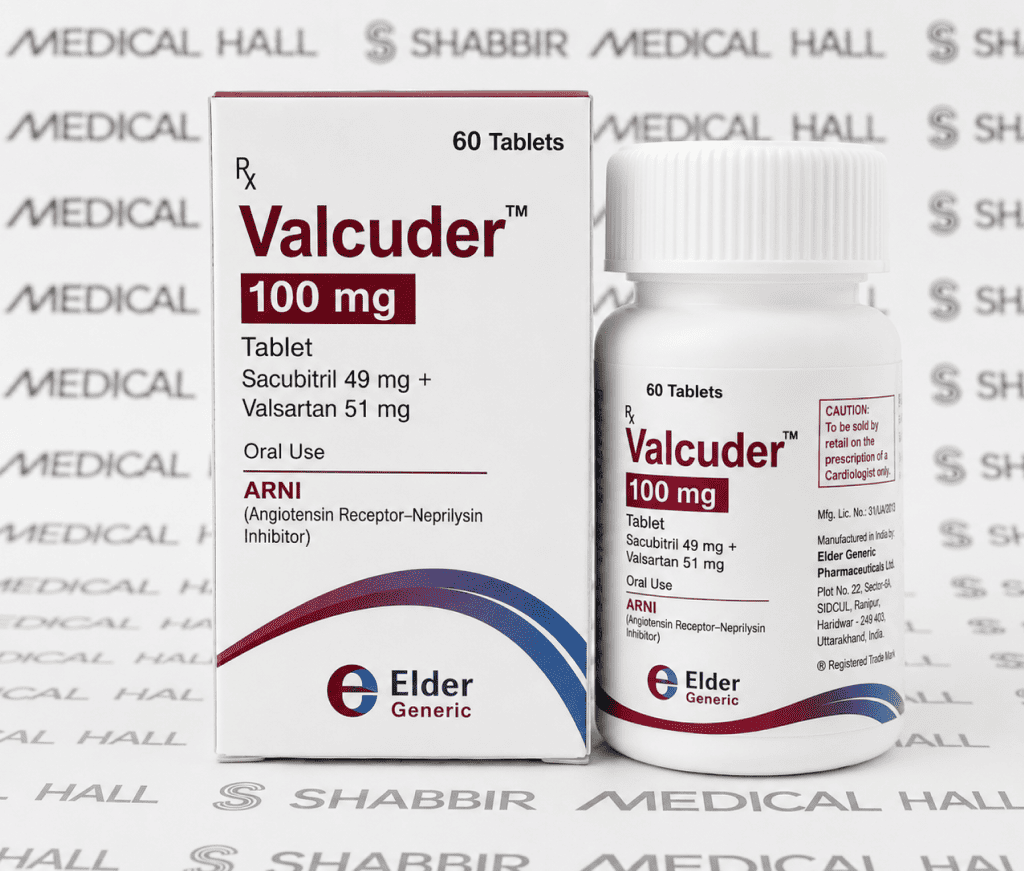
VALCUDER 100MG TABLETS
Manufactured By ELDER GENERIC
Composition VALSARTAN 51MG SACUBITRIL 49MG
RS 697.50
MRP RS 775.00
(10% OFF)
Includes all taxes
Package SIZE
( 14`s )
100% Authentic
Products
Free
Shipping*
Products
Return Policy
Description:
Valcuder 100mg Tablet
Valcuder 100mg Tablet is a fixed-dose combination of Sacubitril 49mg and Valsartan 51mg, manufactured by Elder Generic and classified as an ARNI (Angiotensin Receptor–Neprilysin Inhibitor) — a landmark drug class in the treatment of chronic heart failure with reduced ejection fraction (HFrEF). It works through a dual mechanism: Sacubitril inhibits neprilysin (an enzyme that degrades natriuretic peptides), increasing beneficial natriuretic peptide levels to promote vasodilation, natriuresis, and cardioprotection; while Valsartan simultaneously blocks the angiotensin II type 1 (AT1) receptor to reduce vasoconstriction, sodium retention, and cardiac remodelling. Available from Shabbir Medical Hall at the best price in India, this genuine prescription tablet is available online with fast delivery nationwide.
BENEFITS: Valcuder 100mg Tablet has demonstrated landmark clinical evidence from the PARADIGM-HF trial, which showed that Sacubitril/Valsartan reduced cardiovascular death and hospitalisation for heart failure by 20% compared to enalapril in patients with HFrEF. It is now recommended by international cardiology guidelines (ESC, ACC/AHA) as a first-line therapy for HFrEF, replacing ACE inhibitors in patients who can tolerate it. Benefits include improved symptoms, functional capacity, quality of life, and survival in chronic heart failure patients.
USAGE OVERVIEW: Valcuder 100mg Tablet is taken orally, typically twice daily (every 12 hours), with or without food, as prescribed by the treating cardiologist. The starting dose, titration schedule, and target maintenance dose depend on the patient's prior therapy (ACE inhibitor or ARB dose), blood pressure, renal function, and potassium levels. A 36-hour washout period is mandatory before switching from an ACE inhibitor to prevent angioedema. Regular monitoring of blood pressure, renal function, and serum potassium is essential throughout therapy.
SAFETY OVERVIEW: The most significant risks are symptomatic hypotension (low blood pressure), hyperkalaemia (high potassium), and renal impairment — particularly when combined with other renin-angiotensin system agents. Angioedema risk is elevated if switched from an ACE inhibitor without the mandatory 36-hour washout. This medicine requires a valid prescription from a registered cardiologist.
Uses / Indications:
• Chronic Heart Failure with Reduced Ejection Fraction (HFrEF): treatment of symptomatic chronic heart failure (NYHA Class II–IV) in adult patients with left ventricular ejection fraction (LVEF) ≤40%, to reduce cardiovascular death and hospitalisation for heart failure
• Replacement of ACE Inhibitor or ARB Therapy: Sacubitril/Valsartan replaces ACE inhibitors (e.g., enalapril, ramipril) or ARBs (e.g., losartan, valsartan) in patients who are already stabilised on and tolerating these agents
ADDITIONAL USES:
• Heart Failure with Mildly Reduced Ejection Fraction (HFmrEF, LVEF 41–49%): increasingly used based on expanding clinical evidence and guideline updates
• Heart Failure with Preserved Ejection Fraction (HFpEF): some guideline support (especially in women and patients with lower-normal EF) — specialist decision
• Post-MI Heart Failure: early initiation of Sacubitril/Valsartan post-acute myocardial infarction with reduced EF — as per cardiologist protocol
• Hypertension (off-label): Valsartan component provides antihypertensive benefit — not a primary indication for this combination
WHO IS THIS FOR?
• Adult patients with established HFrEF (EF ≤40%) currently on ACE inhibitor or ARB therapy who remain symptomatic
• Patients newly diagnosed with HFrEF as first-line RAAS therapy (per latest ESC 2021 and ACC/AHA 2022 guidelines)
• Patients hospitalised for acute decompensated heart failure, stabilised prior to discharge (in-hospital initiation)
Interactions / Warnings:
THE 36-HOUR ACE INHIBITOR WASHOUT — CRITICAL WARNING:
Before starting Valcuder 100mg Tablet, there MUST be a minimum 36-hour gap after the last dose of any ACE inhibitor. This is because both neprilysin inhibition (sacubitril) and ACE inhibition increase bradykinin — concurrent use causes a dangerous, potentially fatal risk of angioedema. Document the washout period in the patient's medical record before prescribing.
BLOOD PRESSURE MONITORING:
Check blood pressure at baseline, at 1–2 weeks after initiation, and after each dose increase. If systolic BP <100 mmHg: consider dose reduction or temporary discontinuation. Advise patients to rise slowly from sitting/lying to avoid postural hypotension.
RENAL FUNCTION & ELECTROLYTE MONITORING:
Monitor serum creatinine, eGFR, and serum potassium at: baseline → 1–2 weeks after initiation → after each dose increase → every 3–6 months on stable therapy. If serum creatinine rises >50% above baseline or K+ >5.5 mmol/L: halve the dose; if K+ >6.0 mmol/L: STOP and reassess.
RENAL ARTERY STENOSIS:
Use with extreme caution in patients with bilateral renal artery stenosis — high risk of acute renal failure.
CONTRAINDICATIONS (ABSOLUTE):
Concurrent use with ACE inhibitors (within 36 hours); concurrent use with aliskiren in diabetic patients; pregnancy (all trimesters); severe hepatic impairment (Child-Pugh C); known hypersensitivity to sacubitril, valsartan, or any excipient; prior history of angioedema related to ACE inhibitor or ARB therapy.
DRIVING & MACHINERY:
Dizziness and hypotension may impair driving ability, particularly at treatment initiation or after dose increase — advise caution.
Pregnancy interaction:
• Valcuder 100mg Tablet is CONTRAINDICATED in pregnancy — both Sacubitril and Valsartan (as an ARB) are teratogenic
• Drugs affecting the renin-angiotensin system (ARBs, ACE inhibitors, ARNIs) can cause foetal renal toxicity, oligohydramnios, limb deformities, skull hypoplasia, and neonatal death — particularly during the 2nd and 3rd trimesters
• Women of childbearing potential MUST use effective contraception during treatment
• If pregnancy is detected during treatment, discontinue Valcuder IMMEDIATELY and consult the cardiologist for alternative heart failure therapy that is safe in pregnancy
BREASTFEEDING:
• Valcuder 100mg Tablet is NOT recommended during breastfeeding
• It is unknown whether sacubitril or valsartan is excreted in human breast milk. Given the potential risk to the nursing infant, a decision should be made to discontinue breastfeeding or discontinue the drug, based on the importance of therapy to the mother
FERTILITY:
• No clinical data on effects on human fertility. Animal studies showed no effects on fertility at clinical doses
Expert advice:
1. VERIFY THE 36-HOUR ACE INHIBITOR WASHOUT — EVERY TIME:
• Before dispensing Valcuder 100mg Tablets to any patient who was previously on an ACE inhibitor (enalapril, ramipril, lisinopril, perindopril, captopril, etc.), verify with the patient and check their prescription record to confirm that at least 36 hours have elapsed since the last ACE inhibitor dose
• This is the most critical safety check with this drug — missed washout can cause life-threatening angioedema of the airway
• Document this check. If in doubt, contact the prescribing cardiologist before dispensing
2. EDUCATE PATIENTS ON POSTURAL HYPOTENSION:
• Rise slowly from sitting or lying positions (sit at the edge of the bed for 1–2 minutes before standing)
• Avoid standing for prolonged periods in heat
• Maintain adequate fluid intake (but within any fluid restriction set by the cardiologist)
• Monitor blood pressure at home if a home BP device is available
• Report persistent dizziness, lightheadedness, or fainting to their cardiologist immediately
3. COUNSEL ON ANGIOEDEMA RECOGNITION — RED FLAG EMERGENCY:
• Angioedema (swelling of the face, lips, tongue, or throat) is a rare but potentially life-threatening reaction
• Every patient starting Valcuder must be counselled to stop the tablet immediately if any facial swelling, lip tingling, or throat tightness develops
• Call emergency services (108/112) and go to the nearest A&E immediately
• NOT attempt to manage at home with antihistamines alone
• Inform all healthcare providers of their angioedema history
4. COUNSEL ON TITRATION — DO NOT SELF-ADJUST DOSE:
• Dose titration from 50mg → 100mg → 200mg (twice daily) must ONLY occur under cardiologist supervision and after confirmation of tolerated blood pressure, acceptable renal function (eGFR), and normal potassium levels
• Many patients are started at the lower dose and titrated over 6–12 weeks
• Patients must NOT self-increase the dose based on perceived benefit — dose changes require a clinical review and blood test confirmation
5. ADVISE ON CONCURRENT MEDICATIONS — POTASSIUM & NSAIDs:
• Patients on Valcuder must avoid potassium supplements, potassium-containing salt substitutes, and potassium-sparing diuretics unless specifically prescribed by their cardiologist and monitored with regular serum potassium testing
• They must avoid regular use of NSAIDs (ibuprofen, diclofenac, naproxen) as these impair renal function and can worsen heart failure
• Direct patients to paracetamol for analgesia instead
MONITORING ADVICE:
• Blood Pressure: At baseline, 1–2 weeks post-initiation, after each dose increase, then every 3–6 months
• Serum Creatinine & eGFR: Baseline, 1–2 weeks, after each dose increase, then every 3–6 months
• Serum Potassium: Same schedule as above — target K+ 4.0–5.0 mmol/L; action if K+ >5.5 mmol/L
• Serum Sodium: Baseline and periodic monitoring — hyponatraemia can occur
• Body Weight: Daily self-monitoring at home (same time, same clothing) — weight gain >2 kg in 2 days signals fluid retention
• Symptoms: Monitor for oedema (ankle swelling), dyspnoea, orthopnoea — key HF decompensation signs
• NYHA Class: Reassess functional class at each clinic visit
• Echocardiography: Repeat echo at 3–6 months to assess response (LVEF, left ventricular dimensions)
COMPLIANCE TIPS:
• Take Valcuder at the same time every day — twice daily dosing (every 12 hours) is critical for maintaining therapeutic drug levels
• Use a pill organiser or phone alarm to avoid missed doses in elderly patients
• Never stop Valcuder suddenly without cardiologist advice — abrupt discontinuation can cause acute cardiac decompensation
• Carry a medication card listing all heart medicines, particularly when attending other healthcare providers (emergency, dentist, surgeon)
• Keep a symptom diary — record BP readings, weight, and any new symptoms to share at clinic visits
SAFETY TIPS:
• This medicine MUST NOT be used without a valid prescription from a registered cardiologist or physician
• Do NOT take Valcuder with an ACE inhibitor — this is a life-threatening combination
• Inform all doctors, dentists, and surgeons that you are on Sacubitril/Valsartan before any procedure or new prescription
• Women of childbearing potential must use effective contraception throughout therapy — this drug is teratogenic
Side Effects:
• Hypotension (low blood pressure): dizziness, lightheadedness, especially on standing — most common, particularly at treatment initiation or after dose increase
• Hyperkalaemia (high potassium): especially in patients with renal impairment or on potassium-sparing diuretics or potassium supplements
• Renal Impairment: rising serum creatinine, reduced urine output — monitor renal function at baseline, 1-2 weeks after initiation, and after each dose increase
• Cough: less frequent than with ACE inhibitors (as valsartan is an ARB, not an ACEi), but may still occur
• Dizziness, headache
• Fatigue
• Nausea
SERIOUS SIDE EFFECTS (contact your doctor immediately):
• Angioedema: sudden swelling of the face, lips, tongue, throat — potentially life-threatening airway obstruction. Risk is higher in:
• Patients with prior history of angioedema
• Black / African-American patients
• Those who did not observe the 36-hour ACE inhibitor washout — SEEK EMERGENCY CARE IMMEDIATELY
• Symptomatic Hypotension: syncope (fainting), severe dizziness — may require dose reduction or temporary discontinuation
• Severe Hyperkalaemia (K+ >6.0 mmol/L): cardiac arrhythmia risk — monitor potassium regularly
• Acute Kidney Injury: significant rise in serum creatinine; renal failure in high-risk patients (bilateral renal artery stenosis)
EMERGENCY SIGNS — SEEK IMMEDIATE MEDICAL HELP:
• Swelling of face, lips, tongue or throat (angioedema) — call emergency services
• Sudden severe drop in blood pressure, fainting
• Significantly reduced urine output
• Irregular heartbeat or palpitations (may indicate hyperkalaemia)
How to use:
STARTING DOSE:
• Patients currently on a moderate-to-high dose ACE inhibitor or ARB (e.g., enalapril ≥10mg/day or equivalent): start with Sacubitril/Valsartan 100mg (49/51mg) twice daily
• Patients on a low dose ACE inhibitor or ARB, or ACE inhibitor/ARB naive: start with Sacubitril/Valsartan 50mg (24/26mg) twice daily
• Patients with severe renal impairment (eGFR <30 mL/min/1.73m²) or moderate hepatic impairment: start with 50mg twice daily
TITRATION:
• Double the dose every 2–4 weeks as tolerated (blood pressure, renal function, potassium)
• Target maintenance dose: 200mg (97/103mg) twice daily — this is the dose shown to provide maximum clinical benefit
• If not tolerated at target, maintain at the highest tolerated dose
ADMINISTRATION:
• Take orally with or without food
• Take at the same time each day — ideally every 12 hours (morning and evening)
• Swallow tablet whole — do NOT crush, split, or chew
• If a dose is missed: take as soon as remembered; if close to next dose, skip the missed dose — do NOT double dose
CRITICAL — ACE INHIBITOR WASHOUT:
• MANDATORY 36-hour washout period between last dose of ACE inhibitor and first dose of Valcuder
• Failure to observe this washout significantly increases the risk of life-threatening angioedema
• No washout required when switching from an ARB to Valcuder
DOSE ADJUSTMENTS:
• Renal Impairment: eGFR 30–60 mL/min — use with caution, monitor closely; eGFR <30 mL/min — start with 50mg BD, use with extreme caution
• Hepatic Impairment: Mild (Child-Pugh A) — no adjustment; Moderate (Child-Pugh B) — start 50mg BD; Severe (Child-Pugh C) — CONTRAINDICATED
• Elderly (≥75 years): initiate with caution; lower starting dose may be appropriate
STORAGE:
• Store below 30°C in a cool, dry place away from direct sunlight and moisture
• Keep in original blister strip until use
• Keep out of reach of children
• Do not use after the expiry date on the strip/carton
How it works:
Valcuder 100mg Tablet contains two active components with complementary and synergistic mechanisms of action.
COMPONENT 1 — SACUBITRIL (Neprilysin Inhibitor / NEPi):
• Sacubitril is a prodrug — it is converted in the body to its active metabolite, LBQ657 (sacubitrilat)
• LBQ657 inhibits neprilysin (neutral endopeptidase / NEP), an enzyme that normally degrades natriuretic peptides (ANP, BNP, CNP), bradykinin, and adrenomedullin
• By inhibiting neprilysin, sacubitril increases circulating levels of natriuretic peptides, which produce:
• Vasodilation (reducing afterload and preload on the failing heart)
• Natriuresis and diuresis (reducing fluid overload, oedema, and congestion)
• Inhibition of the renin-angiotensin-aldosterone system (RAAS)
• Anti-fibrotic and anti-hypertrophic effects on the myocardium (cardiac remodelling reversal)
COMPONENT 2 — VALSARTAN (Angiotensin Receptor Blocker / ARB):
• Valsartan selectively blocks the angiotensin II type 1 (AT1) receptor
• Prevents angiotensin II from causing:
• Vasoconstriction (which would increase cardiac workload)
• Aldosterone secretion (which promotes sodium and water retention)
• Sympathetic nervous system activation
• Cardiac and vascular fibrosis and remodelling
WHY VALSARTAN IS PAIRED (NOT AN ACE INHIBITOR):
• Neprilysin inhibition alone would increase bradykinin levels (since bradykinin is also a neprilysin substrate)
• ACE inhibitors also raise bradykinin — combining both would risk dangerous angioedema
• ARBs (like valsartan) block RAAS without raising bradykinin — making this a safe combination
CLINICAL EVIDENCE:
• PARADIGM-HF Trial: Sacubitril/Valsartan reduced the composite endpoint of CV death + HF hospitalisation by 20% vs enalapril
• CV death alone reduced by 20%; all-cause mortality reduced by 16%
• Improved NYHA functional class, quality of life (KCCQ scores), and 6-minute walk distance
Faq for medicine:
Valcuder 100mg Tablets contain Sacubitril 49mg and Valsartan 51mg, working together as an ARNI to reduce hospitalizations due to heart failure. Sacubitril inhibits neprilysin, increasing beneficial natriuretic peptides that promote cardiac unloading and sodium excretion. Valsartan blocks angiotensin II. Combined in Valcuder 100mg, these mechanisms significantly reduce worsening heart failure episodes and related emergency admissions in HFrEF patients.
2.What is the target maintenance dose of Valcuder for chronic heart failure?
The target maintenance dose of Sacubitril/Valsartan is 200mg twice daily (Sacubitril 97mg/Valsartan 103mg), but many patients are stabilized on Valcuder 100mg Tablets twice daily. Titration from 50mg to 100mg and then to 200mg occurs every 2–4 weeks as tolerated. Valcuder 100mg is often the optimal maintenance dose for patients who cannot tolerate the maximum 200mg strength due to blood pressure or tolerability concerns.
3.Can Valcuder 100mg Tablets be used together with beta-blockers for heart failure?
Yes, Valcuder 100mg Tablets are typically prescribed alongside beta-blockers (e.g., carvedilol, metoprolol, bisoprolol) as part of guideline-directed medical therapy (GDMT) for HFrEF. This combination provides synergistic neurohormonal blockade, reducing cardiac remodeling and improving survival outcomes. Valcuder 100mg and beta-blockers are both cornerstone therapies in modern heart failure management and can be safely co-administered with appropriate monitoring.
4.What are the signs of hyperkalemia to watch for with Valcuder 100mg Tablets?
Patients on Valcuder 100mg Tablets may develop hyperkalemia (high potassium) due to Valsartan's inhibition of aldosterone. Symptoms include muscle weakness, numbness, irregular heartbeat, and in severe cases, cardiac arrhythmias. Serum potassium should be regularly monitored, especially in patients with kidney impairment, diabetes, or those on potassium-sparing diuretics. Dietary potassium restriction and dose adjustment of Valcuder may be required.
5.Is Valcuder 100mg Tablet safe for patients with a low blood pressure baseline?
Valcuder 100mg Tablets may cause hypotension, making them challenging in patients with already low blood pressure. Initiation is typically deferred if systolic blood pressure is below 100 mmHg. Dose escalation should be cautious. If symptomatic hypotension occurs, reducing or temporarily stopping concurrent diuretics may allow continued Valcuder use. Risk-benefit assessment by a cardiologist is essential before prescribing Valcuder 100mg in borderline hypotensive patients.
6.How does Valcuder 100mg improve cardiac function over time?
Valcuder 100mg Tablets promote cardiac reverse remodeling in HFrEF patients by consistently reducing ventricular wall stress, decreasing cardiac fibrosis, and improving left ventricular ejection fraction over months of therapy. This functional improvement is reflected in rising LVEF, reduced ventricular dimensions, and improved exercise capacity. Long-term Valcuder 100mg therapy has been associated with sustained improvement in cardiac structure and hemodynamic function.
Medicine interaction:
• ACE Inhibitors (ramipril, enalapril, lisinopril, perindopril): ABSOLUTE CONTRAINDICATION — concurrent use with Sacubitril/Valsartan causes dangerous angioedema risk. Mandatory 36-hour washout from last ACE inhibitor dose required before starting Valcuder
• Aliskiren (direct renin inhibitor): CONTRAINDICATED in patients with diabetes mellitus or renal impairment (eGFR <60 mL/min) — increased risk of renal impairment, hypotension, hyperkalaemia
SIGNIFICANT INTERACTIONS (Use with Caution + Monitor):
• Potassium-Sparing Diuretics (spironolactone, eplerenone, amiloride): increased risk of hyperkalaemia — monitor serum K+ closely
• Potassium Supplements / Salt Substitutes containing potassium: increased hyperkalaemia risk — avoid unless directed by cardiologist
• NSAIDs (ibuprofen, naproxen, diclofenac, aspirin >100mg): may reduce antihypertensive efficacy and increase risk of renal impairment; avoid regular use
• Loop Diuretics (furosemide, torsemide) & Thiazide Diuretics: increased hypotension risk — reduce diuretic dose before initiating Valcuder; monitor blood pressure closely
• Lithium: ARB component (valsartan) may increase lithium toxicity — monitor lithium levels if used concurrently
• Statins (atorvastatin, rosuvastatin): no clinically significant interaction — safe to use concurrently
• Beta-Blockers (carvedilol, metoprolol, bisoprolol): additive hypotension possible; standard co-therapy in HFrEF — monitor BP
• Phosphodiesterase-5 inhibitors (sildenafil, tadalafil): additive hypotension — use with extreme caution in heart failure patients
SUPPLEMENT INTERACTIONS:
• Avoid potassium-rich herbal preparations (noni, aloe vera in large doses) — hyperkalaemia risk
• Always inform your cardiologist and pharmacist of all medications, herbal products, and supplements