


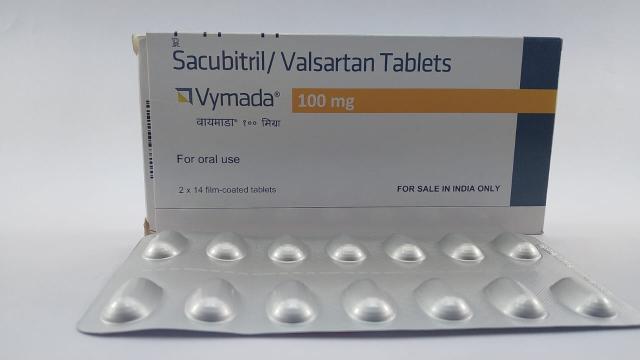
Vymada 100 Mg Tablet
 Item requires a valid prescription
Manufactured By Novartis Farma SpA
Composition Sacubitril 49mg Valsartan 51mg
RS 850.05
MRP RS 944.50
(10% OFF)
Includes all taxes
Package SIZE
( 14 Tablet )

100% Authentic
Products

Free
Shipping*

Products
Return Policy
Description:
Vymada 100mg Tablet is a breakthrough combination cardiovascular medicine containing Sacubitril 49mg and Valsartan 51mg, manufactured by Novartis Farma SpA — the global originator. It belongs to a novel drug class called Angiotensin Receptor–Neprilysin Inhibitors (ARNIs), specifically designed for adults with chronic heart failure with reduced ejection fraction (HFrEF), also classified as NYHA Class II–IV heart failure. Vymada has been clinically proven in the landmark PARADIGM-HF trial to significantly reduce cardiovascular death and hospitalisation for worsening heart failure compared to standard ACE inhibitor therapy (enalapril). Available from Shabbir Medical Hall at the best price in India, this genuine prescription tablet is available online with fast home delivery across major Indian cities.
BENEFITS: Vymada 100mg provides a dual cardiovascular benefit through two complementary mechanisms acting simultaneously on the renin-angiotensin-aldosterone system (RAAS) and the natriuretic peptide system. This dual action reduces cardiac preload and afterload, promotes vasodilation, enhances sodium excretion, and inhibits maladaptive cardiac remodelling — collectively protecting heart muscle function and significantly reducing the risk of hospitalisation and cardiovascular death in heart failure patients.
USAGE OVERVIEW: Vymada 100mg tablets are taken orally twice daily (every 12 hours), with or without food. The starting dose depends on the patient's prior ACE inhibitor or ARB therapy. A washout period of at least 36 hours is mandatory when switching from an ACE inhibitor to prevent life-threatening angioedema. Dose is titrated upward as tolerated, typically to a target of 200mg twice daily (Vymada 200mg), under close cardiologist supervision.
SAFETY OVERVIEW: The most common side effects include hypotension (low blood pressure), elevated serum potassium (hyperkalaemia), and renal impairment. Angioedema is rare but serious. Vymada must NEVER be used with ACE inhibitors concurrently or within 36 hours of ACE inhibitor use. It is absolutely contraindicated in pregnancy.
Uses / Indications:
• Chronic Heart Failure with Reduced Ejection Fraction (HFrEF): to reduce the risk of cardiovascular death and hospitalisation for worsening heart failure in adult patients with NYHA Class II–IV symptomatic HFrEF (EF ≤40%), typically in addition to other standard heart failure therapies (beta-blockers, mineralocorticoid receptor antagonists, diuretics)
ADDITIONAL / EMERGING USES (specialist-guided):
• Post-acute decompensated heart failure (initiated in-hospital before discharge in stabilised patients)
• Heart failure with mildly reduced ejection fraction (HFmrEF, EF 41–49%) — emerging evidence
• Hypertension in heart failure patients requiring additional blood pressure control
• Reduction of progression of renal disease in heart failure (neprilysin-mediated renal protective effects — under investigation)
IMPORTANT: Vymada is NOT indicated for heart failure with preserved ejection fraction (HFpEF, EF >50%) as a standalone indication outside specialist protocol.
Interactions / Warnings:
HYPOTENSION WARNING (especially first dose): Correct volume or salt depletion before initiating Vymada (e.g., pause diuretics 24–48 hrs if safe to do so). Start at the lowest recommended dose in high-risk patients (elderly, low BP baseline, high diuretic dose). Rise slowly from sitting/lying to avoid orthostatic (postural) hypotension — dizziness on standing.
ANGIOEDEMA WARNING: Absolute 36-hour ACE inhibitor washout is mandatory before starting Vymada. Patients with a prior history of ACE inhibitor-induced angioedema are at particularly high risk — discuss alternative management with your cardiologist.
HYPERKALAEMIA MONITORING: Serum potassium should be checked at baseline, within 1–2 weeks of initiation, after every dose increase, and periodically during maintenance therapy. Reduce or withhold Vymada if K+ exceeds 5.4 mmol/L (per prescriber protocol).
RENAL FUNCTION MONITORING: Check serum creatinine and eGFR at baseline and after each dose titration. Vymada is NOT recommended in severe renal impairment (eGFR <30 ml/min/1.73m²) without specialist guidance.
HEPATIC IMPAIRMENT: Mild (Child-Pugh A): Use standard dose with monitoring. Moderate (Child-Pugh B): Start at Vymada 50mg twice daily. Severe (Child-Pugh C): CONTRAINDICATED.
DIABETES PATIENTS: Valsartan may mask hypoglycaemia or enhance the blood glucose-lowering effect of insulin/antidiabetics — monitor carefully.
DRIVING & MACHINERY: Dizziness and hypotension may impair reaction time — assess individual response before driving, especially at initiation or after dose increases.
ELDERLY USE (>=65 years): No dose adjustment required, but elderly patients are at higher risk of hypotension, hyperkalaemia, and renal impairment — monitor more frequently.
Pregnancy interaction:
• Vymada (Sacubitril + Valsartan) is CONTRAINDICATED throughout pregnancy (all trimesters).
• The valsartan component (ARB) causes foetal and neonatal injury, including foetal renal dysplasia, oligohydramnios, limb contractures, hypoplastic skull ossification, and neonatal hypotension.
• These effects can be fatal to the foetus/neonate.
• Women of childbearing potential MUST use effective contraception during therapy.
• Discontinue Vymada immediately if pregnancy is detected and notify your cardiologist urgently.
• Switch to an alternative heart failure therapy that is safe in pregnancy under specialist guidance.
BREASTFEEDING:
• It is not known whether sacubitril or valsartan are excreted in human breast milk.
• Due to the potential for serious adverse effects in nursing infants (particularly renal effects of valsartan), breastfeeding is NOT recommended during Vymada treatment.
• Discuss the risk-benefit balance with your cardiologist and neonatologist.
CONTRACEPTION WARNING:
• Never stop Vymada without consulting your cardiologist — abrupt discontinuation may lead to acute deterioration of heart failure.
Expert advice:
1. STRICTLY OBSERVE THE 36-HOUR ACE INHIBITOR WASHOUT:
• If a patient is switching from an ACE inhibitor (e.g., ramipril, enalapril, lisinopril), the last ACE inhibitor dose must be taken at least 36 hours before the first Vymada dose. This is a non-negotiable safety requirement to prevent life-threatening angioedema.
2. FIRST-DOSE HYPOTENSION AWARENESS:
• Advise patients to take the first dose at home in the evening before bedtime, and to sit or lie down for at least 1 hour after the first dose. Any dizziness or light-headedness on standing should be reported immediately to their cardiologist.
3. POTASSIUM AND SALT SUBSTITUTE ALERT:
• Vymada combined with potassium-sparing diuretics, ACE inhibitors (contraindicated), or potassium-containing salt substitutes significantly raises hyperkalaemia risk. Counsel patients to avoid potassium-enriched salt substitutes and to not self-supplement potassium without medical guidance.
4. NEVER SKIP BLOOD TESTS:
• Regular monitoring of serum potassium, creatinine, and eGFR is essential — particularly in the first 1–2 months of therapy and after every dose increase. Missing scheduled tests may allow dangerous potassium elevation or renal deterioration to go undetected.
5. PREGNANCY — ZERO TOLERANCE:
• Any woman of childbearing age must be counselled at every dispensing visit about the absolute contraindication of Vymada in pregnancy. Confirm active use of effective contraception. Immediate cessation and cardiology referral required if pregnancy is suspected.
MONITORING ADVICE:
• Serum Potassium: Baseline → 1–2 weeks after initiation → after each dose increase → every 3–6 months at stable dose
• Serum Creatinine & eGFR: Baseline → 1–2 weeks after initiation → after each dose increase → every 3–6 months
• Blood Pressure (lying and standing): At each clinical review — check for orthostatic hypotension
• BNP / NT-proBNP: Monitor to assess heart failure response to therapy
• Liver Function Tests: At baseline in patients with hepatic impairment
• NYHA Functional Class & Symptoms: Reassess at each clinic visit — improvement expected within weeks of dose optimisation
COMPLIANCE TIPS:
• Take tablets at the same two times daily — set phone reminders if needed
• Store in a cool, dry place — never leave in a hot car or bathroom
• Keep a record of your blood pressure readings between clinic visits (use a home BP monitor)
• Carry your cardiologist's prescription and a medication alert card listing Vymada and all other heart medicines
• Do not stop Vymada during a hospital admission without explicit instruction from the treating cardiologist
• Weigh yourself daily in the morning — sudden weight gain of >2kg in 2 days may signal fluid retention and should be reported
SAFETY TIPS:
• Avoid alcohol — it may enhance blood pressure-lowering effects and worsen dizziness
• Limit dietary sodium (salt) intake as directed by your cardiologist — high sodium intake counteracts the natriuretic benefit of Vymada
• Stay adequately hydrated but do not over-hydrate — follow your cardiologist's fluid restriction guidance
• Report any sudden face, lip, tongue, or throat swelling immediately — this is a medical emergency (angioedema)
• Do not take NSAIDs (ibuprofen, aspirin at analgesic doses, diclofenac) without explicit approval from your cardiologist — they can worsen heart failure and kidney function
Side Effects:
• Hypotension (low blood pressure): dizziness, light-headedness, especially on standing — most common, particularly at initiation
• Hyperkalaemia (elevated serum potassium): muscle weakness, tingling, abnormal heart rhythm — monitor potassium regularly
• Renal impairment / deterioration in kidney function: increased creatinine, reduced urine output
• Cough (less frequent than with ACE inhibitors, but possible)
• Headache and fatigue
• Nausea and diarrhoea
SERIOUS SIDE EFFECTS (contact your doctor immediately):
• Angioedema: sudden swelling of the face, lips, tongue, or throat — potentially life-threatening; seek immediate emergency care (Risk is significantly higher when switching from ACE inhibitor without 36-hour washout; higher risk in Black/African-American patients)
• Severe hypotension: fainting, collapse — especially after first dose, dose increase, or if volume-depleted
• Severe hyperkalaemia (K+ >6.0 mmol/L): cardiac arrhythmias
• Acute kidney injury (AKI): significant rise in serum creatinine or sharp reduction in urine output
EMERGENCY SIGNS — SEEK IMMEDIATE MEDICAL HELP:
• Sudden swelling of face, lips, tongue, or throat (angioedema)
• Severe dizziness, fainting, or collapse (severe hypotension)
• Markedly reduced or no urination
• Irregular or very slow heartbeat with muscle weakness (severe hyperkalaemia)
How to use:
STARTING DOSES:
• Patients currently on a moderate-to-high dose ACE inhibitor or ARB: Start at Vymada 100mg (Sacubitril 49mg / Valsartan 51mg) TWICE DAILY
• Patients not currently on RAAS therapy, or on low-dose ACE inhibitor/ARB, or with eGFR <30 ml/min/1.73m², or moderate hepatic impairment: Start at Vymada 50mg (Sacubitril 24mg / Valsartan 26mg) TWICE DAILY
TITRATION:
• Double the dose every 2–4 weeks as tolerated
• Target maintenance dose: Vymada 200mg (Sacubitril 97mg / Valsartan 103mg) TWICE DAILY
CRITICAL — ACE INHIBITOR WASHOUT:
• A MINIMUM 36-HOUR washout period is MANDATORY when switching from any ACE inhibitor to Vymada.
• Failure to observe this washout significantly increases the risk of life-threatening angioedema.
• No washout required when switching from another ARB directly.
ROUTE OF ADMINISTRATION:
• Oral tablet; swallow whole with water
• Take with OR without food — food does not significantly affect absorption
• Take at approximately the same times each day (e.g., morning and evening)
MISSED DOSE:
• If less than 6 hours until next scheduled dose: skip the missed dose; take next dose at scheduled time
• If more than 6 hours remain: take the missed dose as soon as remembered
• NEVER double up doses
STORAGE:
• Store below 30°C in a dry place away from heat and moisture
• Keep in original blister pack until use
• Keep out of reach of children
• Do NOT use beyond the expiry date printed on the pack
How it works:
Vymada 100mg contains two active components that work together through distinct but complementary pathways:
1. SACUBITRIL (Neprilysin Inhibitor — via active metabolite LBQ657):
• Sacubitril is a prodrug rapidly converted in the body to the active neprilysin inhibitor LBQ657.
• Neprilysin is an endopeptidase enzyme that degrades natriuretic peptides (BNP, ANP, CNP), bradykinin, and other vasoactive peptides.
• By inhibiting neprilysin, sacubitril increases circulating levels of these beneficial peptides, resulting in:
• Vasodilation (reduced cardiac afterload)
• Natriuresis and diuresis (reduced fluid overload — lower preload)
• Inhibition of maladaptive cardiac fibrosis and hypertrophy
• Reduction in sympathetic nervous system activation
2. VALSARTAN (Angiotensin II Receptor Blocker — ARB):
• Blocks angiotensin II AT1 receptors, preventing the deleterious effects of RAAS over-activation in heart failure:
• Vasodilation (reduces blood pressure and afterload)
• Reduced sodium and water retention (reduces preload)
• Inhibition of cardiac and vascular remodelling
• Co-administration with sacubitril also prevents the angiotensin II accumulation that would otherwise result from neprilysin inhibition.
NET CLINICAL EFFECT (PARADIGM-HF trial, n=8,442 patients):
• Cardiovascular death reduced by 20% vs enalapril
• Heart failure hospitalisation reduced by 21% vs enalapril
• All-cause mortality reduced by 16% vs enalapril
• Improvements in NYHA functional class and quality of life vs ACE inhibitor standard of care
Faq for medicine:
Vymada 100mg Tablet contains Sacubitril 49mg and Valsartan 51mg, double the strength of the 50mg formulation. It is the intermediate maintenance dose in heart failure therapy. Patients are typically titrated from 50mg to 100mg after 2–4 weeks if well-tolerated. Vymada 100mg offers greater RAAS suppression and natriuretic peptide enhancement, contributing to improved cardiac remodeling and symptom relief in HFrEF patients.
2.What blood pressure reduction can be expected with Vymada 100mg Tablet?
Vymada 100mg Tablet provides meaningful blood pressure reduction through Sacubitril-mediated vasodilation and Valsartan-mediated angiotensin blockade. Systolic blood pressure may decrease by 10–15 mmHg depending on baseline values. Symptomatic hypotension can occur, especially in volume-depleted patients or those on diuretics. Regular blood pressure monitoring is essential when initiating or titrating Vymada 100mg to ensure hemodynamic stability.
3.Is Vymada 100mg Tablet safe for patients with impaired renal function?
Vymada 100mg Tablet requires caution in patients with renal impairment. Mild-to-moderate kidney disease does not require dose adjustment, but close monitoring of serum creatinine, eGFR, and potassium is essential. Renal function may temporarily worsen after initiation. Vymada 100mg is contraindicated in severe bilateral renal artery stenosis. In patients with severe renal impairment (eGFR <30 ml/min/1.73m²), caution and specialist guidance are required.
4.Can Vymada 100mg Tablet be used in patients with diabetes and heart failure?
Vymada 100mg Tablet is beneficial in heart failure patients with coexisting type 2 diabetes. While Sacubitril/Valsartan does not have intrinsic antidiabetic properties, it improves cardiac outcomes in diabetic HFrEF patients. Vymada 100mg is often combined with SGLT2 inhibitors such as empagliflozin or dapagliflozin, which together provide synergistic cardiorenal benefits in patients with diabetes and heart failure.
5.What monitoring is required for patients on Vymada 100mg Tablet therapy?
Patients on Vymada 100mg Tablet require regular monitoring of blood pressure, serum potassium, sodium, and renal function (creatinine, eGFR) at treatment initiation and after each dose adjustment. NT-proBNP levels may be tracked to assess therapeutic response. Monitoring for signs of angioedema, hypotension, and hyperkalemia is essential. Follow-up every 1–3 months is typically recommended in stable heart failure patients on Vymada.
6.How does Vymada 100mg Tablet improve quality of life in heart failure patients?
Vymada 100mg Tablet improves quality of life in HFrEF patients by reducing dyspnea, fatigue, and exercise intolerance. Clinical data from the PARADIGM-HF trial show Sacubitril/Valsartan significantly improved Kansas City Cardiomyopathy Questionnaire (KCCQ) scores versus enalapril. Vymada 100mg reduces disease burden by lowering emergency hospitalization rates and slowing ventricular remodeling in chronic heart failure patients.
Medicine interaction:
ABSOLUTE CONTRAINDICATIONS — DO NOT CO-ADMINISTER:
• ACE Inhibitors (e.g., ramipril, enalapril, lisinopril, perindopril): Concurrent use or use within 36 hours — dramatically increases angioedema risk. CONTRAINDICATED.
• Aliskiren (direct renin inhibitor): Contraindicated in patients with diabetes or renal impairment (eGFR <60 ml/min/1.73m²)
MAJOR DRUG INTERACTIONS (monitor closely):
• Potassium-sparing diuretics (spironolactone, eplerenone) and potassium supplements: Additive hyperkalaemia risk — monitor serum potassium frequently
• NSAIDs (ibuprofen, diclofenac, naproxen): May worsen renal function and reduce antihypertensive efficacy; avoid or use with extreme caution
• Lithium: Valsartan increases lithium plasma levels and toxicity risk — monitor lithium levels closely
• Other antihypertensives, diuretics: Additive blood pressure-lowering effect — titrate carefully
• Insulin and oral antidiabetics: Valsartan may enhance hypoglycaemic effects — monitor blood glucose
• Statins (e.g., rosuvastatin, atorvastatin): Sacubitril may increase statin plasma levels via OATP1B1/3 inhibition — clinical significance generally low but monitor
• Metformin: Monitor renal function; dose adjustment may be required if renal impairment develops
VACCINE INTERACTIONS:
• No specific vaccine interactions documented for Sacubitril/Valsartan
SUPPLEMENT INTERACTIONS:
• Potassium supplements and salt substitutes containing potassium: Increase hyperkalaemia risk — avoid without medical guidance
• Herbal products with blood pressure effects (e.g., ginseng, ginkgo): Inform your doctor of all herbal medicines being taken